
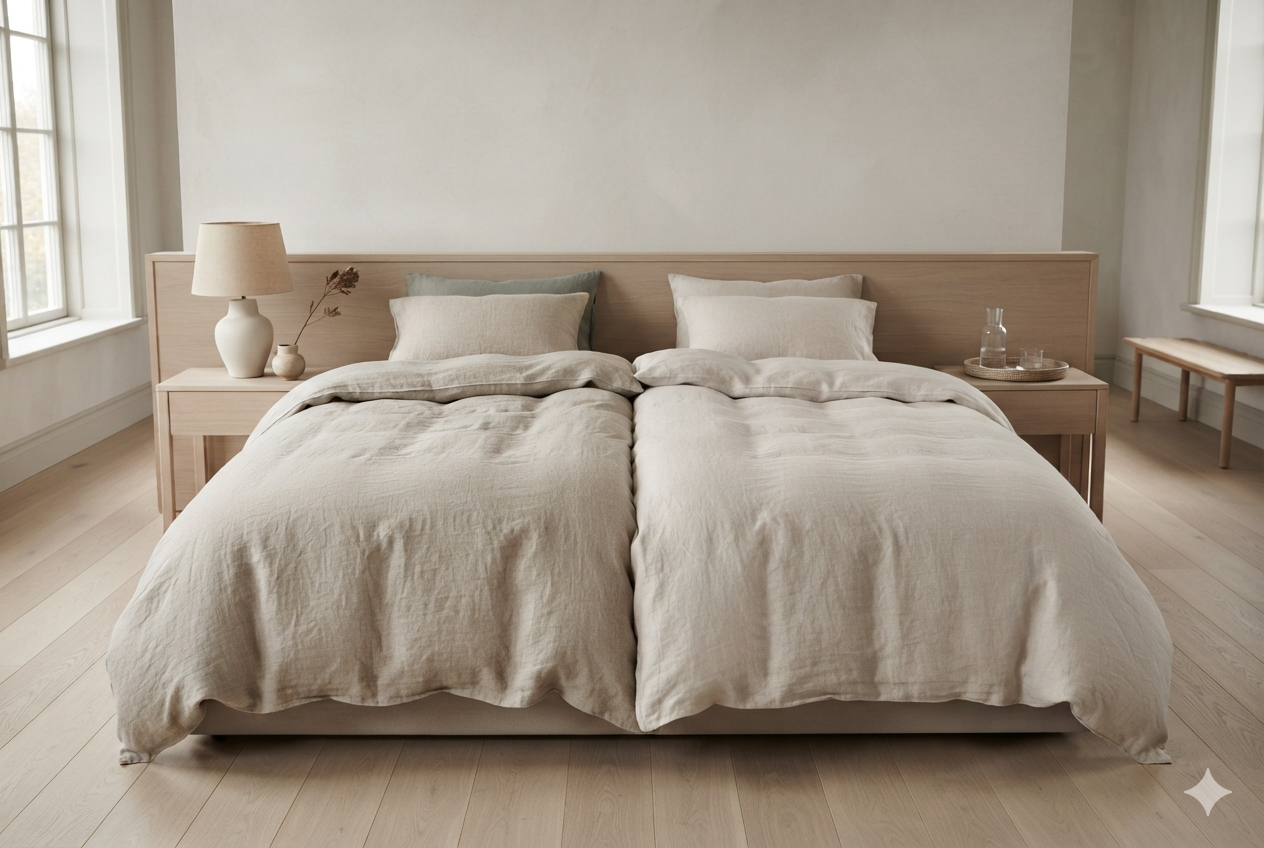
The Scandinavian Sleep Method: Why Two Duvets Beat One
Henrik runs warm. I run cold. Come December, we’re both under the heavier duvet — the lighter one stopped being enough back in November. It’s folded and kept, easily accessible, in case either of us needs it on a milder night.
Most winter nights, the scenario in our bedroom plays out with Henrik picking the thermostat setting to his preference. He gets into bed earlier than I do — I have to check on the girls.
I get into bed, but even before I fall asleep, my hands and feet are feeling cold. If the night is particularly cold, I shiver, curl up, grope Henrik for warmth, and finally start tugging on the duvet.
Henrik does not like this one bit, as he is now without a duvet and is feeling cold. So our “tug of war” begins. No one wins. Actually, both lose literally — lose sleep. Both wake up the next morning feeling still a bit tired.
Astrid came over for coffee last week, and I was telling her about our bedroom “tug of war.”
“So get your own,” she said, like it was nothing.
I laughed. She didn’t.
“At home, nobody shares,” she said. “Two people, two duvets. Same bed. Nobody’s fighting over anything at three in the morning.”
This website participates in the Amazon Associates program. As an Amazon Associate, I earn from qualifying purchases. It also participates in the Impact and AWIN affiliate programs. If you buy through links on this site, I may earn a small commission at no extra cost to you. Thank you for supporting The Hugged Home.
What the Scandinavian Sleep Method Means
Two people, one bed, two separate duvets — two full, independent duvets with their own separate covers, each tucked and adjusted without overlapping the other. No top sheet either, since a duvet cover already handles that job.
It isn’t a hack or a trend, whatever TikTok has decided to call it lately. It’s just how beds are made across Denmark, Norway, and Sweden, and has been for longer than Astrid can pin down.
Why Two Duvets Beat the Nightly Tug-of-War
The problem is not about who hogs the blanket. It’s temperature — rather the temperature difference. Henrik wants less warmth than I do at night. This is not specific to us.
Studies show that the ideal room temperature for a woman is about 4-5°F warmer than a man’s. Essentially, a single thermostat setting and a single shared duvet are bound to make one partner uncomfortable, probably both.
This is where I think the Scandinavians (and most Nordic countries) have cracked the problem. Two separate duvets, each with its own “tog,” eliminate the bedroom “tug of war.”
What is “Tog” and Why It Matters
Tog is a European unit of measurement used to calculate the thermal insulation (warmth) of a duvet, comforter, or blanket. Simply put: the higher the Tog rating, the warmer the blanket will keep you.
Tog ratings generally run on a scale from 3.0 to 15.0. To choose the right one, look at how the ratings match different seasons and sleeping preferences:
| Tog Rating | Season & Weight | Best For |
|---|---|---|
| Very Light / Summer | Hot Summer | Hot summer months, heatwaves, or individuals who sweat heavily and sleep incredibly hot. |
| Mild / Spring & Autumn | Transitional Seasons | A versatile, mid-weight option for spring and autumn, or year-round use in apartments with stable climates. |
| Heavy / Winter | Cold Winter | Cold winter nights and cold sleepers who want to stay warm without needing to crank up the home heating. |
| Extra Heavy / Extreme Cold | Extreme Cold | Freezing, unheated rooms or severe winter climates where extra insulation is needed. |
This number is the reason the Scandinavian sleep method works. A shared duvet has to average out two people’s preferences into one tog rating that satisfies neither. Two duvets let each person pick their own Tog number — each gets what they want.
| Sleep Style / Typical Sleeper | Recommended Duvet Setup | Best Materials |
|---|---|---|
| Runs Hot Most Men (and Perimenopausal Women) |
Lightweight / Low Tog
4.5–7.5 Tog |
Linen, bamboo, or organic cotton percale |
| Runs Cold Most Women |
All-Season / High Tog
10.5–13.5 Tog |
Down, wool, or cozy cotton sateen |
What the Scandinavian Sleep Method Changes
The Scandinavian sleep method of one bed, two duvets certainly solves the temperature battle and eliminates the bedroom “tug of war.”
But it does change one thing.
When each person has their own duvet, you lose that familiar feeling of sharing one big cocoon. And yes, that can make spontaneous under-the-covers cuddling a bit awkward.
Not impossible. Just… different.
It’s one of those things you do not think about when you are shivering at 3 a.m. But once you’ve finally stopped fighting over the duvet, you may notice the difference.
So there is a small trade-off.
Better sleep on one side, a little less under-the-blanket mischief on the other.
For some couples, that’s an easy bargain. For others, perhaps not. Luckily, there is another way.
What If You Want the Best of Both?
You don’t necessarily have to choose between sleeping at the right temperature and keeping one duvet between you.
There is a clever middle ground: the split-tog duvet, sometimes called a partner duvet or his-and-hers duvet.
It looks like one ordinary shared duvet. But inside, the two halves are made differently.
One side might be a lighter 4.5 Tog. The other could be a much warmer 10.5 Tog. They’re joined down the middle, so there is no chilly gap between you and your partner. And because it’s still one duvet, you use one duvet cover.
From the outside, nobody would know you’ve quietly engineered your own personal climate zones.
One Bed. Two Temperatures. No Duvet Divorce.
This is particularly appealing if the only thing putting you off separate duvets is the loss of closeness.
You can keep the shared-bed feeling. You can still reach across to steal a little warmth from your partner — although, strictly speaking, you shouldn’t need to anymore.
And you can each choose the warmth that is right for you, not a middle ground.
Split-tog duvets are available in many familiar Tog combinations, including options built around 2.5, 4.5, 6.0, 9.0, 10.5 and 13.5 Tog.
So before you resign yourself to sleeping under separate blankets like politely married roommates, take a look at the split-tog option.
You might discover that the perfect night’s sleep doesn’t require putting a wall between you, even if that wall is only the gap between two separate duvets.
Where We Are
We haven’t switched yet. I like everything about the logic — the tog explanation alone talked me into it. Astrid says it will be the best thing ever. Henrik is not so sure. So we have not made a decision.
Another reason for not making a decision is that we bought a Martha Stewart White Goose Feathers Down Fiber Comforter a couple of years ago. I reckon it will last at least another five years. A part of me hates to lose money.
Have You Tried It?
So this one’s honestly still open. Have you switched over to the Scandinavian sleep method? What did you buy? Did you buy any of the products listed below? Did it fix the 3 a.m. tug-of-war, or create a different one?
The options based on my search:
Button-Down | Split Comforter (Chic White, King)
Kömforte Dual Zone Comforter, His and Hers Couples Duvet, Split Comforter
The Split-Duvet Bundle from ervét
I’d love to know. Tell me in the comments, or over on The Cozy Edit. I may report back once we’ve tried it ourselves.
For the full picture of how this bedroom is set up otherwise — the color, the light, and everything that works — see the complete guide: Hygge Bedroom.
Light a candle. Slow down. Hygge.
— Elise