The Complete Guide to Hygge Home Decor
Hygge Home Decor TL;DR
- The essence of hygge home decor creates a comforting, warm, and lived-in environment.
- Hygge decor is about creating a home that hugs back through small, intentional decisions over time.
- The guide aims to provide an understanding of hygge home decor principles, not just a look to copy.
- Meik Wiking’s ten elements of hygge form the foundation for understanding hygge home decor.
- Hygge principles are a checklist for what a room or evening should deliver, rather than decor tips.
- Atmosphere in hygge focuses on soft, low, uneven lighting to create pools of warmth.
- Presence in hygge means being fully engaged in the moment, making it easier to be present in a room.
THE 8-WEEK HYGGE HOME TRANSFORMATION PLAN

If you are new to hygge home decor and want to skip the guesswork, I’ve mapped out a Free 8-Week Hygge Home Transformation Plan It is a transformation road map for each room, week by week.
Click the button above · Enter your email · Check your inbox and confirm the verification email · Your transformation plan unlocks instantly · NOTE: Check your spam folder too!
What Hygge in My Home Feels Like
Nine o’clock on a Tuesday in January. I pause for a moment before heading upstairs, taking in the quiet that’s settled over the house.
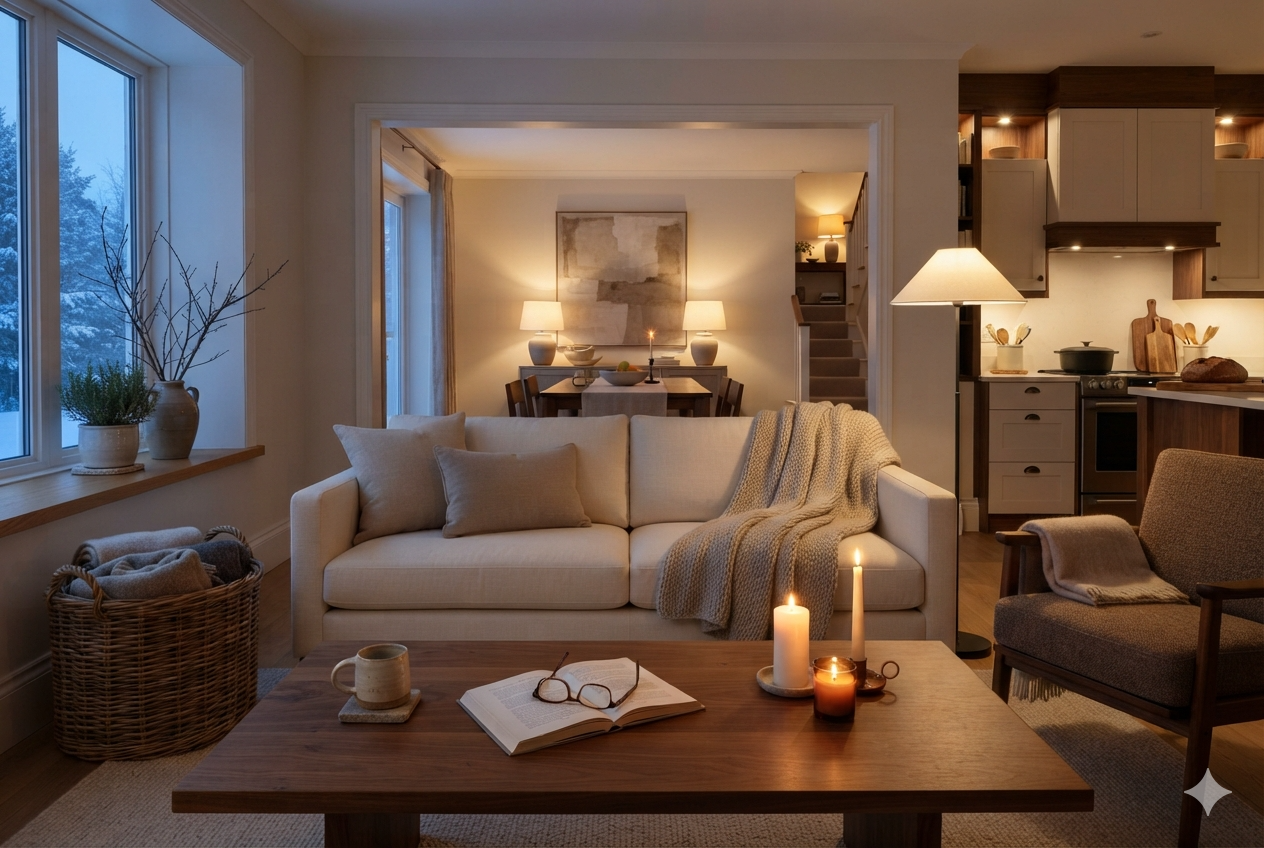
The candles on the coffee table have burned lower since dinner, their light now softer than the lamps around them.
A fuzzy feeling of contentment washes over me. I sense a glow of pride at the hygge home decor I have created — not for any magazine, but for us.
Henrik’s book is still open where he left it; my mug waits beside it. One of the wool throws has slipped halfway onto the rug where Freya was building her “throw cave”.
The dining table has been cleared except for a bowl of pears and the candle. In the kitchen, the cast-iron pot sits on the stove, waiting for tomorrow, and the smell of fresh bread still lingers in the air.
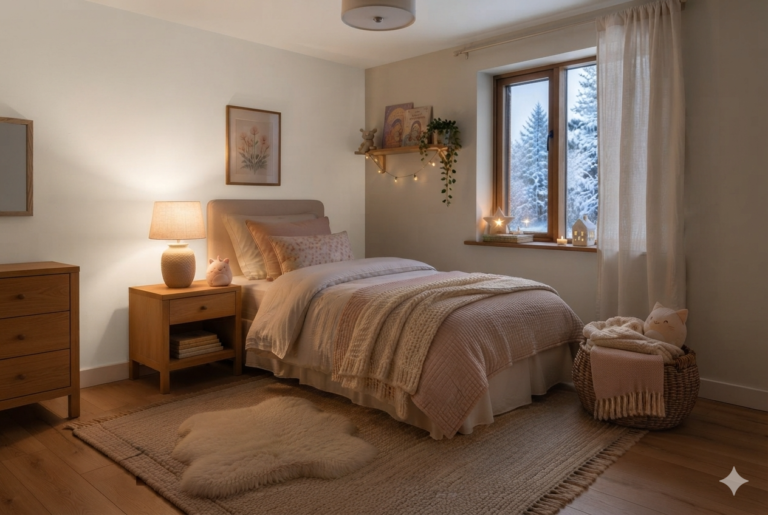
Upstairs, a lamp glows gently on the landing. Maja and Freya are asleep, their bedroom doors closed, and our own room is waiting for us with the bedside lamps already on.
None of this was arranged for anyone else to see. It simply reflects the way we live.
The essence of hygge home decor is all here. The warm light. The natural materials. The blankets within easy reach. The candles that make us slow down.
Hundreds of small decisions, repeated over the years, have turned our house into a home that hugs us back. That’s what this whole hygge home decor guide comes down to.
Read it straight through, or jump to whichever part you need by using the link in the Table of Contents. Either way, by the end, you’ll have more than a look to copy. You’ll have a clearer understanding of the principles of hygge home decor.
This website participates in the Amazon Associates program. As an Amazon Associate, I earn from qualifying purchases. It also participates in the Impact and AWIN affiliate programs. If you buy through links on this site, I may earn a small commission at no extra cost to you. Thank you for supporting The Hugged Home.
Ten Principles of Hygge Home Decor
Before any of the practical stuff — the lamps, the throws, the paint colors — it’s worth knowing what hygge is built on.
Meik Wiking, who ran the Happiness Research Institute in Copenhagen and has studied this more rigorously than most people writing about it in English ever will, breaks hygge down into ten elements.
They’re not decor tips. They’re closer to a checklist for what a room, or an evening, needs to deliver, regardless of what’s on the walls. Everything in the rest of this guide traces back to one of these ten.
Atmosphere
Soft, low light over anything bright and even. A room lit for atmosphere is lit unevenly on purpose — pools of warmth here and there rather than one flat wash of brightness over everything.
This is the whole idea behind my lighting guide. It’s the first thing that all rooms in my house get right. [→ Hygge Lighting]
Presence
Being where you are instead of somewhere else, like on a phone. Of course, a phone is an important part of modern life. But it is not essential to have one with you at all times.
It’s less about banning phones and more about a room that makes being present the easier option — nowhere to charge a phone within arm’s reach of the good chair, for instance.
Presence is a habit a room can support or work against, and most of the small rules in this house exist to support it.
Pleasure
Sensory, tactile, simple joys — the aroma of fresh coffee, the warmth of a soft blanket, bread still warm from the oven.
Hygge is precise about the senses on this point: what a room smells like, what’s warm to the touch, what tastes good enough to slow down for.
None of it needs to be expensive to count.
Equality
Hygge is famously about ‘we’ over ‘me’ — a flatter, more relaxed social register where nobody’s performing status.
In a home that shows up as furniture arranged for conversation rather than display, and rooms that don’t specify who gets the good chair and who doesn’t.
Gratitude
Noticing what’s already good rather than reaching for what’s missing. In practice, this is closer to a habit than a decor choice — there’s a whole small ritual built around saying one good part of the day out loud before bed. [→ Winter Hygge]
Harmony
A hygge room doesn’t have one impressive, expensive piece with everything else fading into the background. It is a set of items that are similar in tone, none of them shouting over the rest.
Comfort
The most literal of the ten, and the easiest to get wrong by overcomplicating it. Comfort means soft seating, the right temperature, nothing scratchy or stiff, standing between a body and rest.
It’s the principle every throw blanket and every warm bulb in this house is ultimately in service of.
Truce
A pause on conflict, disagreement, and difficult topics for the length of an evening. Harder to build into a room directly than the others.
For truce to be running through a house, there tends to be a place people can sit and have a conversation without turning it into a debate, which circles back to Equality and Comfort.
Togetherness
Shared rather than solitary — though hygge alone is real too, this principle is about the version built for more than one person.
Rooms that hold several people comfortably, without anyone being sidelined or left out, tend to get used this way without anyone planning it.
Shelter
A place that feels safe to retreat to, the weather and world kept outside.
This is the principle every room guide on this site ultimately serves — the hyggekrog, the bedroom, and the rest are all, at bottom, about building shelter in miniature, one room at a time. [→ What Is a Hyggekrog?] [→ Hygge Bedroom]
The Essentials of Hygge Decor
Ten principles are the reasoning. The next five are the building blocks — the physical things every room in this house reaches for in some combination to turn the principles above into hygge.
Light
A room lit only from the ceiling is functional. Two or three smaller, layered, light sources — a lamp, a candle, string lights — turn it into a room to relax in.
Warm, low, and layered lighting rather than one overhead fixture is the essence of a hygge room. [→ Hygge Lighting]
Candles and Scent
Candles aren’t decoration in a hygge home; they’re closer to a fixture. An overwhelming 85% of Danes consider candles essential to hygge.
The habit of lighting candles isn’t really about fragrance so much as light — unscented and naturally scented candles are just as central as anything from the seasonal aisle.
The full case for how, when, and what kind is in the candles guide. [→ Hygge Candles]
Textiles and Layering
Throws, cushions, rugs — the textiles are what a room feels like before anyone’s even sat down.
The habit worth building is layering rather than choosing one: a knit throw and a heavier wool one, a rug over hardwood, plus a smaller one where feet land most.
Natural fibers matter here more than almost anywhere else in a room — cotton, linen, and wool hold warmth and age in a way synthetic blends don’t, softening rather than pilling apart.
Check out my dedicated guide to Textiles, Textures, and Layering. [→ Hygge Textiles, Textures, and Layering]
Natural Materials
Wood, wool, wicker, stone, ceramic — anything that is organic rather than synthetic. Natural materials age instead of just wearing out: a wood table gains marks, a leather chair softens, whereas plastic and laminate just show scratches.
Materials from earth also have their own character and texture — the grain of a wooden table, the weave of a wicker basket. You can find my full guide to Natural Materials here. [→ Hygge Natural Materials]
Color Palette
Warm neutrals — cream, sand, walnut, soft browns — rather than stark white or heavily saturated colors.
The reasoning isn’t really aesthetic so much as practical: warm, muted tones reflect lamp and candlelight softly. A room painted in neutral tones feels warmer after dark, not just calmer during the day.
A full guide to building a color palette room by room is here. [→ Hygge Color Palette]
Five essentials, five choices to make in every room.
THE 8-WEEK HYGGE HOME TRANSFORMATION PLAN
If you’d rather take it step by step, work through one room at a time, I’ve mapped out a Free 8-Week Hygge Home Transformation Plan Skip whatever doesn’t apply to your house.
Click the button above · Enter your email · Check your inbox and confirm the verification email · Your transformation plan unlocks instantly · NOTE: Check your spam folder too!
A Room-by-Room Guide
Hygge home decor isn’t about grand makeovers — it’s about small, intentional choices that turn everyday spaces into cozy sanctuaries.
From the hygge kitchen, where meals become rituals, to the living room, where winter evenings are spent together, to the hygge bedroom, where the day winds down — each room has its own distinctive nuances.
Let me walk you through the essentials of hygge living — one room at a time.
The Hyggekrog
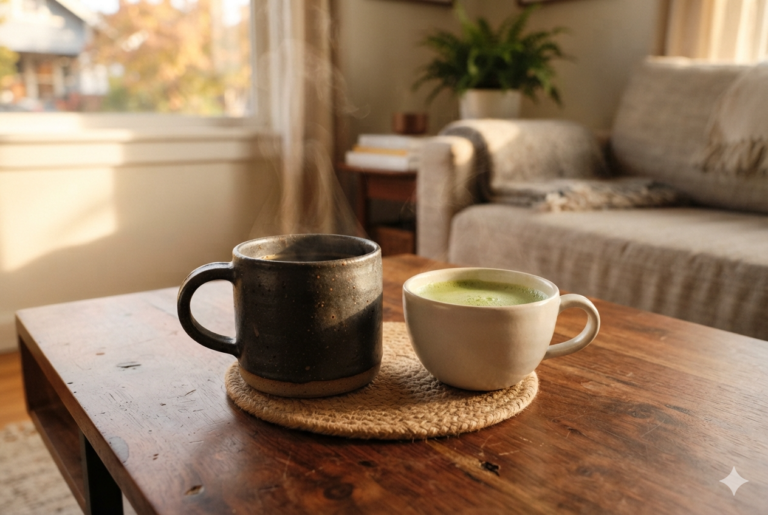
At seven in the morning, even before Henrik or the girls are up, I find my way to my hyggekrog, a steaming cup of coffee in hand. Pronounced “hoo-guh-kro,” this is my sanctuary, my “cozy nook”.
Hyggekrog, an ancient “wellbeing-bend,” is rooted in the Old Norse word krókr. Science calls it Prospect-Refuge Theory—the evolutionary pull toward the “cave mouth,” where we can see the room without exposing our backs.
Creating your own hyggekrog isn’t a renovation project; maybe a cozy armchair by the window, a blanket within reach, a book, a candle, and a coffee mug on the side table. That is all it takes.
The full story of ours, and how to find yours, is here. [→ What Is a Hyggekrog?]
The Hygge Kitchen
My typical Sunday afternoon in winter starts with my lighting a candle and placing it on the kitchen counter; even before I start chopping the onions. And before the cast-iron pot goes on the stove.
A hygge kitchen is all about the ritual of presence. Lighting a candle before you start chopping, letting a slow-cooking soup anchor the day, and keeping phones away while you eat are all deliberate choices.
The rituals ultimately influence the essentials and decor of a hygge kitchen. Read the full story of our kitchen practice, and how to start yours, here. [→ The Hygge Kitchen]
The Hygge Living Room
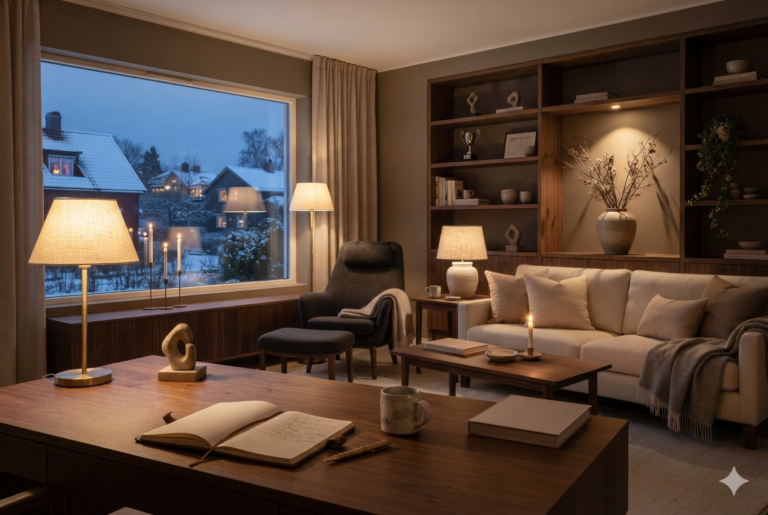
On winter evenings, the overhead light in our living room is turned off, and every lamp is turned on — from the brass floor lamp by Henrik’s chair to the string of bulbs along the bookshelf. We meet the darkness with our own layered glow.
A hygge living room is not a staged catalog page but a “cozy nest” for the family. Fill it with warm light from low lamps and candles, keep plenty of throws within easy reach, and let board games take over the floor.
Create coziness and warmth with soft lighting, texture, and signs of lived-in life — worn patches, coffee rings, and all. The hygge living room asks nothing of you but to linger.
Find the full story of our living room, and how to layer your own here. [→ The Hygge Living Room]
The Hygge Bedroom
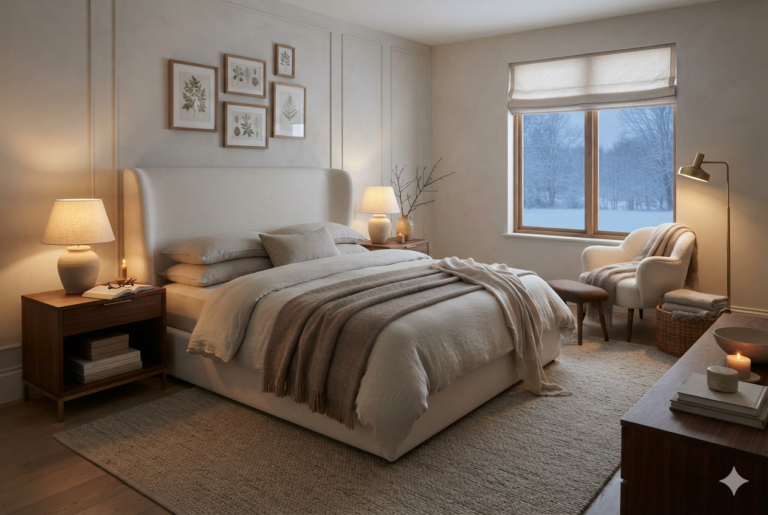
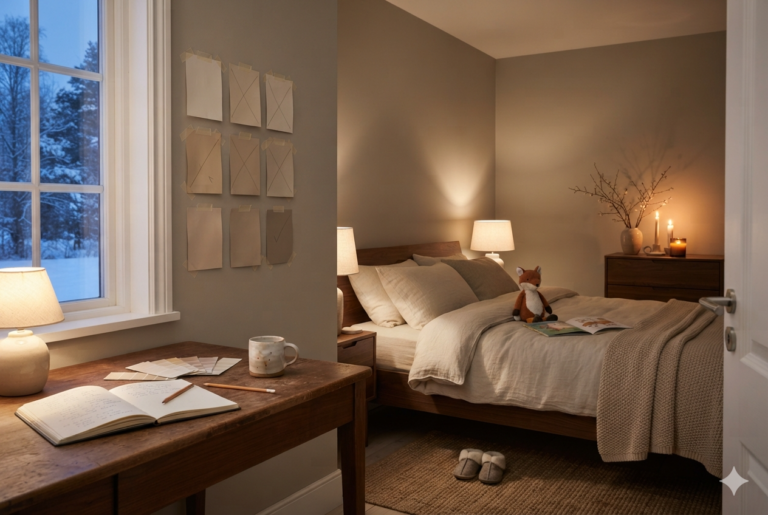
Henrik is half-dozing beside me, glasses sliding down his nose. The lamps throw a warm, softened glow that makes the day finally feel “done”. This best describes my hygge bedroom, but it was not always like this.
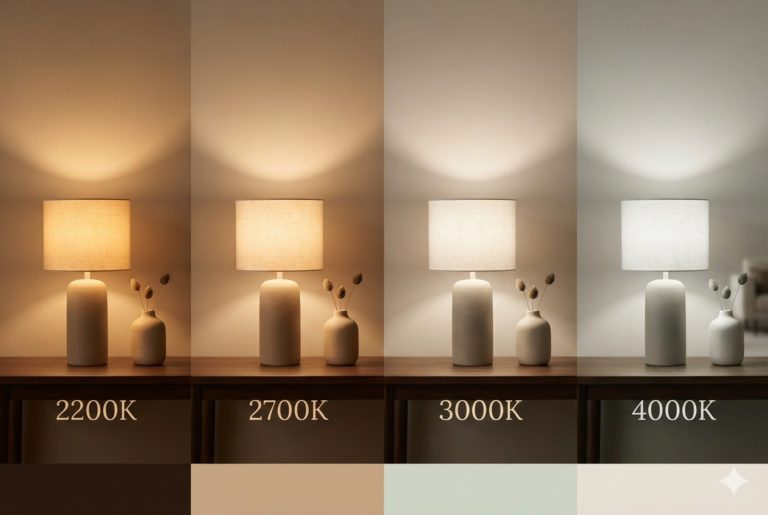
I once grumbled about my poor sleep to my Danish friend Astrid. She asked, “What kind of bulb is in your lamp?” That changed everything.
I realized a hygge bedroom isn’t meant to be in a Pinterest pin; it is meant to be a space styled for sleep, not show. The science of melatonin and the 2700K bulbs is what tells your body the day is over.
Beyond bulb swap, layer the blankets, paint the facing wall in a neutral color, and keep only one book on your nightstand—all signals to your brain that there is no “unfinished business” here.
Read the full story of our bedroom makeover, and how to start yours, here. [→ The Hygge Bedroom]
The Hygge Dining Room
It’s a cold winter evening, and I’ve already lit the candle before Henrik starts to set the table.
Freya leans toward the flame, Maja laughs at her napkin shapes — each detail a ritual of warmth and shared presence.
A hygge dining room is built around the unhurried meal — the difference between fueling up and gathering. Equality at the table matters more than the tablecloth: nobody’s chair outranks anyone else’s.
No one rushes to clear the table when dinner is over. Nobody will blow out the candle. That’s just how we do dinner now.
Read the full story of our table, and how to set your own, here. [→ The Hygge Dining Room]
The Hygge Entryway
It’s dark by five most nights in November, and the cold has begun to bite as I get out of the car. Both the porch lamp and the table lamp in the entryway are set on a timer.
I am greeted by a square patch of light that streams through the door glass onto the mat. At this hour, and in this weather, that square of light is just the welcome I need.
A hygge entryway is the boundary between outside and in — the room, or in plenty of homes, just the hallway, that is a welcome transition.
A warm bulb on a timer, several hooks for coats, scarves, and hats, and a boot tray to capture the mess do most of the work. The scent of cedar from the diffuser is a gentle reminder that we are home.
Read our full story and learn how to transform your entryway here. [→ The Hygge Entryway]
THE 8-WEEK HYGGE HOME TRANSFORMATION PLAN
If everything above feels like a lot to take in at once, that’s exactly why I built a Free 8-Week Hygge Home Transformation Plan It’s a roadmap, not a to-do list — skip the entryway if you don’t have one.
Click the button above · Enter your email · Check your inbox and confirm the verification email · Your transformation plan unlocks instantly · NOTE: Check your spam folder too!
A Buying Guide for the Hygge Home Decor
Every guide above points to a small handful of things actually worth buying, rather than a long list of things to buy.
The Nest List will become live soon. It is where all my recommended picks live in one place — organized by room and by essential, so you can shop for the one thing you need instead of scrolling back through eleven articles to find it.
By Room
Hyggekrog — [→ Nest List: armchair picks] [→ Nest List: throw picks]
Kitchen — [→ Nest List: cast iron picks] [→ Nest List: linen towel picks] [→ Nest List: ceramic mug picks]
Living Room — [→ Nest List: reclaimed furniture ideas] [→ Nest List: rug picks] [→ Nest List: electric fireplace picks]
Bedroom — [→ Nest List: bedroom diffuser picks]
Dining Room — [→ Nest List: dining candle picks]
Entryway — [→ Nest List: entryway hooks and benches]
By Essential
Light — [→ Nest List: warm bulb picks] [→ Nest List: dimmer picks]
Candles and Scent — [→ Nest List: soy candle picks] [→ Nest List: beeswax picks] [→ Nest List: candle holder picks] [→ Nest List: wick trimmer and snuffer sets]
Textiles and Layering — [→ Nest List: wool throw picks] [→ Nest List: cushion insert picks]
Natural Materials — [→ Nest List: solid wood furniture picks] [→ Nest List: handmade ceramic picks] [→ Nest List: leather armchair picks]
Color Palette — [→ Nest List: warm neutral paint picks] We don’t add something to this list until it’s actually been used in this house long enough to earn a place on it. If a link’s missing here, it just hasn’t earned its way in yet.
Every room above has its own full buying guide already. This section is a starting point, not a replacement for any of them — one hero item per room, plus a few things that haven’t come up anywhere else on the site yet.
One Hero Item Per Room
The Reading Chair — A cream or neutral armchair, comfortable enough to sit in for a full hour, is the single piece worth prioritizing over everything else in a living room. [→ Nest List: armchair picks] [→ Hyggekrog]
The Cast Iron Pot — Heavy, visible, permanent-looking even when it’s empty. One good Dutch oven does more for a kitchen’s atmosphere than any amount of open shelving. [→ Nest List: cast iron picks] [→ Hygge Kitchen]
The Floor Lamp — A warm-bulb floor lamp beside the main seat in a living room changes the room faster than almost anything else on this list. [→ Nest List: floor lamp picks] [→ Hygge Lighting]
The Weighted Throw — Not decorative — one substantial enough to keep for years, folded loosely, somewhere it’ll be reached for the same day it’s unwrapped. [→ Nest List: throw picks] [→ Hygge Living Room]
The Unscented Candle — Buy one before any scented one. It teaches the habit of lighting for the light, not the fragrance, and it works in every room in the house. [→ Nest List: unscented candle picks] [→ Hygge Candles]
A Few New Additions Not Covered Elsewhere
The Entryway Bench — Somewhere to sit and take boots off matters more than anything decorative by the front door. [→ Nest List: entryway bench picks]
An Everyday Rug — Not the good rug for company, the one that’s allowed to get walked on, spilled on, and vacuumed weekly. [→ Nest List: everyday rug picks]
A Doormat That Means It — Heavy enough to scrape boots clean before they reach the entryway bench above. Small, unglamorous, and the first thing that greets anyone at the door. [→ Nest List: doormat picks]
If You’re Starting From Nothing, Buy These Five First:
1. One comfortable armchair
2. One warm-bulb floor lamp
3. One substantial throw
4. One unscented candle
5. One rug worth walking on
Everything else in this guide builds on those five.
THE 8-WEEK HYGGE HOME TRANSFORMATION PLAN
If you are just starting out on a renovation, I strongly recommend getting my Free 8-Week Hygge Home Transformation Plan It is a transformation road map for each room, week by week.
Click the button above · Enter your email · Check your inbox and confirm the verification email · Your transformation plan unlocks instantly · NOTE: Check your spam folder too!
Where to Go From Here
If you only have twenty minutes this weekend, start with the hyggekrog — one chair, one throw, one lamp, and you already understand the rest of this guide by feel rather than by reading it. [→ What Is a Hyggekrog?]
If you’re renting, or not ready to touch paint or fixtures, start with candles and textiles — the two essentials that ask nothing of a landlord and do the most per dollar. [→ Hygge Candles] [→ Hygge Textiles and Layering]
If you’ve got a family filling the house every evening, start with the living room and the dining table — the two rooms doing the actual work of holding everyone in the same space at the same time. [→ The Hygge Living Room] [→ The Hygge Dining Room]
And if you’re not sure where to start at all, start where I did: swap one bulb, light one candle before you need it, and see what the room feels like by six o’clock in the evening. The rest of this guide will still be here.
THE 8-WEEK HYGGE HOME TRANSFORMATION PLAN
If you’d rather just get on with it, I have put everything into a Free 8-Week Hygge Home Transformation Plan Use the road map in whatever order that works for you.
Click the button above · Enter your email · Check your inbox and confirm the verification email · Your transformation plan unlocks instantly · NOTE: Check your spam folder too!
Back at the top of the stairs tonight, the house is doing what it does most nights — nothing dramatic, no single room trying to impress anyone, just a run of small, warm decisions adding up room by room.
If you’re only taking one thing from everything above, take this: none of it works as a single choice. It’s the whole house, together, over a whole season, that holds you.
From here, if you want the reasoning behind all of it — why any of this is called hygge in the first place, and what it’s meant to do for a life rather than a living room — that’s next. [→ What Is Hygge?]
Should you want to know more about me and my initiation into the Hygge Life, look me up here. [→ About Elise]
And if you just want to keep browsing pieces of a real house, one at a time, that’s what the Nest List and the rest of this site are for.
Light a candle. Slow down. Hygge.
— Elise