What is a Hygge Entryway and How to Create One?
A hygge entryway is the intentional transitional space between the cold outdoors and the warm sanctuary of your home. It is designed as a dedicated, clutter-free spot to shed winter coats, remove muddy boots, and step into your cozy home.
Standard Entryway vs. Hygge Entryway: What’s the Difference?
A traditional entryway prioritizes utility with bright overhead light and open coat hooks. A hygge entryway emphasizes visual calm with soft 2700K warm lighting, enclosed solid wood storage, and natural scents like cedarwood.
| Feature | Standard Entryway | Hygge Entryway |
|---|---|---|
| Lighting | Bright, harsh, single overhead ceiling fixture | Layered, indirect ambient lighting (2700K) |
| Storage | Cluttered hooks, overflowing shoe piles | Intentional solid wood furniture , like a console table |
| Atmosphere | Purely functional, often chaotic | A calming, sensory transition zone |
| Scent | Artificial & strong air fresheners | Natural, grounding aromas like cedar or sandalwood, often from a lit candle |
This website participates in the Amazon Associates program. As an Amazon Associate, I earn from qualifying purchases. It also participates in the Impact and AWIN affiliate programs. If you buy through links on this site, I may earn a small commission at no extra cost to you. Thank you for supporting The Hugged Home.
It’s a Tuesday in November, already dark by five. I pull into the driveway after work, rain sharpening into icy needles across the windshield.
The porch lamp, set on a timer, has already come on and casts a soft glow. The table lamp in the entryway has also turned on. It is on the same timer—a square patch of light streams through the door glass onto the mat.
At this hour, and in this weather, that square of light is just the welcome I need.
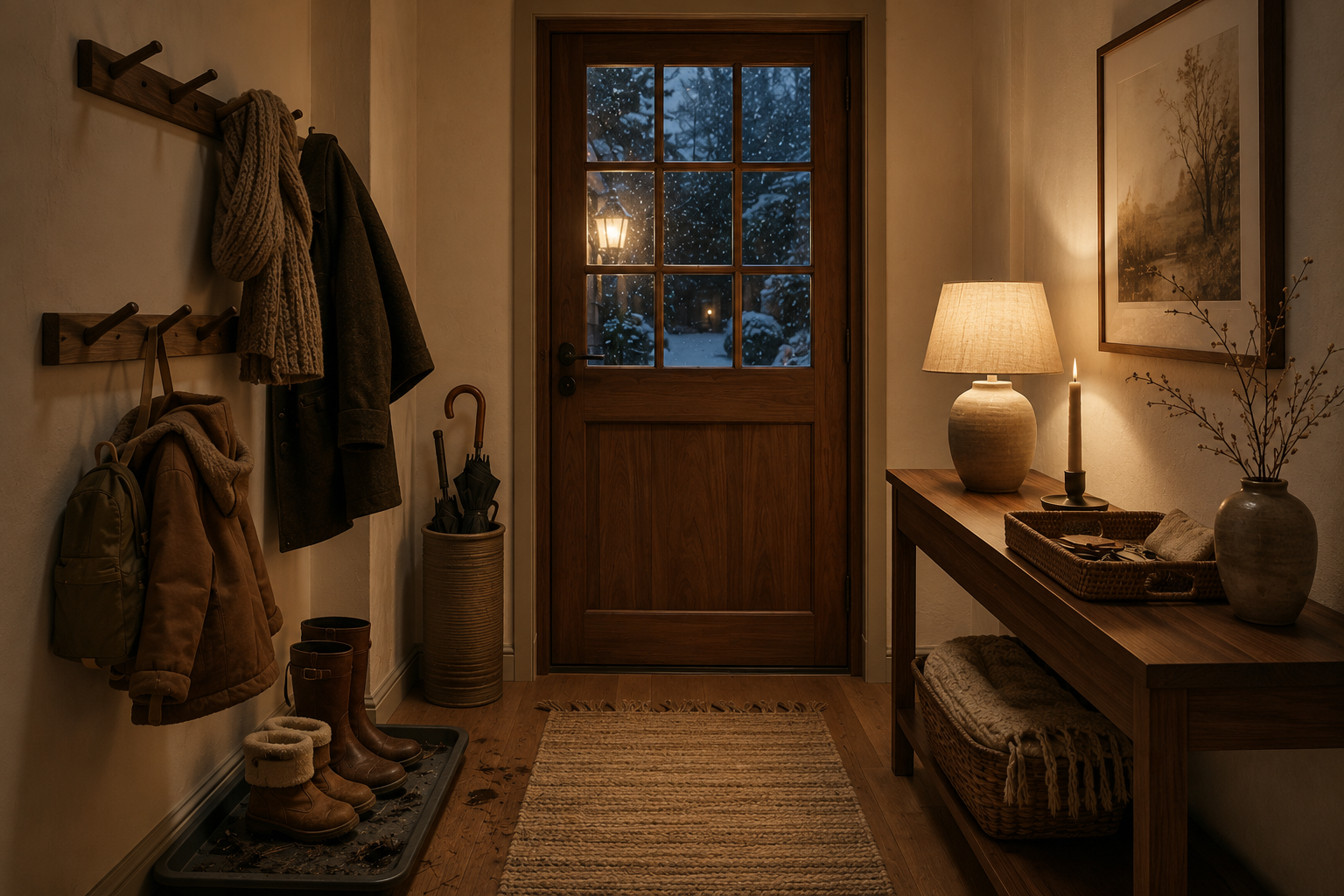
Keys turn, and I am inside. Maja’s shoes are in the boot tray, and her coat hangs from the lower hook, just where it should.
Henrik must be back too, because his coat is hanging from the upper hook and the candle on the side console is already burning. I hang mine, breathe in the cedar from the diffuser, and say to myself, “I’m home.”
It is my hygge entryway that makes this transition possible: from dark and cold outdoors to light and warmth within.
The Entryway: Where Outside Ends, and Home Begins
In American home design, the entryway marks the boundary between outside and inside. You’re no longer outdoors, but not yet in the living room. It’s rarely a room of its own.
In my article on hyggekrog, I mentioned Prospect‑Refuge Theory—the idea that our brains still carry instincts from cave‑dwelling days. The entryway is the cave mouth; the hyggekrog is the refuge within. [→ What Is a Hyggekrog?]
The entryway is the threshold you cross to reach that refuge. It’s where transition happens, where “outside” ends and “home” begins. It’s also the practical spot for shoes, coats, umbrellas, and keys.
Merriam‑Webster notes that “entryway” is often synonymous with foyer, lobby, or hallway. A hygge entryway isn’t about size or luxury—it’s about how it makes you feel the moment you step inside.
From a Cold Hallway to a Warm Hygge Entryway
For years, our entryway felt more like a passage than a welcome. We’d arrive home in the dark, fumbling for keys, coats piling up in the closet or a bench beside it. The space felt almost as cold as the night outside.
Astrid, my Danish friend, gave me a few simple tips that transformed my entryway. I didn’t even have to spend much!
The change started with a simple timer plug. Now the porch lamp clicks on at 4 pm, the time it starts to get dark, come winter. I also changed the bulb to 2700K so the glow is soft and warm.
That small adjustment made the house feel like it was expecting us, not catching up after we arrived.
Next came the hooks for the coats. We got rid of the closet, and added a row of hooks—high ones for us, low ones for Maja and Freya.
Now, our coats are hung up neatly because it was easy, and the sight of wool and canvas became part of the entryway’s honesty.
Finally, a cedar diffuser joined the lamp. Its fragrance greets us within the first steps, a quiet signal that we are inside and the outside world is behind us.
And there’s a candle here too — of course there is — but a different one from the kitchen or the bedroom. I light it so that it is burning when Henrik arrives later. I can tell he appreciates this small act.
But if he comes home earlier than me, as sometimes happens, he will light it. [→ Full guide to Hygge Candles]
Together, light, hooks, and scent turned a cold threshold into a hygge entryway—one that says, you’re home now.
The Seven Essentials of a Hygge Entryway
A hygge entryway is less about décor and more about ritual—small cues that help you transition from the dark, cold outdoors into the light and warmth of your home.
None of these needs a major renovation, a mudroom, or even a room you’d call an entryway with a straight face.
Hygge Entryway Lighting Ideas to Set the Mood
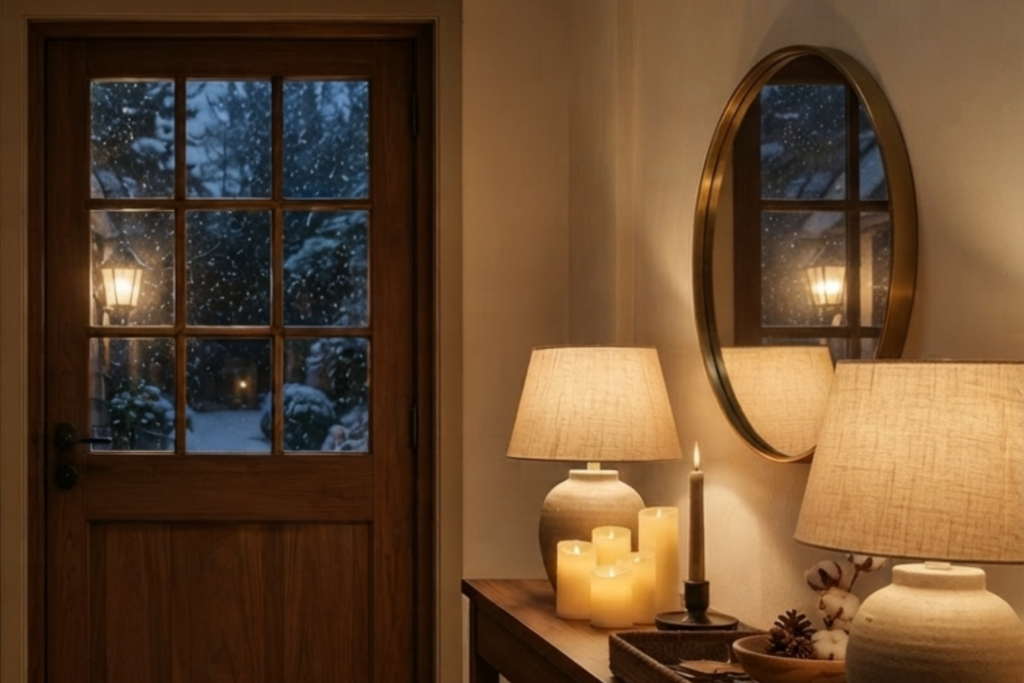
The moment you open your front door, the lighting should signal to your nervous system that you are home. Hygge entryway lighting ideas completely avoid harsh, cool-toned overhead fixtures.
1. Put the entry light on a timer.
The porch or hallway lamp should already be lit before anyone’s due home — not switched on by the person to arrive first, fumbling in the dark.
A plug-in timer or a driveway sensor does this for a few dollars and takes less time to install than it takes to explain.
2. Keep that lamp under 2700K.
The same rule that governs every other room in this house applies here too. A stark porch light or a bright overhead in the hall undoes the whole point — it reads as daylight or the reception hall of a dental clinic, not a welcome.
The 2700K Rule: Swap out any bulbs above 3000K. A warm 2700K light bulb in a small table lamp or wall sconce mimics the golden hour, making the space feel warmer instantly.
For a deeper dive, explore our complete guide on how to light a room without overhead lighting or my guide to Hygge Lighting.
3. Let coats hang in plain sight.
A hygge entryway doesn’t need a closet for coats and the like. Hooks at the right heights — including a low one for kids — get used because it’s convenient and visible.
Hanging coats, scarves, and hats isn’t clutter. It’s proof that the house is lived in. [→ Nest List: entryway hooks and benches]
4. Choose a mat or tray that can handle mess.
Something built tough to handle salt, mud, and wet boots. Not so delicate and pretty that you wince every time someone steps on it after walking over a slushy sidewalk on a rainy January.
A boot tray by the door does more real work than almost anything else on this list.
5. The Best Hygge Scents for Your Entryway
Not the kitchen candle, not the bedroom one — something separate and distinct, so the smell itself becomes the cue that you’re home.
Scent is the most powerful trigger for memory and mood. The best hygge scents for an entryway should feel grounding and natural, never synthetic or overpowering.
It should hit you within the first three steps as you go through the door.
- Woods (cedar, sandalwood): Evokes the feeling of a quiet, snowy forest.
- Spices (cinnamon, clove): Instantly signals comfort and the holidays.
- Evergreens (balsam fir, pine): A subtle, clean, natural outdoorsy aroma.
A simple, scented soy wax candle or a reed diffuser with natural winter candle scents placed near the door creates an invisible, welcoming embrace. The diffuser that works for me was an easy find on Amazon.
6. Always have a table, a shelf, or a bench.
A shelf or narrow table for keys and mail — not a catch-all for all your groceries or sports gear. Just enough surface at the right height to free your hands before you’re fully inside.
If you are handy, building a simple DIY hygge entryway bench from reclaimed wood is a rewarding weekend project.
Even if you buy one, choosing a piece of solid wood furniture ensures it will age beautifully.
Just remember to regularly oil it using our tips on how to care for wood furniture to protect it from wet winter boots.
7. No real entryway? Your hallway qualifies.
If all you’ve got is four feet of hallway rather than a proper foyer, that will do. You don’t need to invent a room that isn’t there.
A single hook rack, a small mat, and that same warm lamp turn a plain hallway into a hygge entryway — the transition is the same whether it happens in a mudroom or a hall.
Small Entryway Hygge Decor for Apartments
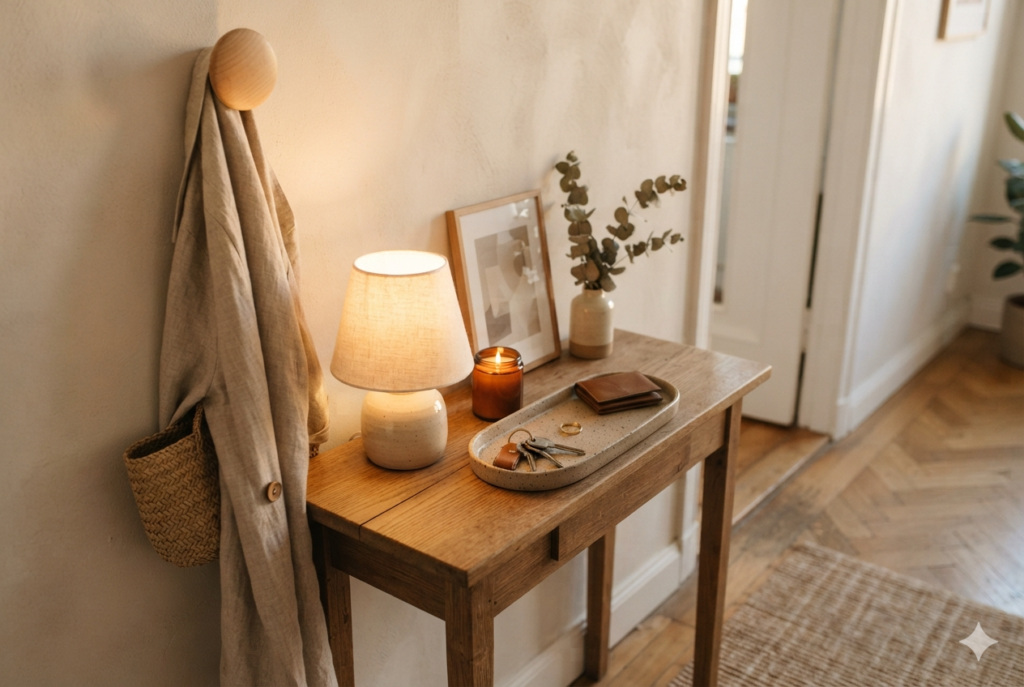
You do not need a sprawling mudroom to achieve this feeling. Small entryway hygge decor is about maximizing vertical space and intentionality.
- Install a single, beautiful wooden peg hook instead of a bulky rack.
- Place a shallow, decorative tray on a narrow console table to corral keys and mail. (For inspiration, see our guide to entryway console table styling).
- Use a slim, woven basket tucked under the table to hide shoes, keeping the visual noise to an absolute minimum.
Hygge Entryway FAQ
What is the best lighting for a hygge entryway?
Avoid harsh overhead lighting. Instead, use a small table lamp or wall sconce with a warm 2700K light bulb. Use a smart timer.
What scents are best for a hygge entryway?
The best hygge scents are grounding and natural. Opt for subtle aromas like cedar, pine, cinnamon, or clove. Avoid synthetic or overpowering artificial air fresheners.
How can I make a small entryway feel hygge?
Focus on intentionality over square footage. Use vertical space with a single wooden peg hook, place a shallow decorative tray on a narrow console table for keys, and use a slim woven basket for storage.
Our Entryway’s Real Purpose
When Henrik arrived earlier than me and was greeted by the already lit porch lamp and the table lamp in the entryway. The candle was there, unlit. So he lit it first.
Only then did he remove his coat and hang it on the hook. Took off his shoes and placed them on the boot mat. He exhaled; office worries slipped away. He’s simply home.
That’s our entryway’s only real work: to mark the line where outside stops and inside begins.
The hooks, the warm bulb, the cedar scent—they sharpen that boundary just enough that crossing it feels like a shift. Once you’ve stepped through, the rest of the house takes care of the welcome.
From here, the rest of the house is easy to find.
Head into the living room [→ The Hygge Living Room], follow the smell of something on the stove to the kitchen [→ The Hygge Kitchen], or go back to the full room-by-room walkthrough in The Complete Guide to Hygge Home Decor [→ Hygge Home Decor].
Light a candle. Slow down. Hygge.
— Elise