Solid Wood Furniture: What Makes It Hygge
Henrik was ready to buy the dresser. It looked right — warm oak tone, dovetail-style joints, the kind of piece that photographs well.
I pulled out the top drawer, out of habit more than suspicion. The inside was flat white. We were obviously looking at a replica, made from particleboard or MDF, with a layer of oak veneer on the outside.
“No, this won’t do,” I said. “Why?” asked Henrik. “It looks good to me and is well within our budget.”
Henrik was pretty confused when I replied, “Because the dresser is not for me. It’s for Maja.” After a few moments, he understood, and his eyes lit up.
This website participates in the Amazon Associates program. As an Amazon Associate, I earn from qualifying purchases. It also participates in the Impact and AWIN affiliate programs. If you buy through links on this site, I may earn a small commission at no extra cost to you. Thank you for supporting The Hugged Home.
Seven Hygge Reasons for Buying Solid Wood Furniture
1. Astrid and the Danish Concept of “Arv”
I told Astrid about the dresser a few days later, half-expecting her to think I was being sentimental about a piece of bedroom furniture. Actually, she fully supported my decision.
“You already understand arv,” she said. “You just don’t have the word for it yet.”
Arv is the Danish word for inheritance, for legacy — but Astrid was quick to correct me. Arv does not only come into play when you actually hand something down.
“An arv starts the moment you decide to take care of something for someone else,” she told me. “Not the day you give it to them. The years before that count too. Maybe they count the most.”
Arv is not a financial transaction; it is a sentiment that you cherish for years, actually decades.
That reframed the whole dresser for me. It isn’t sitting in storage waiting for a future birthday or marriage. It’s in our room, in use by me now.
The caretaking is the inheritance, as much as the object eventually is. Veneer over particleboard doesn’t really support that kind of relationship. It won’t last that long.
2. Biophilia Hypothesis and Our Affinity for Nature
Solid wood furniture connects us directly to nature. Biologist E.O. Wilson proposed the biophilia hypothesis—the idea that humans evolved surrounded by natural materials and still feel an innate pull toward them. [→ Hygge Natural Materials]
Physicist Richard Taylor studied why certain natural patterns calm us. His answer was fractals—shapes that repeat at different scales, like tree branches, clouds, rivers, coastlines, and the grain in solid wood.
Taylor’s research shows that viewing mid‑complexity fractals can lower stress by up to 60% in seconds.
Our eyes naturally trace these shapes using a search pattern called a Lévy flight—the same efficient path animals use when foraging. That match between eye movement and fractal geometry creates ease and fluency.
Plain, uniform surfaces bore the brain. Chaotic, jagged ones overstimulate it. Fractals sit in the middle, offering complexity without confusion. Solid wood furniture brings the same calming effect home.
3. Authenticity and Human Craftsmanship
Hans Wegner, the Danish designer behind more than five hundred chairs—including the iconic Wishbone—saw solid wood as a living material. He treated it with respect for its grain, limits, and warmth.
His conviction was simple: quality matters, and it comes at a cost.
For Wegner, that cost was literal. He chose each piece of timber for how its grain would run through the final form, working with the wood as a partner rather than hiding it under lacquer or veneer.
That’s craftsmanship in its truest sense: not just skilled hands, but a material honest enough to deserve the skill.
A veneered replica can mimic a joint. What it cannot mimic is the detail and craftsmanship.
This is the difference between furniture that imitates a crafted look and furniture that truly is.
4. Tactile Feeling of Warmth
Wood feels warmer to the touch than metal or glass even when all of them are at the same room temperature, and it isn’t an illusion — it comes down to thermal conductivity.
Wood is a poor conductor of heat, so it doesn’t pull warmth away from your skin the way metal or glass does. That’s real science, not just an emotion.
5. Visual Softness (Almost Sensual)
Meik Wiking has written about how furniture with sharp angles works against a cozy atmosphere. He says that rounder forms — a circular dining table, or curved furniture promote equality, peace, and more eye contact.
Solid wood furniture naturally tends towards softness. Real grain has no straight lines — it moves, curves, and varies board to board. Wood grains are organic, fractals in nature even in a perfectly rectangular tabletop.
A printed veneer, by contrast, sooner or later repeats its pattern in a visible, regular interval, and the human eye can sense that manufactured repetition.
6. Alignment With the “Slow Down” Hygge Philosophy
There’s a name for what we’re really talking about here: slow furniture, the same instinct behind slow food and slow fashion, choosing fewer, better things over a constant churn of replacements.
Fast furniture is designed to be replaced within a few years. That cycle keeps manufacturing profitable but leaves homes full of disposable pieces and landfills full of waste.
Slow furniture takes the opposite path. Solid wood furniture relies on craftsmanship, traditional joinery, and natural materials.
They take longer to make, but last decades—sometimes generations. This longevity sustains artisans and small‑scale industries.
Buying fewer, better pieces means less shipping, less waste, a lower carbon footprint, and less synthetic laminate destined to peel.
It also means timelessness. A well‑made oak table doesn’t chase trends; it anchors a room for years without looking dated.
And yes, slow furniture asks for care. Sanding out a water ring takes an afternoon. Re‑oiling a tabletop takes fifteen minutes. These small acts of maintenance are part of the rhythm—unhurried, hands‑on, and deeply hygge.
Slow furniture isn’t just about durability. It’s about mindful purchasing, sustainability, and the quiet satisfaction of living with things worth keeping.
7. Durability and Ease of Care
The practical case underneath all of this: according to the EPA’s own numbers, Americans throw away more than twelve million tons of furniture every single year, and over 80% of it goes straight to a landfill.
Most of that is fast furniture — composite core, glued rather than joined, built to survive a move or two and not much else.
Solid wood is the exception to that math. It can be sanded, refinished, re-glued at the joints, and passed on, instead of thrown out.
Ease of care is almost embarrassingly simple: an occasional coat of oil, a coaster for mugs and glasses, and place mats for dinnerware are all that you need.
I rely on Tried & True Original Wood Finish for keeping all my solid wood furniture in good condition.
The initial cost of solid wood may be high, but spread over its long lifespan, it probably even makes financial sense.
Why Is Solid Wood Furniture Perfect for the Winter Season?
Warm feeling. Wood is a poor conductor of heat, so it doesn’t pull warmth from your skin the way metal or glass does. A wood armrest feels inviting even in a cold room — no illusion, just physics.
Cozy visual appeal. Warm-toned grain against low winter light is instantly inviting. Bare metal frame or glossy laminate can never quite manage that, however well-lit the room.
Natural insulation. Wood’s cellular structure traps tiny air pockets, giving it real thermal resistance — useful in furniture that sits against exterior walls or drafty windows through the coldest months.
Maintains structural integrity. Proper joinery — mortise-and-tenon, dovetail — lets solid wood expand and contract with winter’s dry indoor air without cracking.
Glued veneer over composite core has no such give; it can delaminate instead.
Easy to maintain. A seasonal coat of oil and the occasional gap re-tightened at the joints is the entire winter care routine — no more than that, and nothing that requires professional help.
The Woods Worth Knowing
Oak is the workhorse — strong, prominent grain, ages to a deeper gold over years of sun exposure. Good for dining tables and any furniture that needs to handle daily wear.
Walnut is richer and darker from the start, with a tighter, quieter grain. It’s the wood that photographs the way a hygge home is supposed to feel — warm without trying.
Maple is pale, smooth, and understated, a good choice where you want the piece to recede rather than anchor the room.
Pine is the softest and most affordable of the four, prone to dents and scratches, but that softness makes it approachable rather than precious.
Pine is a good choice for a first solid wood piece, since the marks it picks up feel more like character than damage.
Whichever wood you choose, look for a maker who names it. A listing that says “solid wood construction” without specifying the species may be hiding something.
Real quality and craftsmanship are a selling point the manufacturer is proud to name, not a detail they need to bury.
Solid Wood Furniture: What to Skip
Skip any listing that says “real wood” without the word “solid” in front of it — veneer is real wood too, technically, just a thin slice of it over a different core.
Skip judging a piece by the front panel alone. The showroom side of any dresser, table, or cabinet is where a manufacturer puts the most effort regardless of what’s underneath.
It is the back, underside, and inside of a drawer that are where the material actually reveals itself.
And skip the instinct to sand out every mark the moment it appears. A water ring or a light scratch on real wood isn’t damage requiring immediate repair.
Left alone, most of it becomes part of the surface’s character within a year or two, the same way a favorite cutting board looks better scarred than pristine.
The Dresser We Bought Finally
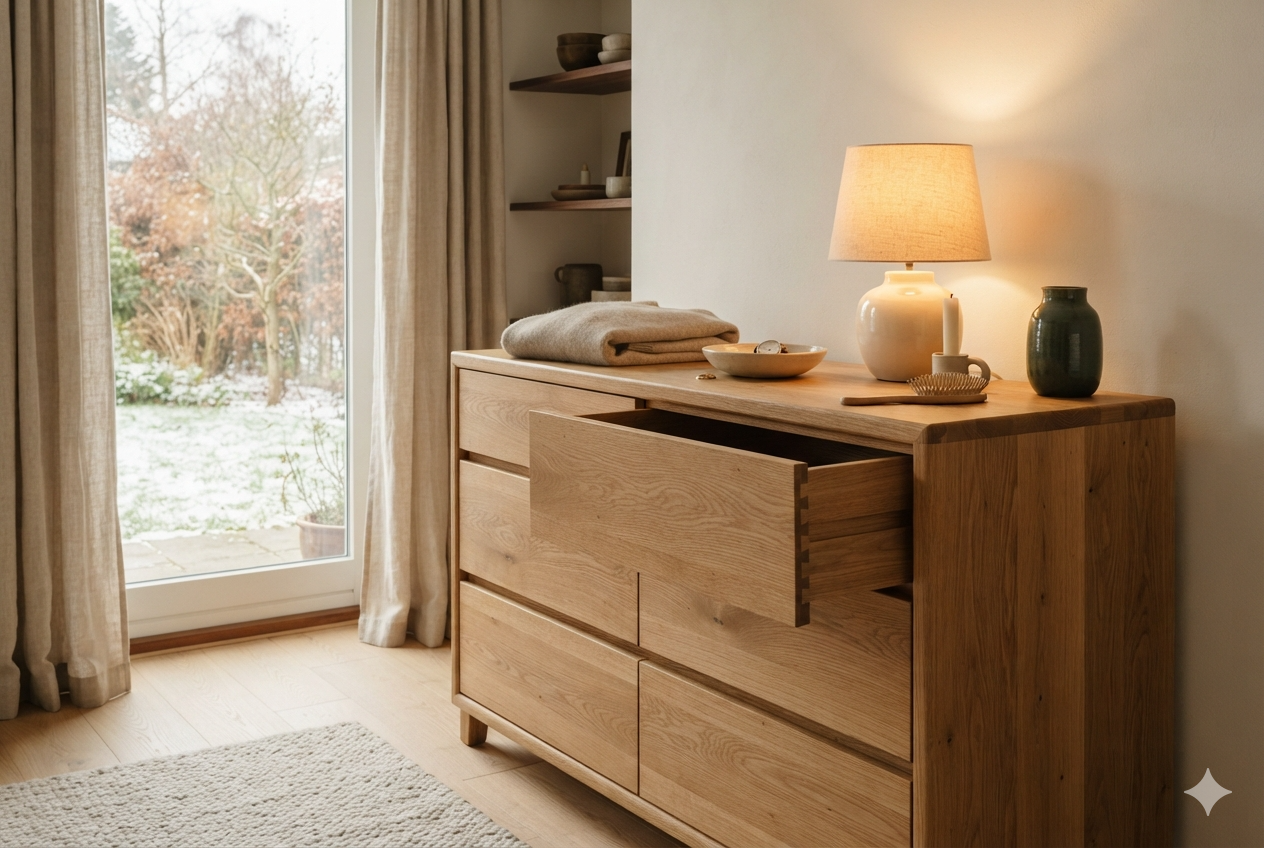
After three weeks of visiting almost every furniture shop in the vicinity, we found a solid oak dresser that was perfect.
It’s in our bedroom now, grain running the same on every visible surface. It cost a lot more than the dresser Henrik almost bought.
It’ll still be here, sanded and re-oiled, till Maja takes over. She knows it and gives it a light caress every time she comes to my bedroom. It will be her arv, eventually.
For the full picture on choosing natural materials that age well throughout the house — wicker, leather, ceramic, and the two rules I use for all of it — see the full guide: Hygge Natural Materials.
Light a candle. Slow down. Hygge.
— Elise