What is Hygge Lighting? (Why is it Essential for Coziness in Winter?)
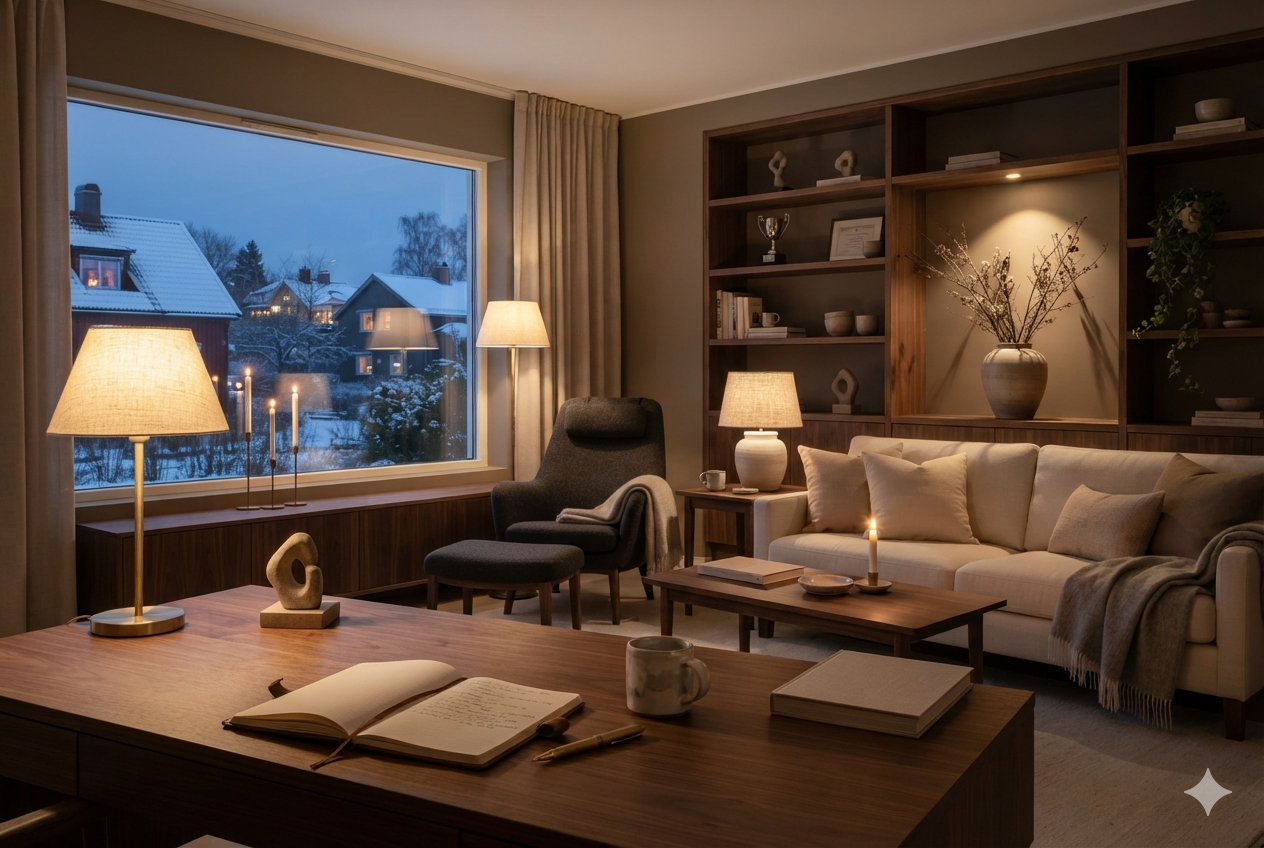
Hygge lighting uses soft, warm, layered light to create a cozy, calming atmosphere. It skips harsh overhead fixtures in favor of 2700K bulbs, candles, and well-placed lamps. This signals your brain that it’s time to relax, recharge, and reconnect.
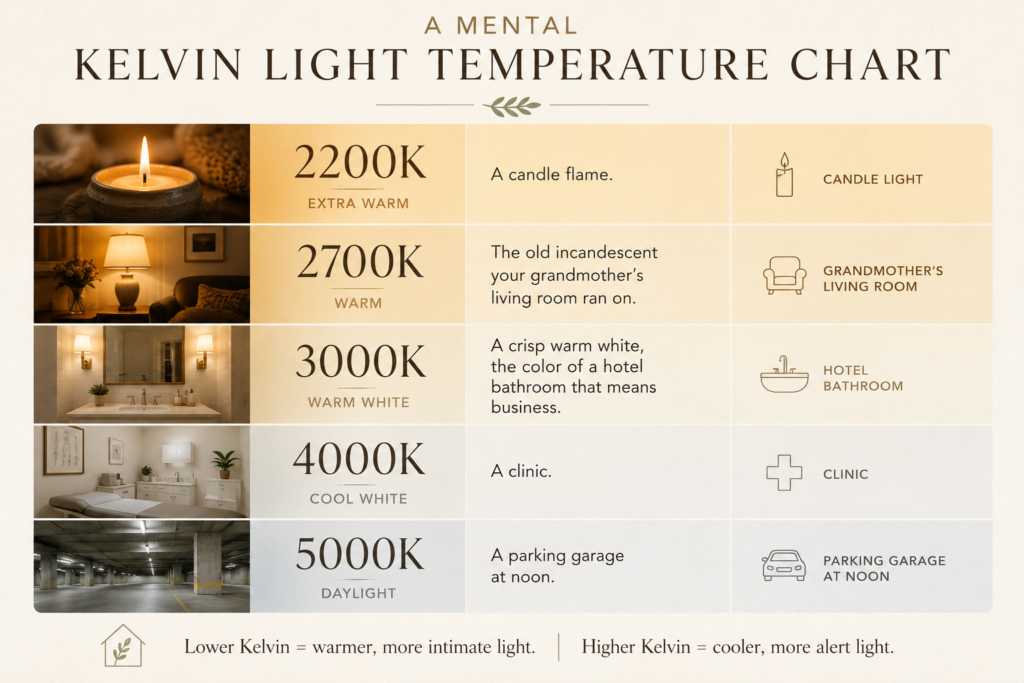
Choosing the Right Bulb: Kelvin Explained
This website participates in the Amazon Associates program. As an Amazon Associate, I earn from qualifying purchases. It also participates in the Impact and AWIN affiliate programs. If you buy through links on this site, I may earn a small commission at no extra cost to you. Thank you for supporting The Hugged Home.
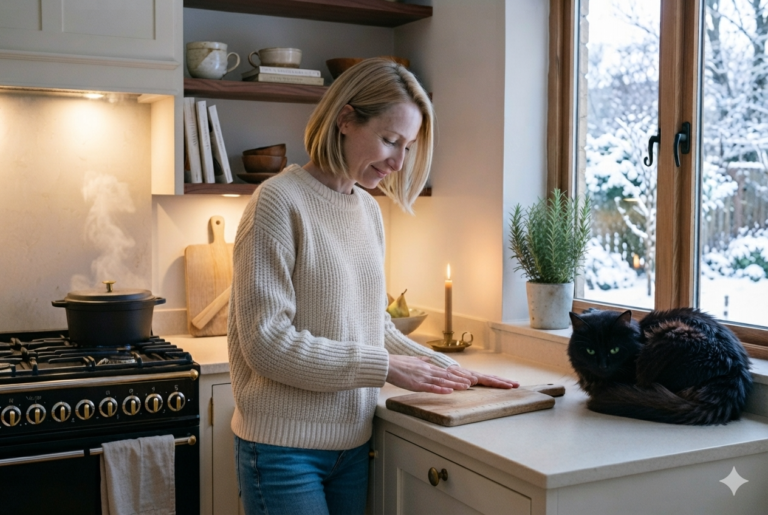
Around four o’clock in winter — sometimes earlier when it gets really dark — I walk through the house and turn off the overhead lights. I do this every evening without thinking about it anymore.
Every room. One by one. The ceiling light in the living room. The kitchen overhead. The hallway. Off.
Then I turn on the lamps. This is my hygge lighting ritual in winter.
The house doesn’t get darker. It gets warmer. The rooms that felt like workspaces now feel cozy, embracing you in a gentle, comforting hug.
Freya stops moving quite so fast through the hallway. Björn finds his spot under the floor lamp and settles. I start looking forward to a delicious dinner with Henrik and the girls and then retiring for restful sleep.
I learned this from Astrid. She called it the most important hygge habit in her house. “We don’t use the big light at night,” she said, as if this were the most obvious thing in the world.
For a Dane, it is.
Why Overhead Lighting Is Bad For Your Mood?
This isn’t aesthetic preference. There’s a reason overhead lighting feels wrong in the evening, and it has more to do with science than with interior design.
Overhead lighting floods a room evenly from above — the same way as the sun does during the day. Your brain reads it as daytime. As a result, your body stays alert. Cortisol levels stay elevated.
The sense that something still needs to be done doesn’t go away. When you are in a brightly lit room, your brain is alert and ready for action.
“The closest you will ever come to seeing vampires burnt by daylight is by inviting a group of Danes for a hygge dinner and then placing them under a 5,000K fluorescent light tube. At first, they will squint, trying to examine the torture device you have placed in the ceiling. Then, as dinner begins, observe how they will move uncomfortably around in their chairs, compulsively scratching and trying to suppress twitches.”
― Meik Wiking, The Little Book of Hygge: The Danish Way to Live Well
The light is working against their bodies. It isn’t hygge. It’s the opposite of hygge.
The Danes have understood this intuitively for generations. Half of all Danish people light candles at least four times a week. A third light six or more at a time.
This isn’t a decorating trend. It’s a deeply held cultural understanding that warm, low light is a form of wellbeing — not luxury, not ambiance. Wellbeing.
When Astrid told me not to use the big light, she wasn’t talking about style. She was talking about what the overhead light does to the mood of the people in the room.
The Science Behind Slowing Down in the Evening
I had the same instinct with hygge lighting that I had with the hyggekrog corner — I felt it before I understood it, and then I went looking for the explanation.
Here’s what I found.
Your body has a circadian rhythm — an internal clock that regulates when you feel alert and when you feel ready to slow down. It is an “evolution” thing. Light is the primary signal that sets this clock; specifically, the color temperature and direction of light.
Bright, cool, overhead light (4000K and above) signals daytime. Your body responds by suppressing melatonin and staying alert. This is exactly what you want at 9 am.
Here is how direct overhead light disrupts a cozy environment:
- Triggers Alertness: It suppresses melatonin, making it harder for your body to wind down after a long day.
- Casts Unflattering Shadows: Direct light from above creates harsh shadows on faces and surfaces, which feels clinical rather than comforting.
- Eliminates Intimacy: Diffuse, low-level light draws people inward and encourages quiet conversation, while bright overhead light makes a room feel exposed and expansive.
It’s the opposite of what you want at 5 pm in January. It is getting dark outside, the day is winding down, it is time to slow down, and your home needs to feel like a refuge.
What Does a Warm White Light Bulb (2700K) Do?
To achieve true hygge, the color temperature of your bulbs matters just as much as the fixture itself. When shopping for a warm white light bulb, Kelvin ratings are your most important metric.
The Kelvin (K) scale measures color temperature. Daylight is around 5000K–6500K (cool and blue), while standard home bulbs are often 3000K.
For a hygge home, you must drop down to 2700K or lower. This specific range emits a soft, amber glow that mimics candlelight or a sunset.
Warm, low, directional light (2700K and below) signals evening. Melatonin begins to rise naturally. Your shoulders drop. Your breathing slows. Your brain and body respond to the change in light — and start preparing for rest and sleep.
If you want to upgrade your fixtures, start by reading my complete guide to 2700K light bulbs to ensure every room feels like a warm embrace.
A candle flame measures at approximately 1800K. This is the warmest, most deeply calming light available. It is also moving and alive in a way that no electric light can fully replicate.
This is why Danes light candles before dinner, not during. The candle starts the transition before the meal begins.
This is not a design philosophy. It’s biology. The Danes just built their homes around it.
Ordinary Evening Lighting vs. Hygge Lighting
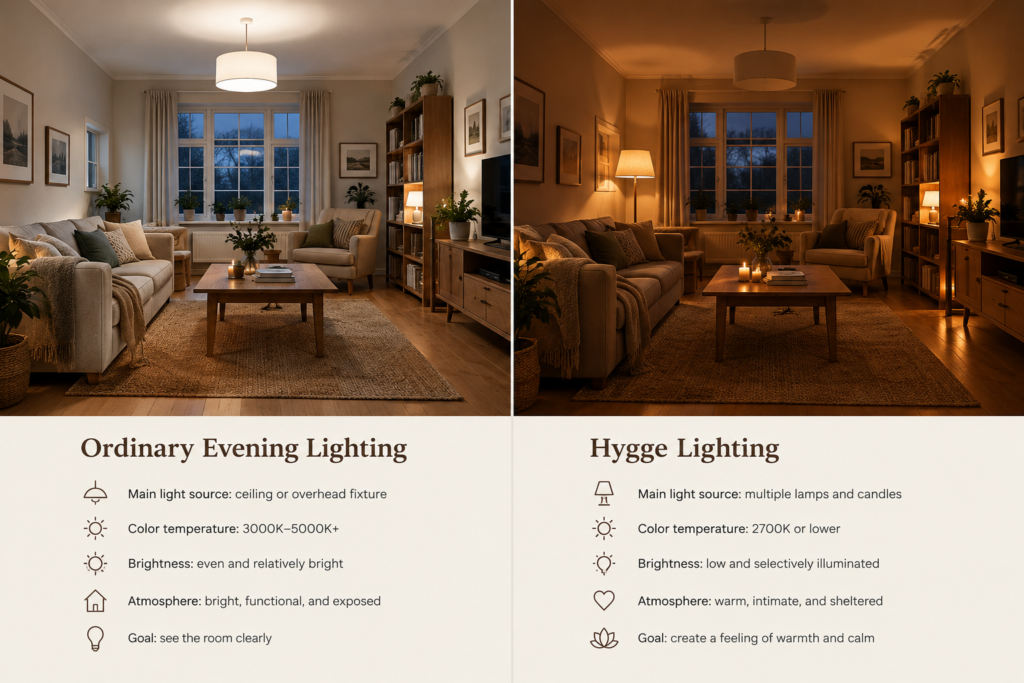
The difference between ordinary evening lighting and hygge lighting isn’t simply how bright a room is. It is where the light comes from, how warm it feels, and how the light affects your body and mind after sunset.
| Feature | Ordinary Evening Lighting | Hygge Lighting |
|---|---|---|
| Main light source | Ceiling or overhead fixture | Multiple lamps and candles |
| Light direction | Mostly from above | Downward, inward, and from different heights |
| Color temperature | Often 3000K–5000K+ | 2700K or lower |
| Brightness | Even and relatively bright | Low and selectively illuminated |
| Number of sources | One dominant source | Several small pools of light |
| Shadows | Minimized | Soft shadows are welcomed |
| Room atmosphere | Bright, functional, and exposed | Warm, intimate, and sheltered |
| Evening ritual | Lights switched on as needed | Lamps and candles become part of the routine |
| Primary goal | See the room clearly | Create a feeling of warmth and calm |
The Basic Principle of Hygge Lighting
The principle is simple: no overhead lighting in the evening. Everything else follows from that.
In practice, a hygge-lit room has multiple small sources of light at different heights — none of them coming from directly above.
The light creates what Wiking calls ‘small caves of warmth‘ — pools of amber rather than a flat wash of brightness. Some areas of the room stay in soft shadow. That’s not a flaw. Light and shadow complement each other.
Here’s how I’ve done it in each room of my home:
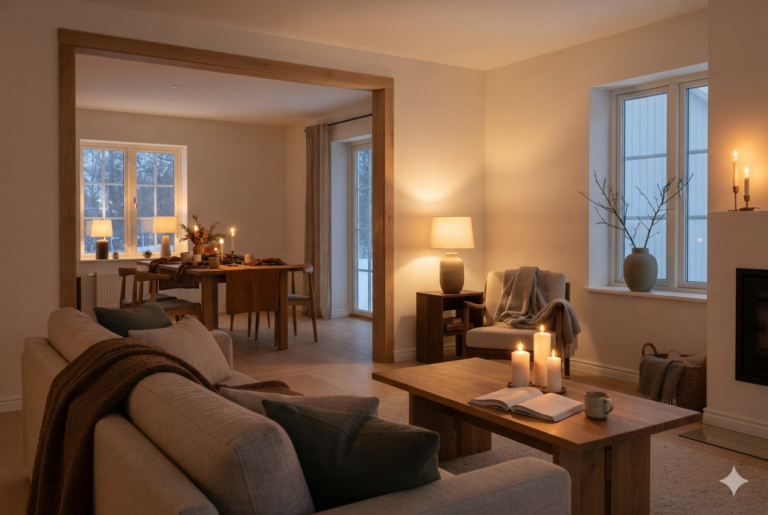
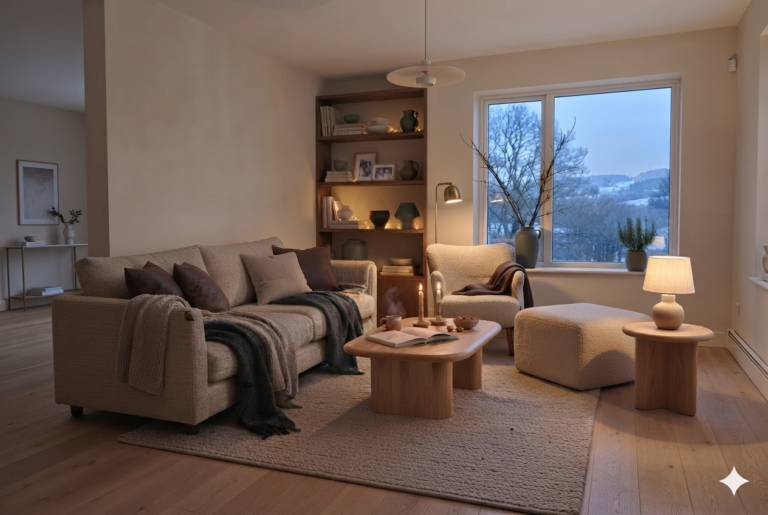
The Living Room
One floor lamp in the corner near Henrik’s hyggekrog — [→ see the hygge living room] — positioned to cast light downward and inward.
A table lamp on the bookshelf at the opposite end of the room. Two or three candles on the coffee table and side table. The overhead light: off from four o’clock onward, every day, from October through March.
The room has four light sources at four different heights. None of them is the ceiling.
It took me three months and two returned lamps to get the floor lamp right — the others were too bright, too white, too modern. The right one makes the room feel like it exhales.
The Kitchen
Under-cabinet lighting on a warm bulb, on from around four o’clock. One candle on the counter while cooking — always before I start, never after.
The overhead kitchen light stays on only when I really need it (chopping, reading a recipe) and goes off when I don’t. [→ More on the hygge kitchen candle ritual]
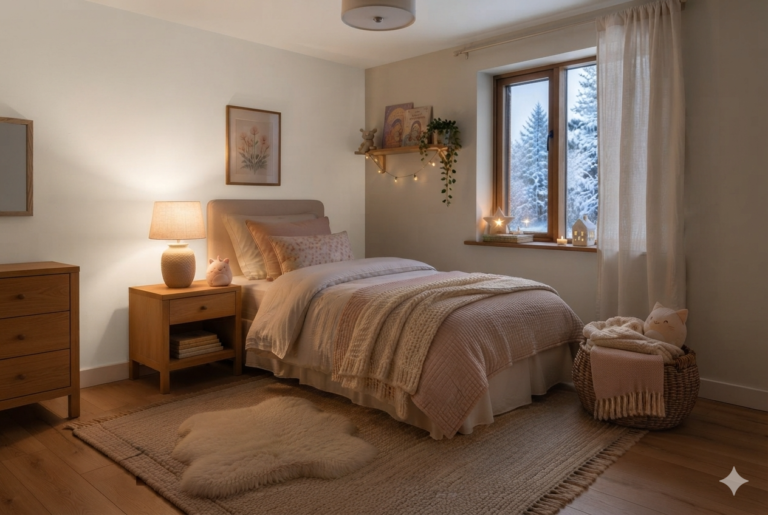
The Bedroom
A warm lamp on each nightstand — both on 2700K bulbs. No overhead at night. This one took the longest to change because the overhead was a habit. [→ see the hygge bedroom]
Now the bedside lamps go on first; the overhead never goes on at all in the evening. The room is calmer for it. We both sleep better. I’m not certain the lighting is the only reason, but I’m fairly certain it’s part of it.
The Entryway
A small lamp on the entrance table. That’s it. When you come home to a lamp rather than a switched-on overhead, the house feels more welcoming the moment you open the door. [→ see the hygge entryway]
This is, I think, the highest-leverage lighting change in the whole house. Three seconds to switch on. Immediate effect.
Hygge Lighting Ideas for Small Apartments
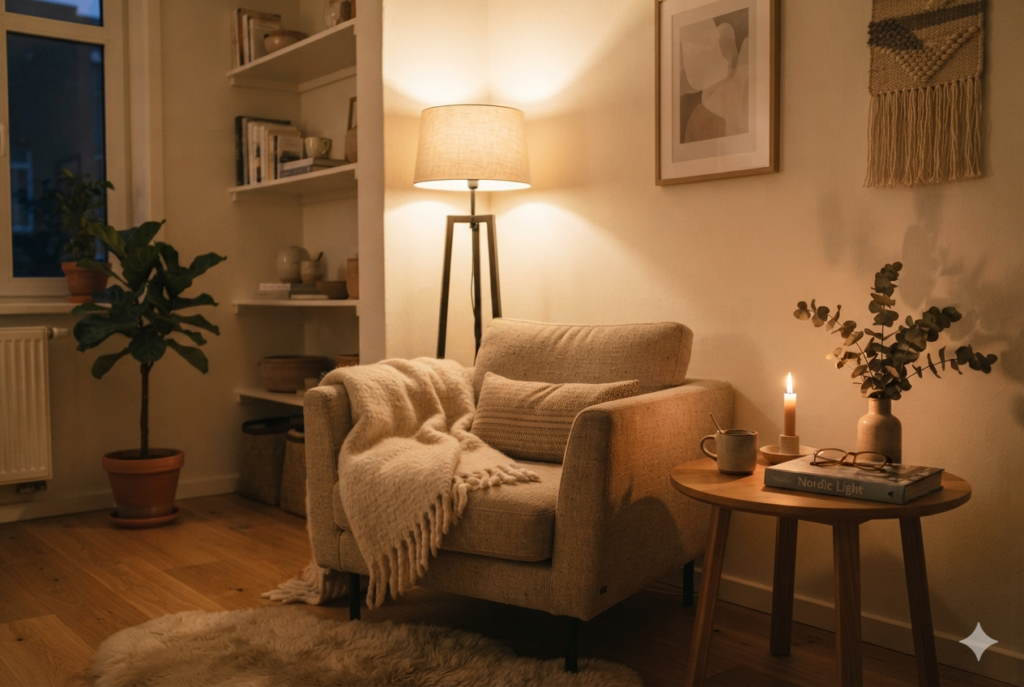
Actually, hygge lighting ideas for small apartments are often the most effective because the light bounces beautifully off nearby walls. An apartment’s smaller space is already conducive to coziness.
- Indirect Floor Lighting: Place a floor lamp behind a sofa or armchair, facing the wall. This creates a soft, indirect “wash” of light that makes the room feel cozier.
- Plug-in Wall Sconces: If you lack hardwired fixtures, plug-in sconces with fabric shades add permanent, low-level ambient light without taking up precious table space.
- Smart Timers: Plug your favorite lamp into a smart outlet. Having your entryway or living room softly illuminated before you even unlock the door is the ultimate winter luxury.
For more strategies, see our guide on how to light a room without overhead lighting.
The Practical Guide: How to Hygge Your Lighting
You don’t need to buy anything very expensive to get started. Most people have lamps they’re not using well — in the wrong place, with the wrong bulb, or not switched on at the right time. Start there.
Step 1: Replace Your Bulbs
Check every lamp in your home. If the bulb is above 2700K, replace it. 2700K is the upper limit for hygge lighting. Below 2700K is warmer still — 2400K gives a deeper amber glow. My favorite brand is Philips.
Above 2700K starts to feel like a waiting room. [→ Nest List: warm bulb picks]
Step 2: Move Your Lamps
Most people have lamps in the wrong place. A lamp in the corner near the floor creates more warmth than a lamp on a high shelf. A lamp at eye level when you’re sitting creates more intimacy than one above your eyeline.
Walk around your rooms at lamp height and see what the light is actually doing.
Step 3: Add a Dimmer to Your Overhead
If you can’t eliminate the overhead, a dimmer switch costs around $20 and takes thirty minutes to install.
At 20% brightness with a 2700K bulb, an overhead light stops being an overhead light and starts being another warm source. Not ideal, but functional. [→ Nest List: dimmer picks]
Step 4: Light a Candle
Before you do anything else. Before you check what’s for dinner, before you turn on the television, before you sit down. Light a candle. One candle.
That’s the Danes’ first move every evening. The candle sets the register of the room before anything else happens in it. [→ On hygge candles — why Danes light them every day]
Step 5: Make It a Habit
The most important thing Astrid told me about hygge lighting wasn’t about lamps or bulbs. It was this: make it a part of your routine.
The big light goes off at four. The lamps come on. The candle gets lit. Not when you feel like it. Every day. The ritual is what makes it hygge rather than just a design choice.
Once it’s a habit, you stop noticing the individual acts. You just notice that your home feels cozier after four o’clock. Your family shifts to the “calm” mode. Nobody seems to be rushing anymore.
That is the point.
FAQ on Hygge Lighting
What is the best Kelvin rating for hygge lighting?
The best Kelvin rating for hygge lighting is 2700K or lower. A warm white (2700K) light bulb mimics a sunset, signaling to your nervous system that it is time to wind down and relax.
Why is overhead lighting bad for a cozy home?
Harsh overhead lighting mimics midday sun, triggering cortisol production and alertness, making it hard for your body to shift into rest mode.
How can I create hygge lighting in a small apartment?
Focus on indirect, layered light. Place a floor lamp behind furniture, use plug-in wall sconces to save table space, and rely on warm 2700K bulbs. For more strategies, learn how to light a room without overhead lighting.
It’s been four winters since Astrid told me not to use the big light. I couldn’t tell you the last time I switched on the overhead in the living room after dark.
Not because I made a rule about it. Because the lamps are warmer. The candles are alive in a way electricity isn’t. The room finally feels like it’s ours.
That’s what changing the light did for one room. Multiply it across the whole house, and you get the full picture — which is exactly what this guide walks through, room by room. [→ The Complete Guide to Hygge Home Decor]
Light a candle. Slow down. Hygge.
— Elise