Layered Lighting for Bedroom: The Case for Turning Almost Everything Off
It was a Wednesday in January, past nine, and Henrik had just come up from the living room to find me standing in the doorway of our bedroom with my hand still on the overhead switch.
“You’ve been up here two minutes,” he said. “Almost in the dark.”
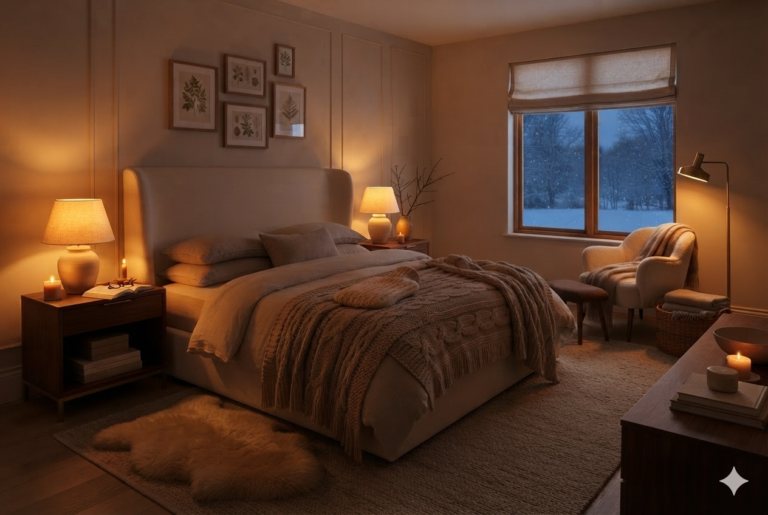
I hadn’t been in the dark, exactly. I had just turned on both nightstand lamps and turned off the overhead lights. The ceiling light was on a dimmer anyway, but even that was no longer required.
That’s the whole idea about layered lighting for a bedroom. The rules of three different types of lighting – ambient, task, and accent do not apply. Bedroom layered lighting is about reducing it to just the task lighting for bedside reading.
This website participates in the Amazon Associates program. As an Amazon Associate, I earn from qualifying purchases. It also participates in the Impact and AWIN affiliate programs. If you buy through links on this site, I may earn a small commission at no extra cost to you. Thank you for supporting The Hugged Home.
Why the Bedroom Needs Less Light, Not More
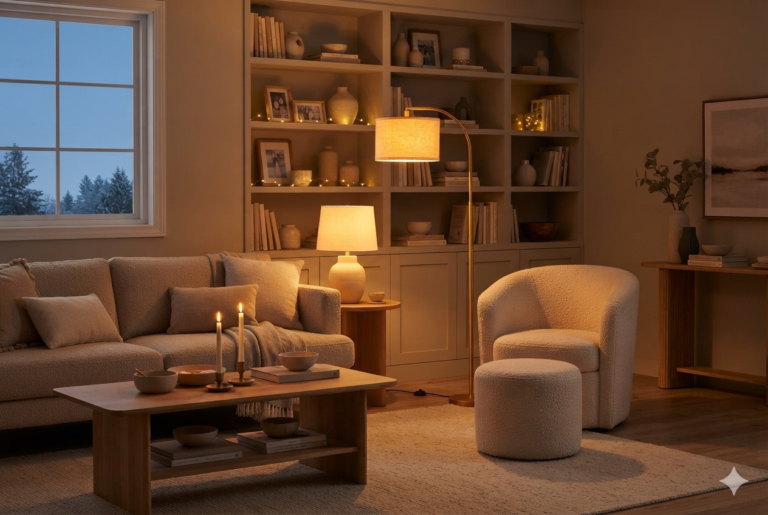
Every other room in this guide gets more layers, not fewer — a living room needs three or four sources working together, a kitchen needs both task and ambient light. The bedroom breaks that pattern on purpose.
This is the one room in the house where the goal isn’t a fuller layer of light. It’s the fewest sources that still let you function — read a page, find your glasses, not stub a toe on the way to bed — before the room goes properly dark.
Astrid put it more bluntly than I would have, the first time she saw our bedroom lit up like the rest of the house.
“This is not a room for atmosphere,” she said. “It is a room for sleeping. Atmosphere is what gets you to sleep, not what keeps you up admiring it.”
She turned off everything except the two nightstand lamps and left it at that.
Two Lamps, Always Matching
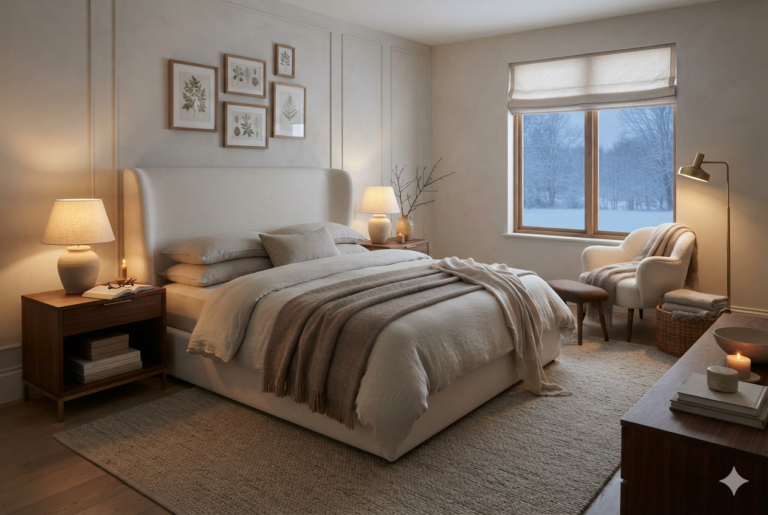
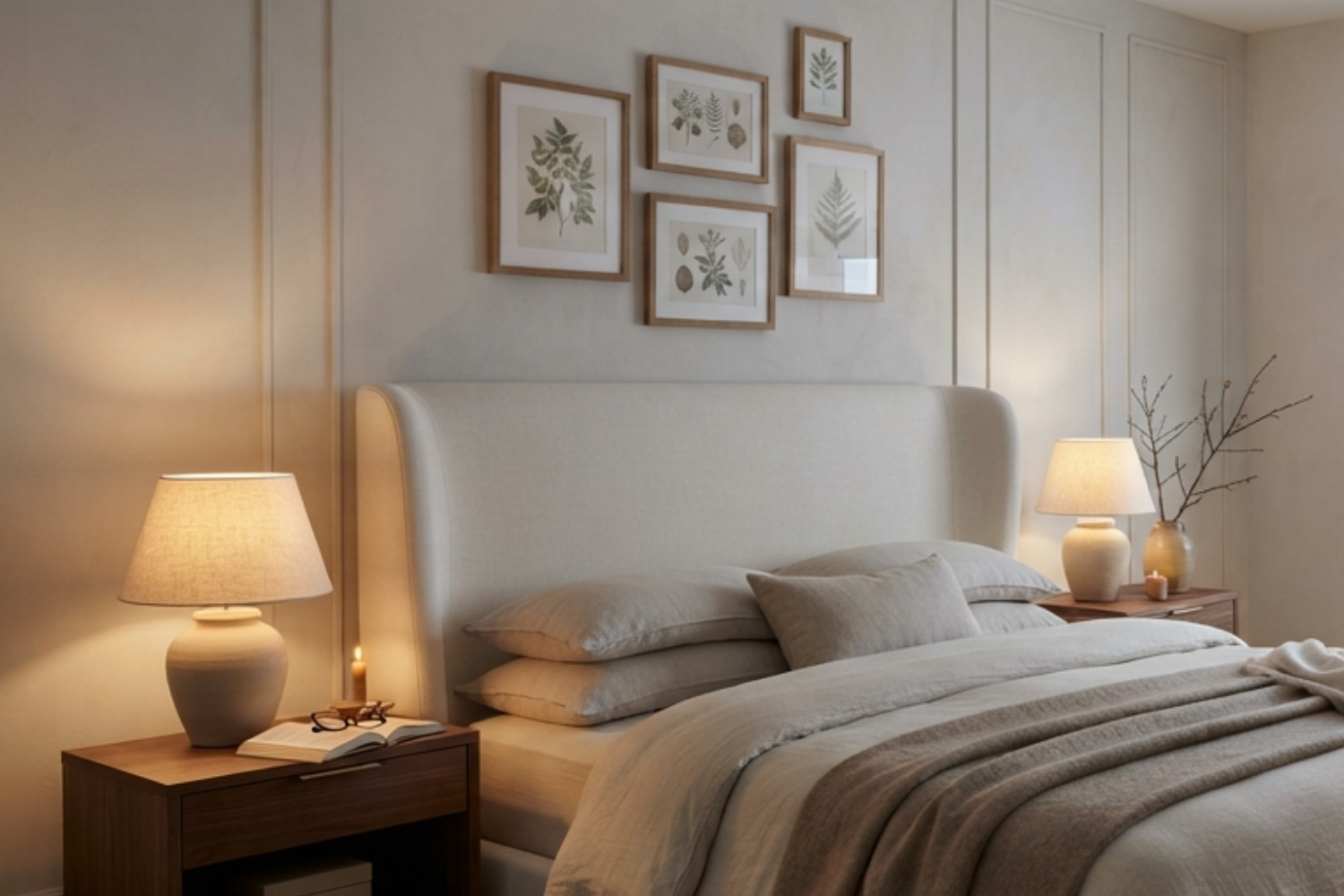
Our bedroom has exactly two light sources: one lamp on each nightstand. Matching, deliberately — I prefer symmetry in my bedroom.
There’s a reason for that beyond looks. Two identical lamps mean two identical pools of light, one on each side of the bed, which keeps the room visually calm right before sleep.
We use a pair of ceramic table lamps with linen shades on ours — nothing fancy, but pretty, low-wattage, 2700K bulbs in both.
Of course, this is a personal choice. You can start your search on Amazon. There are several ceramic nightstand lamps, set of 2 here.
The Case for No Overhead Light At All
This recommendation surprises people the most: turn the ceiling light off after dark, and don’t turn it back on. Not even dimmed. Off.
We still use ours in the morning, getting dressed, or during the day when the shades are drawn. But from dusk onward, the ceiling light in our bedroom is almost never turned on. Not unless I dropped an earring and must find it.
The two nightstand lamps provide all the light the bedroom needs once the sun’s down — enough light to read by, enough to find a glass of water, never so much that sleep hormones disappear. Restraint is absolutely the correct call in a bedroom.
Reading Light Before Sleep
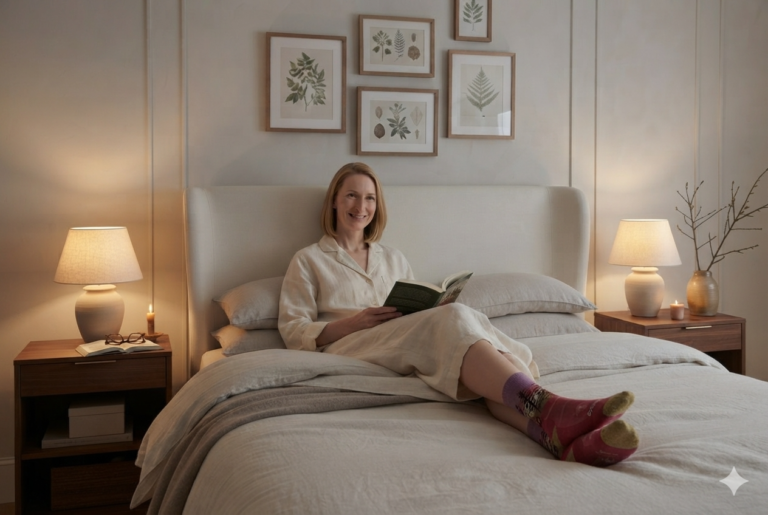
If you read in bed — and if you’re the kind of person still reading a home decor guide this deep into it, you probably do — your nightstand lamp is quietly doing task-light duty for twenty minutes before it goes off for the night.
That means the same rule from the living room reading chair applies here: warm temperature, but a shade that directs light down onto the page rather than diffusing it evenly around the whole room.
A lamp that lights the entire ceiling while you’re trying to read one page is working against you twice — once by keeping the room too bright to wind down in, and again by not being bright enough where you need it.
Both of us love to read in bed so we got a pair of Glocusent 5W Clip on Lights. Unlike other bed lights for headboard, our book light has 36 well-distributed LED beads, and lights up the area you positioned evenly.
This clip on bed lamp has 3 color modes: Amber(1800K), Mild(3200K) and Natural(6000K). Plus a handy controller and a 30-min auto off timer, makes it a perfect reading light for bed headboard.
Layered Lighting for Bedroom: What to Skip
Skip the smart-bulb color scenes here. A bedroom doesn’t need “relax mode” in blue, or a sunset gradient timed to your alarm. Novelty lighting is the opposite of what this room is for.
All your bedroom needs at night are two steady, warm, low light sources, matched, and on either side of the bed.
Skip string lights and fairy lights as accent light sources, too, however charming they look in photos. They have their place, but your bedroom is not that place.
And skip trying to make the room “cozier” by adding more lamps. A bedroom with four light sources isn’t four times as cozy. It’s just harder to turn off.
A Night, Reconstructed
Henrik climbed in on his side of the bed, picked up the book he’s been three chapters into for two weeks now, and read by his own small pool of warm light. I read by mine, a few feet away, in a room that was otherwise almost entirely dark.
Neither of us reached for the overhead switch. We haven’t in years.
Ten minutes later his lamp went off first, same as always. Mine stayed on a little longer, and then the room went properly, fully dark. This is exactly how a day is supposed to end up — every single night.
For the full breakdown of the layering principles behind all of this — the 2700K rule, the three types of light, and how to build the layers room by room — see The Complete Guide to Layered Lighting.
Light a candle. Slow down. Hygge.
— Elise