Layered Lighting for Living Room: The Perfect Transformation
It was early days in my hygge journey. I had invited my Danish friend Astrid for a glass or two of wine. It was an early evening on a Tuesday in November; she took one look at our living room, winced, and blurted.
“Elise. Turn off the big light.”
I admit, I was a bit uncomfortable with her directness. But then she is a friend, and that is the way she is, always direct and to the point.
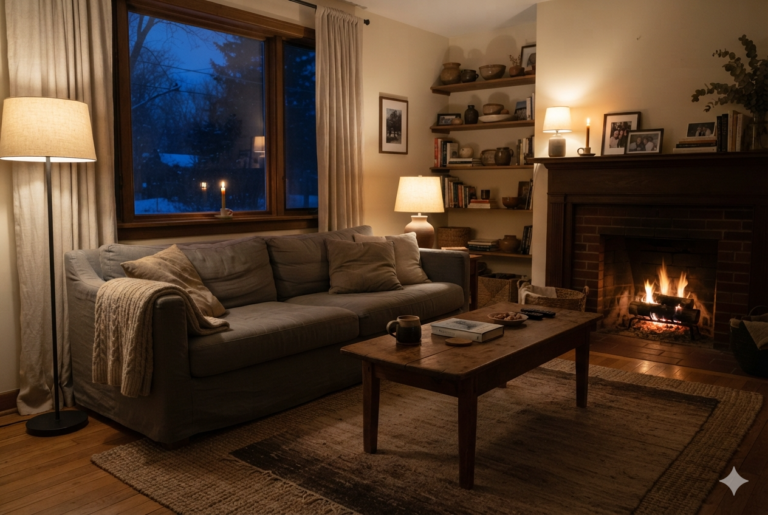
Anyway, I turned off the overhead light; she walked over and turned on the floor and table lamps. Then she knelt and lit the candle on the coffee table.
The living room transformed from what had looked like a dentist’s waiting room to one that now felt cozy, comfortable, and strangely warmer.
“This is the effect of using layered lighting for the living room,” smiled Astrid as she took her glass of wine and settled down on the sofa. For good measure, she kicked off her shoes, curled her feet under her, and pulled the wool throw over her lap.
This website participates in the Amazon Associates program. As an Amazon Associate, I earn from qualifying purchases. It also participates in the Impact and AWIN affiliate programs. If you buy through links on this site, I may earn a small commission at no extra cost to you. Thank you for supporting The Hugged Home.
Why Layering Lights for a Living Room is Tricky
Lighting a living room is tricky; trickier than any other room in the house. Why? Most rooms have a single purpose, but a living room is used for several activities, often simultaneously.
It’s where we read, chat, watch TV half‑heartedly, or flop down watching the kids build a Lego empire on the rug. One single overhead light won’t cut it—it makes everything feel flat and lifeless.
That’s why layering lights for a living room matters even more. You need ambient light to set the mood, task lighting for reading or knitting, and accent lighting to highlight corners or décor.
Miss one layer, and the room feels either too harsh or too gloomy.
The challenge is balance. Too much brightness and it feels like a showroom; too little and you’re squinting at your book. The living room isn’t about being “seen”—it’s about being comfortable, lived‑in, warm, and welcoming.
So yes, it’s the hardest room to get right. But when the layers click together, it becomes the heart of the home, not just another lit box.
Here’s how I would build it, chair by chair, corner by corner.
Start With Where People Actually Sit
Walk through the living room with a notepad and pencil. Sketch a rough floor plan—nothing fancy, just enough to mark the main areas.
Make a note of every spot someone might sit for more than five minutes — the couch, the armchair, the reading corner if you have one, or even the floor by the coffee table if your kids claim it to solve their puzzles.
Mark these places clearly and jot down quick comments. Don’t worry about accuracy or neatness; this is for your own use, not for a presentation.
Each of those spots needs its own light source, at roughly shoulder height when seated, not overhead. This exercise is the first step in transforming your living room from adequately lit to thoughtfully layered, with the correct mix of ambient, task, and accent lighting.
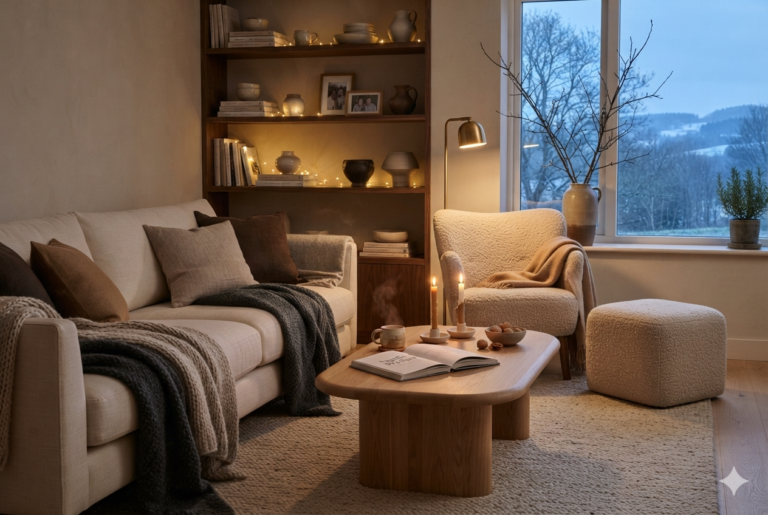
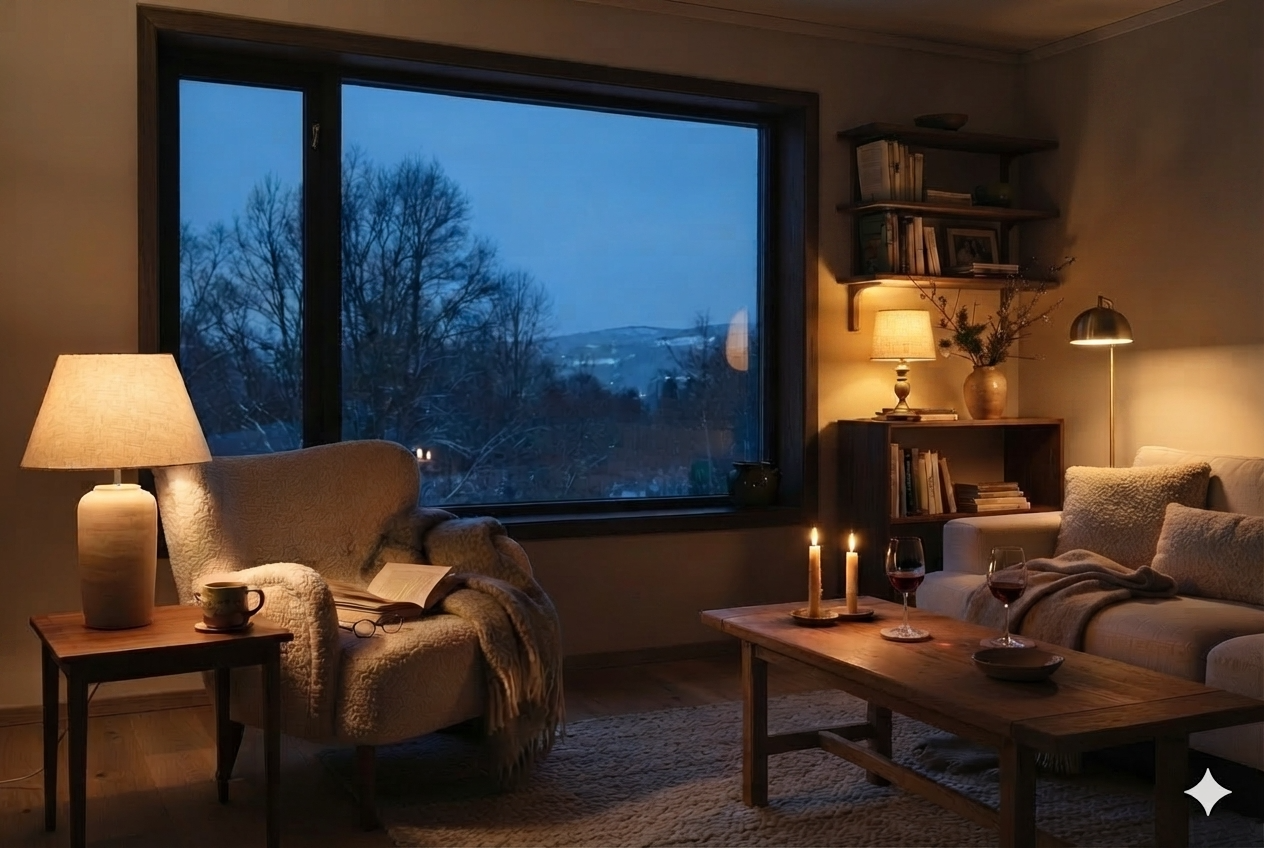
In our living room, Henrik’s hyggekrog chair has a brass floor lamp behind it; the light falls directly onto his book when he reads. Beside the sofa, a ceramic table lamp adds a warm glow.
The Coffee Table Does More Work Than You Think
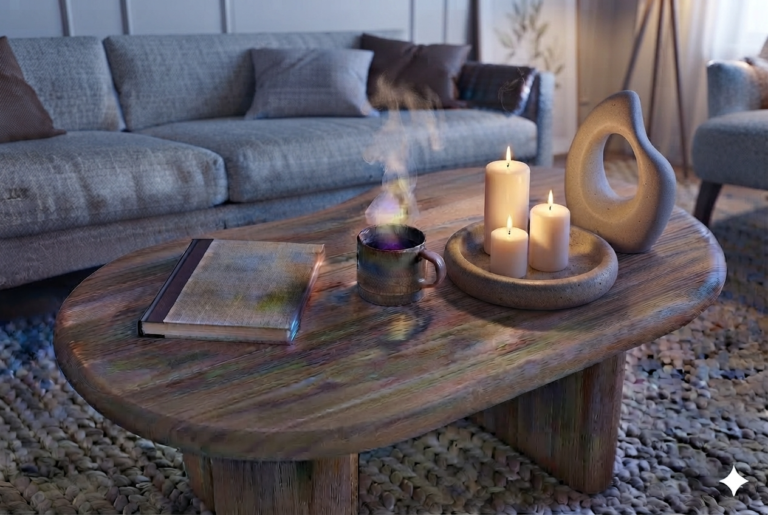
A coffee table is prime real estate for accent light — lighting that makes the room feel considered. Two candles, off-center rather than perfectly symmetrical, do more for layered lighting for a living room than almost anything else on this list.
They’re low, they’re warm, and they move, which no lamp can do realistically. Technology allows close copies, but only close copies.
There is a reason the Danish word for candles is levende lys, literally “living light.” Not a mood. Not a setting on a dimmer. Light that behaves like it’s alive — it flickers, it leans, it asks, in its own small way, to be tended, not turned on. [→ Full guide to Hygge Candles]
Reading Light Needs to Be a Task Light, Not Ambient Light
If you read in the living room — actually read, not just have a book open on your lap while you look at your phone — the lamp next to that spot needs to be brighter and more directional than the rest of the room’s lighting.
This is the one place in a hygge living room where “warm and dim” isn’t the only goal. A dim reading lamp will strain your eyes and be an excuse to stop reading.
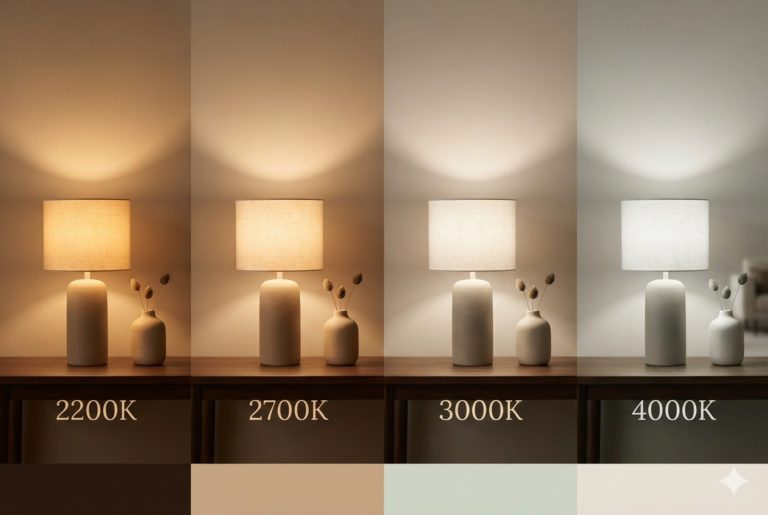
The fix: keep the lamp warm (2700K, always), but choose a shade that directs light down onto the page rather than diffusing it evenly around the room. An adjustable cozy reading floor lamp is worth investing in if you like to read in the living room.
Don’t Forget the Room’s Edges
Most living room lighting mistakes happen because every lamp is clustered around the seating areas; the corners and the room edges go completely dark.
A small lamp on a bookshelf, or a floor lamp in the room’s least-used corner, pulls the eye outward and makes the whole room feel bigger and more finished — even though it’s technically the least “useful” light in the room.
This is accent light doing its real job: not helping you see, helping the room feel whole.
Layered Lighting for Living Room: What to Skip
Overhead lighting on any dimmer setting still reads as overhead lighting once it’s above maybe 20%. Don’t remove the fixture; just don’t turn it on in the evening. Use the lamps.
Uplighting a living room with recessed floor-level fixtures is a hotel-lobby move, not “layered lighting for a living room.” It’s technically “layered” in the sense that it’s not overhead, but it lights every surface evenly, which is exactly the flatness you are trying to avoid.
An Evening, Reconstructed
That evening in the living room, with Astrid and me sipping wine and sharing local gossip, was a masterclass in “layered lighting for living room.” When you layer light well, the space shifts from functional to inviting, from a room you pass through to a room you linger in.
The glow from a lamp, the flicker of a candle, the soft reach of light into the corners—each adds a note to the atmosphere.
What makes it tricky is also what makes it rewarding: the living room is never just for one activity. It’s family time, quiet time, reading time, and sometimes simply “being together” time.
Layered lighting respects all those roles without forcing the room into a single mood.
So, don’t think of lighting as switches and fixtures. Think of it as comfort, rhythm, and warmth. When you build it chair by chair, corner by corner, you’re not just arranging lamps—you’re shaping how the room feels at its best.
And when the balance is right, you’ll know. The living room won’t just look lit—it will feel lived in.
For the full breakdown of the layering principles behind all of this — the 2700K rule, the three types of light, and how to build the layers room by room — see The Complete Guide to Layered Lighting.
Light a candle. Slow down. Hygge.
— Elise