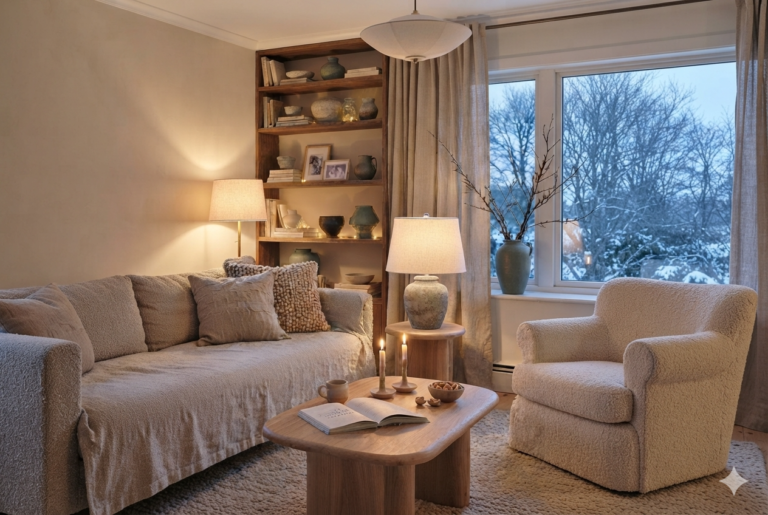
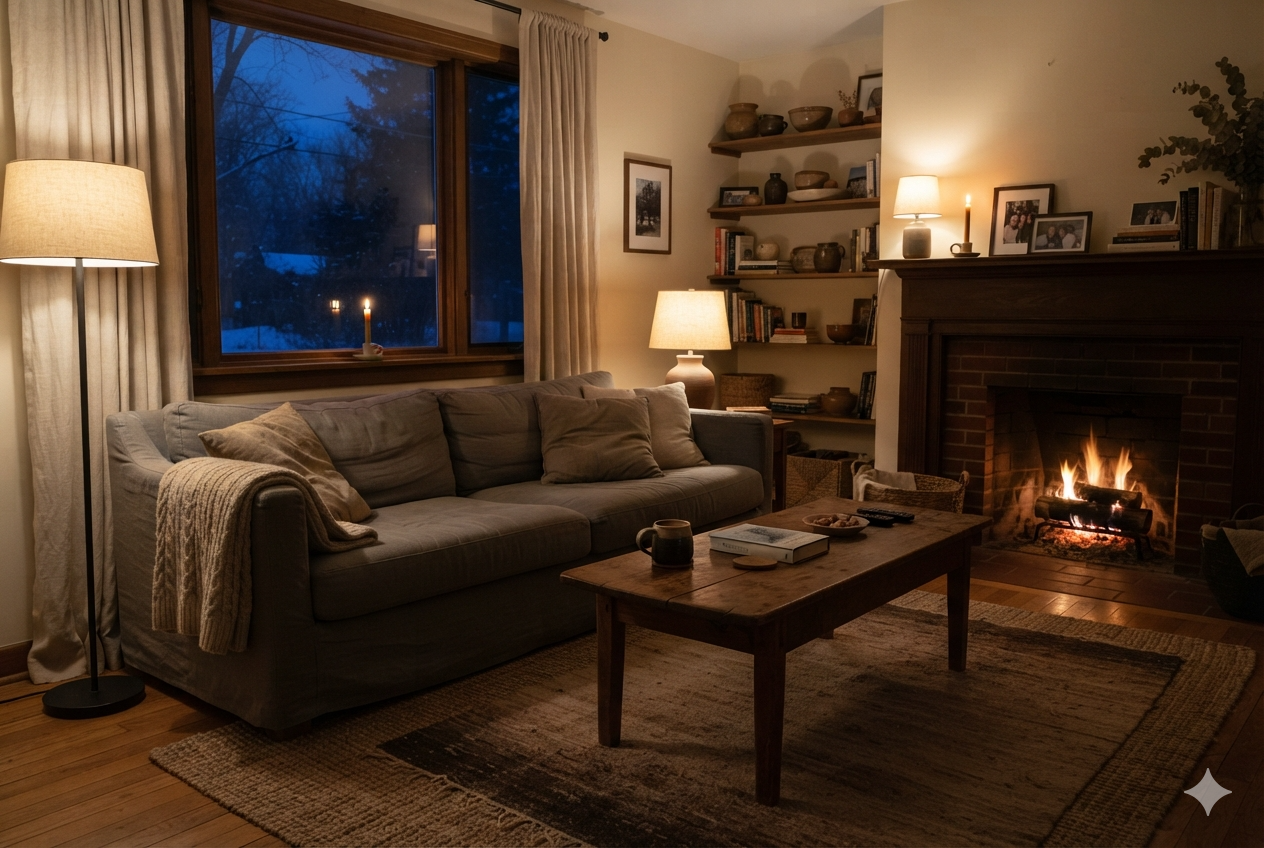
Cozy Winter Living Room Ideas That Don’t Require a Renovation
It was 5 p.m. on the first Sunday after the takedown, and the living room looked like it had lost its soul.
The tree was gone. The ornament boxes were stacked in the attic, the stocking hooks were bare, and the pine needles I had been sweeping up for two weeks had finally surrendered.
Then, carrying the last bin of December down from the shelf, I made the mistake. I flipped on the overhead light.
The room flattened. The sofa I have loved for six years looked like a stranger’s sofa. The coffee table was a bare rectangle of oak with a ring from somebody’s mug and nothing else.
Next evening when Astrid dropped in for tea, she took one look at the ceiling light with squinted eyes and made a face, as if in pain.
“The room is tidy, Elise,” she said. “But it is not hjemlig.”
I asked her what that meant. “Hjemlig is not cozy,” she said at last. “Cozy is what a room looks like in a photograph. Hjemlig is whether the room knows who lives there.”
Till a week earlier, this same room had held the quiet Scandinavian Christmas — candles in the windows, a tree that glowed from within, the smell of clove and orange peel.
The decorations had not been the hygge. They had only been the evidence of it. The evidence was now in a box in the attic, and what remained was a cold, bright, “uncozy” room.
So this is the work of January. Not buying new things, instead making our living room hjemlig again.
This website participates in the Amazon Associates program. As an Amazon Associate, I earn from qualifying purchases. It also participates in the Impact and AWIN affiliate programs. If you buy through links on this site, I may earn a small commission at no extra cost to you. Thank you for supporting The Hugged Home.
Why a 70-Degree Room Can Still Feel Cold
The thermostat says 70. Your shoulders say otherwise.
Part of it is physics. Your body does not read air temperature; it reads radiant temperature.
In January, your windows and exterior walls are cold surfaces, and cold surfaces pull heat away from your skin even when the air is technically warm.
A 70-degree room with freezing glass feels colder than a 66-degree room with warm walls. The thermostat is not lying. It is just answering a different question.
Part of it is older than physics. In 1975, the geographer Jay Appleton proposed prospect–refuge theory: humans prefer environments where we can see without being seen.
A vantage, and a wall at our back. Most American living rooms are arranged against this instinct — sofa floating mid-room, back exposed to a hallway, facing a black television instead of a door.
The body keeps a small guard on duty all evening. It never fully settles down. Instincts ingrained in our DNA for millennia.
And part of it is stranger, and more wonderful. In a 2008 study published in Science, researchers Williams and Bargh found that people holding a warm cup judged strangers as warmer and more trustworthy than people holding a cold one.
Physical warmth is read, at the deepest level, as emotional warmth. The body does not distinguish carefully. A warm mug in the hands is not a beverage. It is a message.
You cannot rebuild the walls. You cannot re-glaze the windows this month. But you can change the light, the surfaces within hand-reach, and the way the furniture faces the dark.
That is the whole game.
Start with a warm winter color palette in your textiles, then do these nine small things.
9 Easy Ways to Make the Living Room Hjemlig Again
1. Kill the Big Light First
One switch. That is the entire first step. The overhead is for cleaning days and finding lost earrings.
For evenings, build three low pools of light at 2700K or lower — one beside the sofa, one in the far corner, one on a shelf — so the room has topography again.
My layered lighting plan for the living room walks the placement. And if your current lamps are the cold kind, swap them.
A linen-shade table lamp earns its place in a single evening: at 2700K it turns a corner into a campfire — no glare, just a warm glow.
2. Give the Sofa Something to Watch
Push it toward the room. Solid back to a wall, sightline to the door and the window. Prospect in front, refuge behind. You will feel the difference within a week and never be able to explain it. That is the point.
3. Layer the Floor Twice
A bare floor is a cold radio, broadcasting January upward through your socks. Layer a flatweave jute base under a wool rug, and the floor stops being a surface and becomes a place. Bare feet will instantly acknowledge their satisfaction.
4. Retire Some of the Fleece
I know. The fleece was a gift, and it is fine. But fleece traps sweat and becomes cold and clammy, while wool beats fleece by holding heat even when damp.
I keep a few fleece throws for the girls because it is sacrificial. When they spill some soup on a $30 fleece throw, it goes in the wash.
I am practical enough to keep the Pendleton Eco-Wise Washable Throw, the workhorse of the sofa: 100% wool, a plaid that forgives pilling, and a weight that says stay.
The throw on Henrik’s armchair in the living room is from Faribault Mill. It keeps him cozy and warm, as he reads. Faribault Mill — a Minnesota mill has been weaving since 1865.
5. Keep Wood Within Hand-Reach
Wood is a poor conductor of heat, so it meets your skin at its own temperature instead of stealing yours. That is why wood feels warm even in a cold room.
A wood side table. A wood tray across the sofa arm. Even a wooden bowl corralling the remotes. Every one of them is a small handshake of warmth.
6. Dress the Windows for the Dark
At five o’clock the glass turns into a black mirror showing you your own tired face. Hang linen panels to break the glare, and set a candle or a small warm lamp on the windowsill.
From inside, the window becomes a frame again. From outside, it says what Astrid’s grandmother wanted it to say: someone is home.
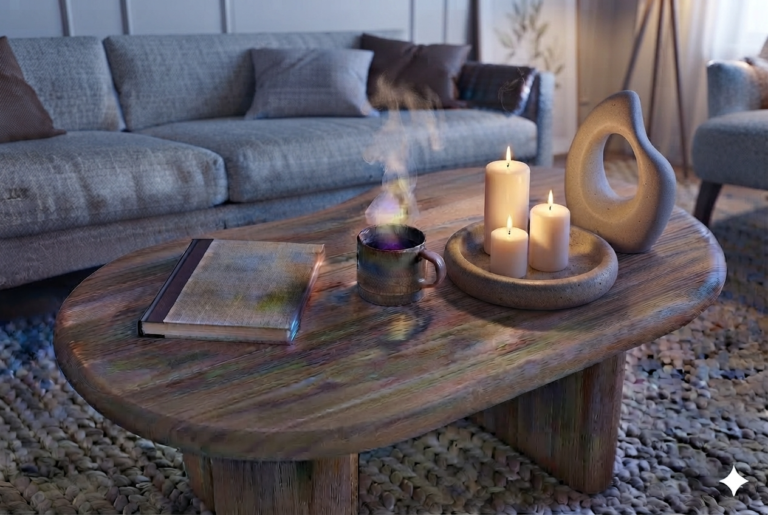
I arrange two sets of three Soy Wax Creamy White Pillar Candles of varying heights on a heavy stone tray. One goes on the coffee table and another on the windowsill.
7. Set the Mug Station Before Sunset
Two stoneware mugs on a tray. The kettle filled, the cocoa tin open. Do it at four o’clock, before anyone asks for anything.
The warm-cup study was never really about cups; it was about being handed warmth. A mug pressed into a child’s hands at dusk is almost as good as a mother’s hug.
8. Anchor One Scent for the Season
One candle, chosen for the whole winter, lit at the same hour each evening. Not a different scent per mood.
Repetition is the point: scent is the shortest road to memory, and by February this one smell will mean the entire season.
I prefer to use a Ceramic Essential Oil Stone Diffuser in the living room. I keep an assortment of Majestic Pure Lavender Essential Oil bottles. I will pick a scent I like, maybe lavender or lemongrass, and it stays for a couple of months.
It is lit at the same hour nightly, and becomes the smell our family associates with being safe indoors.
9. Leave One Chair Half-Hidden
Every hjemlig room keeps one seat slightly out of the way — angled into a corner, lamp beside it, throw over the back. A refuge within the refuge.
If you have the square feet, give it a hyggekrog of its own. If not, the corner chair is the krog wearing a winter coat. In our house, Henrik has his in the living room, mine is between the dining room and the kitchen.
The Half-Inch of Candle
It is late now. The movie ended twenty minutes ago, and nobody moved, because Freya fell asleep before the credits — one sock off, the other still on, cocooned in the pilled wool throw like a burrito with bangs.
Henrik has not moved an inch. If he moves, he becomes the man who carries her to bed, and he knows it, and so he watches the end of a film he has already seen four times with the patience of a saint.
On the shelf, the candle has burned to its last half-inch. The flame is small and steady, making our living room feel warm and cozy, while it is freezing outdoors.
I switch off the entry light. I leave the small lamp on. Not for me. For whoever comes down last, so the room can say, in its own low voice: I know you. Sit down.
Your next step: the hygge living room guide walks the whole room corner by corner, for when January turns.
Light a candle. Slow down. Hygge.
— Elise