Hygge Natural Materials: How They Foster Calm and Coziness
What Are Hygge Natural Materials?
Hygge natural materials are raw, organic elements — solid wood, linen, wool, stone — that ground a space in nature. Prioritizing tactile, sustainable textures over synthetics creates a calming, restorative environment that engages the senses and forms the foundation of Danish coziness.
This website participates in the Amazon Associates program. As an Amazon Associate, I earn from qualifying purchases. It also participates in the Impact and AWIN affiliate programs. If you buy through links on this site, I may earn a small commission at no extra cost to you. Thank you for supporting The Hugged Home.
THE 8-WEEK HYGGE HOME TRANSFORMATION PLAN

If you are new to hygge home decor and want to skip the guesswork, I’ve mapped out a Free 8-Week Hygge Home Transformation Plan It is a transformation road map for each room, week by week.
Click the button above · Enter your email · Check your inbox and confirm the verification email · Your transformation plan unlocks instantly · NOTE: Check your spam folder too!
Hygge Interior Design Principles: Natural Materials
Turn hygge principles into tangible choices with natural materials that add warmth, texture, simplicity, and comfort.
| Hygge Principle | Sensory Goal | Natural Materials | Best Used For |
|---|---|---|---|
| Warmth & Comfort | Softness, warmth, insulation | Wool, sheepskin, solid wood | Throws, rugs, cushions, seating |
| Simplicity & Function | Visual calm, useful design | Oak, ash, linen, stoneware | Furniture, bedding, dining, storage |
| Connection to Nature | Grounding, organic texture | Stone, jute, wood, greenery, beeswax | Rugs, accents, vessels, candles |
| Tactile Layering | Texture, softness, visual depth | Wool, bouclé, linen, rattan | Throws, pillows, baskets, upholstery |
| Warm Light & Atmosphere | Soft glow, relaxed mood | Beeswax, wood, linen | Lamps, shades, candlelight |
| Togetherness & Ease | Relaxation, comfort, connection | Wood, wool, linen, ceramics | Sofas, dining areas, reading nooks |
It is a Sunday evening in early November. Dinner is over, the dishwasher is humming quietly downstairs, and I am making one last round of the upstairs before we all settle in for the night.
I stop for a moment at the landing.
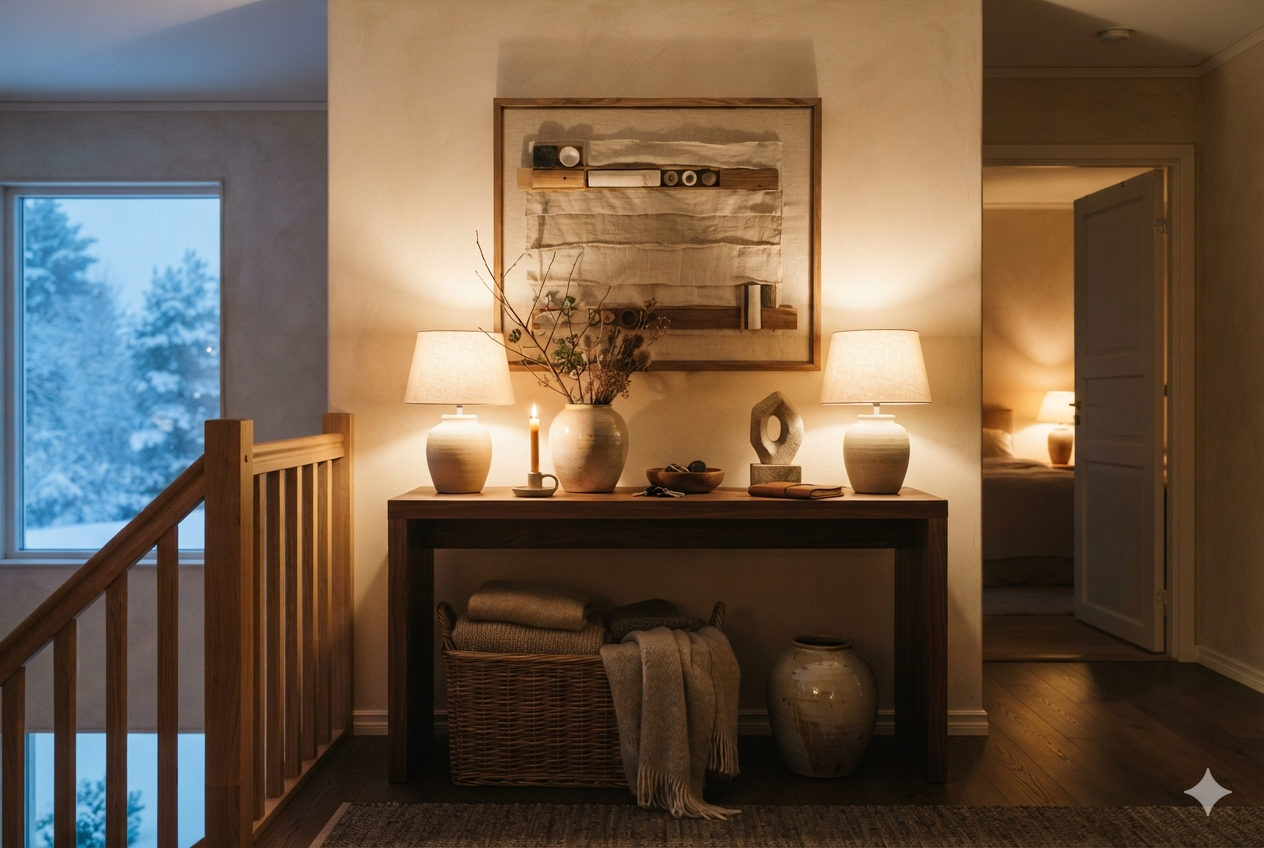
Some of the wool blankets have found their way back into the wicker basket after another weekend of being borrowed from room to room.
I straighten the leather notebook Henrik left on the walnut console, trim the little beeswax candle, and replace a couple of olive stems in the ceramic vase.
It is only a minute or two of tidying. I feel a sense of calm wash over me as I touch each piece.
Above the console hangs my favourite piece in the house.
Astrid found it years ago at a Scandinavian craft fair and insisted I come back with her before it sold. It isn’t a painting in the usual sense.
Layers of natural linen are stretched over a simple oak frame, with handmade ceramic pieces worked into the composition. Nothing about it shouts for attention, yet everyone who comes upstairs seems to stop and look at it.
Perhaps that’s because everything in and around it is made from something that once lived, grew, or was shaped by a human hand. Solid walnut. Wicker. Linen. Stone. Clay. Wool. Materials that don’t hide what they are.
As I stand there for a moment before turning out the lamps for the night, I find myself wondering why these ordinary things make our home feel so settled and welcoming.
Could it be the hygge natural materials that make this landing so endearing? And the answer is a resounding yes! They don’t simply decorate a house. They make it feel alive.
Browse Stoneware, Ceramics, etc. →
Natural Materials Age Well
My friend Astrid has a wooden bowl on her own counter that belonged to her grandmother and is still in daily use. When I asked if she’d ever consider a nicer one, she looked offended.
“This one is my arv,” she said — the Danish word for inheritance, or legacy. “Why would I trade my arv for a new one?”
Danish design carries a long-standing tradition of buying once and buying well, so that the item can eventually become somebody’s heirloom — an armchair, a writing table, a leather jacket.
Of course, natural materials capable of aging – wood that gains character instead of just scuffing, leather that softens instead of cracking – work the best. [→ The Complete Guide to Hygge Home Decor]
Why We Crave Natural Materials?
I assumed for years that I just preferred the look of wood and wool to plastic and synthetic — a style thing, nothing more. But the curious me wondered if there was more to it than just a preference.
Seems there is. Biologist E.O. Wilson proposed what’s called the biophilia hypothesis: humans evolved surrounded by natural materials; hence, they have an innate, genetic predisposition to connect with nature and other forms of life.
Want to know more? Check out The Science Behind Biophilia by Biophilic Innovations.
The biophilia hypothesis and hygge overlap significantly because both rely on the natural world to create emotional safety and psychological comfort. While biophilia explains the “why”, hygge provides a cultural “how-to”.
In fact, surrounding yourself with hygge natural materials—such as clay mugs and sheepskin throws—helps lower stress and fosters a sense of grounded calm.
At the same time, by filling our homes with these raw elements, we are not just decorating; we are answering an ancient, biological call to be one with the earth.
Sustainable Hygge Decor: The Environmental Benefit
True hygge is inherently tied to respecting the natural world, making sustainable hygge decor a core pillar of the philosophy.
- Longevity Over Trends: Natural materials like solid wood and high-quality linen are built to last decades, not seasons. This reduces waste and the need for constant replacement.
- Non-Toxic Living: Organic materials don’t off-gas harmful VOCs (volatile organic compounds) like synthetic plastics and polyurethanes do, ensuring your indoor air quality remains pure and safe.
- Biodegradability: When natural textiles like cotton, wool, or jute finally reach the end of their lifecycle, they return to the earth naturally, unlike petroleum-based synthetics.
My Two Rules Regarding Hygge Natural Materials
Buy Natural Materials, Even When They Cost More
I always look for natural materials, rather than synthetic ones, whenever I need to buy new furniture, furnishings, or clothing.
I wanted to buy a study table for Freya. Ultimately, I bought one made from oak. It is smaller and more expensive than the plastic one I had seen online. But then it is timeless, warm, and will age well. “Arv” for sure!
Henrik’s birthday was coming up, and I wanted to buy him a pair of loafers he would love to wear. I searched online, and saw some; bulletproof against rain, but cold, stiff, and entirely devoid of soul.
That wasn’t Henrik. He didn’t belong in mass-produced plastic; he deserved something that felt human, grounded, and easy to wear.
I picked up unlined chocolate suede loafers instead, from the local artisan store. I overshot my budget, but the moment I touched the velvety, breathable leather, I knew it was what Henrik would want.
Mix the Materials, Don’t Match Them
Wood, wicker, stone, and ceramic don’t need to come from the same collection to belong—they just need to be authentic.
The cast-iron pot on the stove, the wicker basket, and the reclaimed side table share an honesty about what they are made of, not a shared finish. [→ The Hygge Kitchen]
By mimicking natural ecosystems, this textured variety satisfies our biological craving for sensory richness (biophilia), which actively lowers stress.
Culturally, mixing authentic elements fosters hjemlig — the deep, cozy sense of homeliness core to hygge. It rejects showroom perfection for a relaxed environment where nothing is too precious to touch.
Hygge natural materials celebrate craftsmanship, carrying unique imperfections that tell a story. Practically, an eclectic mix is incredibly forgiving; a new scratch or patina doesn’t ruin the room—it adds character.
Natural materials age gracefully, becoming more beautiful through years of daily use.
The Complete Guide to Choosing Natural Materials
To create an authentic Scandinavian aesthetic, prioritize hygge natural materials like untreated oak, chunky wool, and brushed linen. Here’s the complete picture — what ages well, what to avoid, and how to care for heirloom pieces.
Wood
1. Solid Wood Ages Better Than Veneer.
A veneer looks identical to solid wood to begin with, but it can never age as well. It can’t be sanded, refinished, or repaired the way solid wood can.
Pay for solid wood where hands and light will touch it; veneer is fine, hidden inside a cabinet.
2. Let Marks Stay Marks.
A water ring or a light scratch on a real wood table isn’t damage to sand out immediately.
Left alone, most of it becomes part of the surface’s character within a year or two — the same way a favorite cutting board looks better scarred than pristine.
Wicker, Rattan, and Woven Fiber
3. Choose Wicker for Storing Textiles.
A blanket basket, a laundry hamper, a low-shelf basket — wicker breathes, plastic bins don’t. This matters more than it seems, storing damp towels or wool that needs to air out.
Elise would pick
KOUBOO Round Rattan Storage Basket
A woven natural basket is a classic hygge storage piece. This one is listed as handwoven rattan in gray-brown, with handles, and I would pick it for holding throws and blankets by a sofa.
See itAffiliate link. As an Amazon Associate I earn from qualifying purchases.
4. Expect the Color to Shift.
Natural wicker and rattan silver slightly with age and sun exposure. That’s not fading in the sense of ruining it — it’s similar to the way linen looks better after its first dozen washes than it does straight off the shelf.
Stone and Ceramic
5. Handmade Ceramic Over Perfectly Uniform Sets.
A slightly uneven glaze or a rim that isn’t perfectly round is proof that human hands, not a machine, made it. Cherish it, especially in this age of automation, robots, and AI.
Elise would pick
Stoneware Dinnerware Set for 4
Every piece differs in color, since this stoneware set for four is listed with a reactive glaze. I would pick it for a table that welcomes imperfection, which suits hygge better than a matching set.
See itAffiliate link. As an Amazon Associate I earn from qualifying purchases.
6. Stone Coasters and Trivets, Not Cork.
Slate or marble coasters and trivets handle cold and heat much better than cork. They age by developing a soft patina rather than warping, which cork eventually does under a hot pan.
7. A Chip Is Not a Reason to Replace It.
Unless it’s sharp enough to cut a lip, a small chip in a mug or bowl is a detail, not a defect. Some of the most-used pieces in this kitchen have at least one.
Leather and Hide
8. Go for Full-Grain Leather.
Full-grain leather develops a genuine patina — a deepening, softening color that bonded or “genuine” leather never can.
Real leather sure costs more up front, but it pays for itself when you spread the investment over its life. The look and feel are a bonus.
9. Condition It Twice a Year, Not Twice a Week.
A light leather conditioner in spring and fall keeps it supple. Treating it too often only results in a greasy, overdone. Twice a year is really enough.
Care and Patina
10. Oil Wood Surfaces Once a Season.
A food-safe mineral or beeswax oil, rubbed in with a cloth a few times a year, keeps wood from drying out and cracking without ever making it look freshly varnished.
Elise would pick
Tried & True Original Wood Finish
Described as a linseed oil and beeswax wood finish. For a wooden table, shelf or bench, I would pick a simple oil-and-wax finish, which suits the natural, lived-in wood a hygge home leans on.
See itAffiliate link. As an Amazon Associate I earn from qualifying purchases.
It is perfect for all your woodwork projects. It claims to be long-lasting and food-safe.
11. Never Hide Real Wood Under Plastic Covers.
A plastic tablecloth over a well-made wood table is, honestly speaking, an insult to the table and the human being who made it.
If you’re worried about spills, a linen runner does the job while letting the surface breathe. You also succeeded in mixing up textures, a desirable element of hygge decor.
12. Repair Before You Replace.
A wobbly chair leg, a re-glued handle, a cracked bowl fixed rather than binned — repair is not only cheaper, it brings a good piece closer to becoming an heirloom.
The Best Natural Materials for a Cozy Home
If you are curating your space, this checklist of the best natural materials for cozy home environments will ensure you are hitting the right sensory notes:
- Solid Wood (Oak, Walnut, Pine): Provides structural warmth and beautiful, unique grain patterns that age gracefully.
- Linen & Cotton: Offers breathable, relaxed texture for bedding and curtains, softening beautifully over time.
- Wool & Alpaca: Delivers unparalleled tactile warmth and acoustic dampening, making rooms feel quieter and cozier.
- Stone & Terracotta: Adds an earthy, cooling contrast that grounds lighter textiles and wood tones.
- Beeswax: The ultimate hygge material for lighting. Unlike paraffin, pure beeswax candles burn cleanly and emit a subtle, natural honey scent.
FAQ About Home Decor
What are some current interior design styles?
Current interiors include quiet luxury, New Traditionalism, organic design, vintage-modern rooms, and warm minimalism. Common threads include natural materials, layered textures, richer colors, vintage pieces, and spaces that feel personal rather than overly coordinated.
What will be the next home decor trend?
Rather than one dominant trend, the next wave of home decor is likely to favor personalization, natural materials, craftsmanship, vintage and antique pieces, richer colors, and layered interiors. Longevity, repairability, and lower-impact materials are also gaining attention.
What is eco-friendly home decor?
Eco-friendly home decor reduces environmental impact across a product’s life cycle. Practical choices include buying less, choosing durable and responsibly sourced materials, buying secondhand, reusing pieces, and selecting products designed for repair or recycling.
The Home Grows More Beautiful With Time
Before I head downstairs, I turn off the lamps one by one.
The landing grows quieter with each pool of light that disappears. Tomorrow morning, the blankets will leave the basket again. Life will carry on, exactly as it should.
Natural materials aren’t meant to stay perfect. Wood develops a richer patina. Linen relaxes. Wool becomes softer. Handmade ceramics gain character through years of daily use. [→ The Complete Guide to Hygge Home Decor]
A showroom stays beautiful because nobody lives there. A hygge home becomes beautiful because people do.
That’s the difference. And to me, that’s what makes a house feel like home.
Light a candle. Slow down. Hygge.
— Elise