How to Create a Cozy Reading Nook This Winter: The Ultimate Hygge-Inspired Guide
Maja claimed the window seat in her room as her reading nook, way back in June. She placed a flat cushion that didn’t quite fit. Books kept sliding off the sill onto the floor because there was no shelf.
This built-in window seat did not even have its own light bulb to read once the sun went down. No wonder it was hardly used all summer. Lofty intentions, poor execution.
But then I can’t blame Maja; she is a child after all. The fault was completely mine. I had not given any thought to this project.
So I did what I almost always do when faced with a home decor project: I asked my Danish friend Astrid for help.
She came by two evenings later, studied the sorry little window seat for a long moment before asking what my plan was for that space.
“Build a hyggekrog, for Maja,” I said.
“At her age, Maja does not need a hyggekrog — a cozy nook to sit down, relax, have a hot drink and feel content. She needs a reading nook,” she replied.
“A reading nook matters more in winter, you know, than it does in summer,” she continued. “In June, Maja should be outdoors — the yard, the park, anywhere with lots of sunshine. Come October, she needs a reading nook.”
That partially explained why Maja’s reading nook had failed all summer. And why it could really work now. And, with Astrid’s help, it did.
Whether you call it a reading nook, a cozy book nook, or just your favorite little book corner, this guide walks through everything Astrid talked me through that evening.
Also everything I learned building it afterward — real measurements, real mistakes, and the little tips and tricks to make it cozy in winter.
This website participates in the Amazon Associates program. As an Amazon Associate, I earn from qualifying purchases. It also participates in the Impact and AWIN affiliate programs. If you buy through links on this site, I may earn a small commission at no extra cost to you. Thank you for supporting The Hugged Home.
What Makes a Reading Nook Different From a Hyggekrog
My hyggekrog is where I sit before anyone else wakes up. It’s where I have my coffee. It’s where I read. It’s where I often nap. [→ What is a Hyggekrog?] Henrik’s is the cream armchair by the living room window.
A hyggekrog can be any chair, anywhere, the moment you decide it’s yours — and technically, it doesn’t even need to be a chair. Everyone else just knows it. Nobody will encroach on your hyggekrog.
In Denmark, a hyggekrog can even be a seat on the porch swing in summer, where you could sit, knit, or watch the birds go about their lives. Basically, it is the place you reach for when you need deep relaxation and contentment.
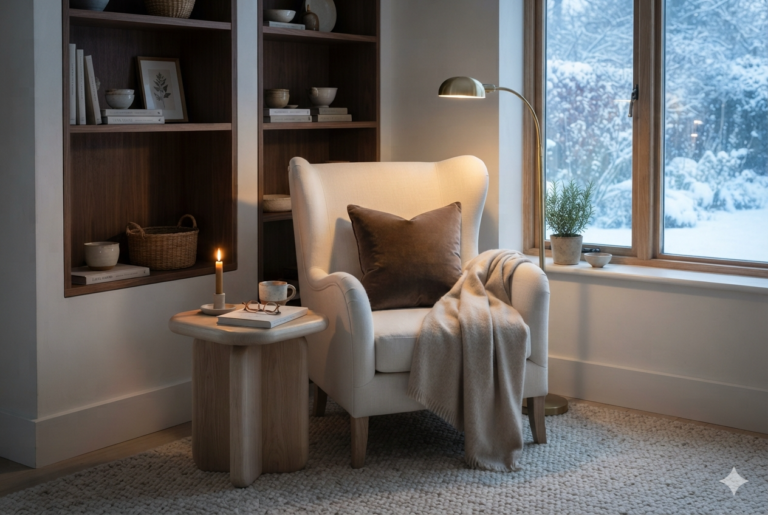
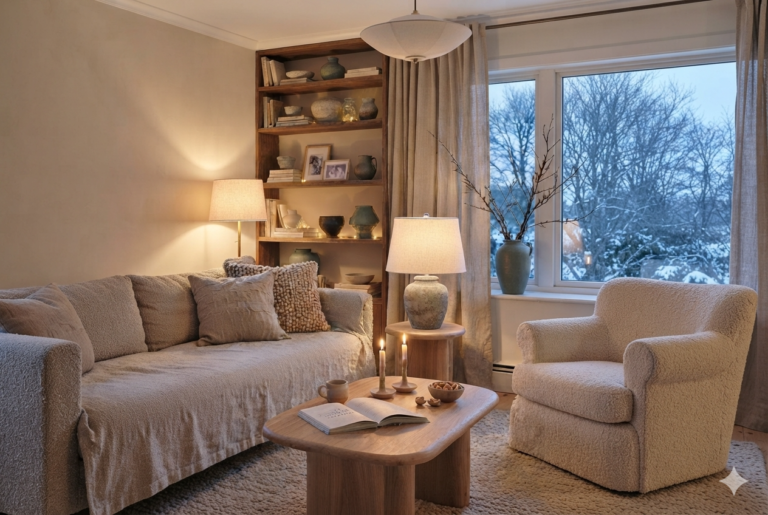
A hyggekrog needs a wall behind it, so it is facing outward toward the rest of the room or garden. It should make you feel safe and protected. Add warm lighting, a snug throw, a side table to keep your coffee mug, and you have your hyggekrog.
A reading nook, on the other hand, has a very specific function. It is the place to read. Naturally, you need task lighting and a shelf or basket to keep books.
Typically narrower — an actual built or semi-built space carved out of architecture that would otherwise go to waste: a window seat, a bay window bench, the awkward triangle under a staircase.
If you’ve got dead space anywhere in the house, building a reading nook there can be transformative. That dead space could actually become one of the coziest spots in the house.
How to Choose the Right Spot for Your Reading Nook
Most reading nook roundups treat window seats, bay windows, and under-stair corners as interchangeable. They’re not, and picking the wrong one for your house is a sure way to end up with a reading nook nobody ever curls up in.
A standard window seat works anywhere you have a single window with at least 24 inches of sill depth and a flat wall on either side — the easiest reading nook to build if you’re retrofitting rather than starting from scratch.
A bay window is the upgrade version — the recessed, three-sided shape does half the enclosing work a reading nook needs on its own. Bay window reading nooks feel instantly cozy.
Under-stair space is the odd one out — no window, often a lower ceiling on one side, but frequently unclaimed footprint in the house. Storage or reading nook are really the only two viable uses of the space.
If your house has more than one option, the bay window wins on coziness, the plain window seat wins on ease, and the space under the stairs wins on sheer capacity.
Building a Winter-Ready Cozy Reading Nook
Aim to create a cocoon of warmth and comfort. Here are the essential elements:
1. Strategic Insulation
- Thermal Window Treatments: Make sure to install thick, floor-length velvet or thermal-insulated curtains to trap cold glass drafts, if not already installed.
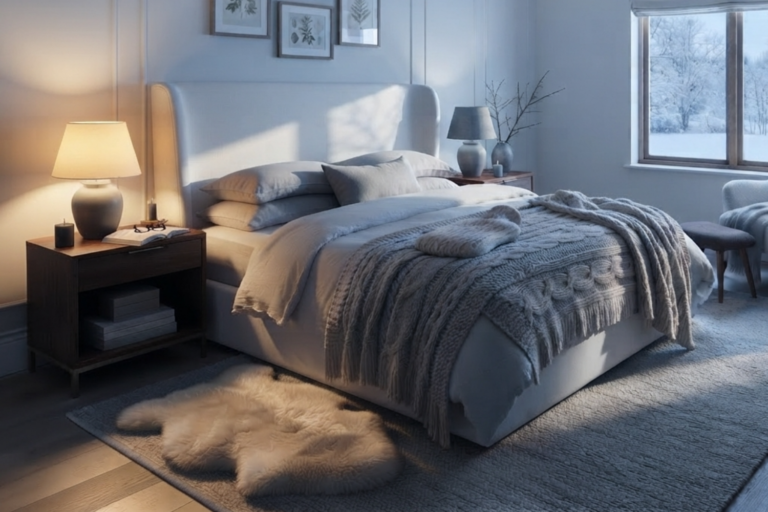
- Plush Floor Barriers: Lay a high-pile shag or sheepskin rug over a thick felt pad to insulate your feet from freezing floors.
- Wall Lining: Position full bookcases against exterior-facing walls to act as a natural structural barrier against cold transfer.
2. Oversized Deep Seating
- Enveloping Shapes: Choose a high-backed “barrel chair”, chaise lounge, or deep armchair (minimum 45–50 inches wide and deep).
- Room to Curl: Ensure the frame is wide enough to let you tuck your feet up and shift positions easily.
- Dense Core Support: Opt for memory foam or down-wrapped foam cushions that retain your natural body heat.
3. Heavy Tactile Layering
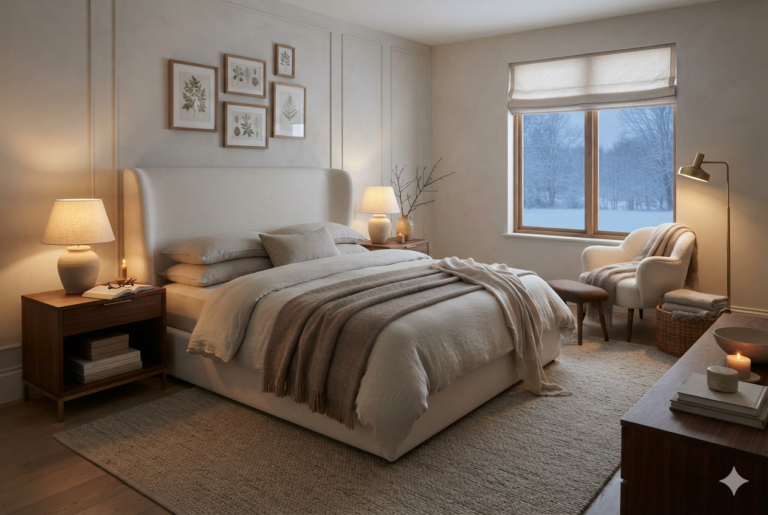
- Thermal Blankets: Stack multiple throws made from high-gsm wool, cashmere, chunky cable-knit cotton, or faux fur.
- Lumbar Pillows: Add plush, feather-filled accent cushions dressed in corduroy, boucle, or flannel covers for adjustable structural support.
- Draft Blockers: Keep a weighted fabric draft-stopper at the base of nearby doors or low windowsills.
4. Warm-Spectrum Lighting
- Amber Bulbs: Avoid harsh white lights; use LED bulbs rated at a warm 2200K–2700K color temperature. My favorite brand is Philips.
- Dual-Source Lighting: Combine an adjustable, directional floor lamp for reading task light with soft, ambient string lights or faux candles for a golden-hour glow.
- Flickering Accents: Consider including safe, battery-operated LED pillars to mimic the hypnotic, relaxing visual warmth of a real fireplace. [→ The Complete Guide to Layered Lighting]
5. Convenient Reach Surfaces
- Low Side Table: Anchor the space with a small wooden stool or C-table to hold steaming mugs of tea or coffee.
- In-Reach Storage: Use low shelves or a woven basket to access your reading queue without stepping away into the cold room.
- Aromatherapy Anchor: Place a wood-wick scented candle (with notes of amber, pine, or cinnamon) to engage the senses and boost feelings of contentment. A diffuser is certainly a great idea!
6. Color Scheme
This is not an essential, more of a design feature and a matter of personal choice. You really have three options here:
- The Accent Approach: Painting the nook a different color from the rest of the room makes it feel like a unique, dedicated space. In my opinion, this approach is not consistent with the concept of a hygge home.
- The Integrated Approach: Using colors that connect with the surrounding room ensures the nook feels like part of the original architecture rather than an afterthought. Perfect for a window seat reading nook in a child’s bedroom.
- The Elevated Approach: Painting a reading nook or its trim a shade or two deeper than the surrounding room adds immediate “depth and dimension” without making the space feel disconnected. This works well for bay window or under-the-staircase reading nooks. [→ Warm Winter Color Palette Ideas]
Here are three very popular cozy reading nook ideas, and how to actually build and furnish them.
Window Seat Reading Nook
A window seat has always felt a little magical to me, especially in a child’s bedroom. It lets you be part of the world outside while staying wrapped in warmth inside.
On snowy afternoons, there’s something comforting about watching flakes drift past the glass with a book in your lap and a blanket pulled over your knees.
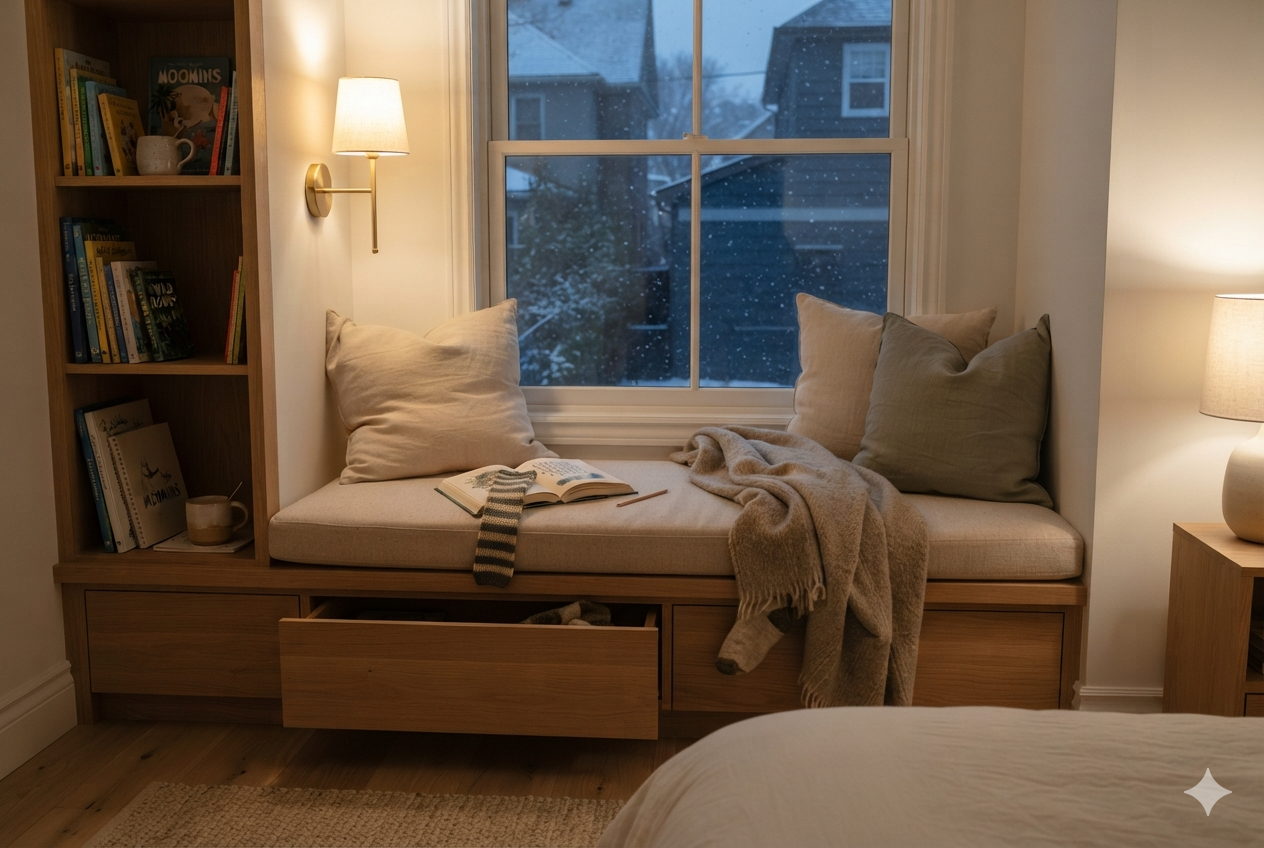
In Maja’s room, I’d make the seat deep enough to curl up comfortably, with a soft linen cushion, a wool throw, and a few oversized pillows for leaning against the wall.
Drawers beneath the bench are perfect for hiding extra blankets, favorite books, puzzles, or stuffed animals, keeping the room calm without taking up more floor space.
A small shelf beside the seat gives her a place for the book she’s reading, while a warm 2700K wall sconce turns the nook into an evening retreat long after daylight fades.
Keep the window treatment light so winter skies, spring rain, and autumn leaves remain part of the experience.
Children don’t remember every piece of furniture in their room. They remember the places where they loved to linger. A window seat has every chance of becoming one of those places.
Bay Window Reading Nook
A bay window reading nook already has a sense of being gently tucked away: something most cozy corners have to create. Surrounded by windows on three sides, it feels like its own little room while still being part of the main room.
The natural light is the real luxury here. It changes from morning to evening, making the nook just as inviting for a quiet cup of tea as it is for an afternoon with a good book.
A built-in bench with hidden storage below keeps blankets, books, and seasonal cushions close at hand without adding clutter.
The temptation is to dress the windows too heavily, but that’s the one thing I’d resist. Thick curtains hide the very feature that makes a bay window special.
A simple woven shade, or no window treatment at all where privacy allows, lets the changing light become part of the experience.
Finish the seat with a linen cushion, a wool throw, and one warm 2700K reading lamp for evenings. When daylight fades, the gentle glow takes over, and the nook becomes just as welcoming after sunset as it was in the afternoon.
Reading Nook Under the Staircase
A reading nook under the staircase solves a problem most homes have: what to do with that awkward space beneath the stairs.
It can quickly become the place where shoes, bags, and forgotten boxes end up. Instead of an unsightly mess, why not make it the coziest seat in the house?
The secret is working with the slope instead of fighting it. Place the bench at the tallest end, where you can sit comfortably with a book, and let the lower section become built-in shelving or hidden storage.
Those triangular spaces are surprisingly good at holding books, baskets, and blankets.
Because these nooks rarely have a window, lighting matters even more. A warm 2700K wall sconce mounted beside the seat creates a gentle pool of light without the harshness of an overhead fixture.
Add a soft cushion, a wool throw, and a small basket for your current reads, and the space begins to feel less like leftover architecture and more like a quiet retreat.
Cozy Reading Nook Ideas: What to Skip
- Skip the flat, off-the-shelf cushion — a reading nook that doesn’t match its own seat depth never quite gets used, no matter how good it looks in a photo.
- Skip overhead lighting entirely — a single warm lamp or sconce, positioned at shoulder height, is what makes a reading nook cozy and welcoming.
- Skip filling the space with decorative pillows that never move — the same rule as any hygge textile: if it’s too perfectly arranged, it won’t get used.
- Skip building one before checking clearance — leave at least three feet of walking space in front of any built-in bench, especially on a staircase landing, or the reading nook becomes an obstacle instead of a retreat.
- Skip treating it as a one-season project — a reading nook built only for summer light gets abandoned when days get shorter. Build the reading nook with a “winter-ready” mindset.
What Actually Happened to Maja’s Reading Nook
By the time Henrik and I finished, Maja’s reading nook looked surprisingly simple. We hadn’t built anything extraordinary.
We had added a better cushion, a proper reading light, a small shelf within easy reach, and a wool throw she now disappears under most evenings.
The biggest change wasn’t the furniture. It was how the space was used.
When the afternoons grew shorter, and the first cold rain arrived, Maja naturally drifted toward that little cozy book corner by the window. Sometimes she reads for an hour. Sometimes only ten minutes before bed.
Sometimes she simply watches the wind move through the trees with a book lying open beside her.
Astrid was right. Summer asks children to run outside. Winter invites them to slow down.
Whether your reading nook is a window seat, a bay window, or space beneath the stairs, it doesn’t have to be large or expensive. It only needs to feel inviting enough that opening a book becomes more desirable than reaching for your phone or laptop.
If this little corner becomes the place your family returns to all winter long, it has done what it was meant to do.
Every room in this house tries to do one job well. See what that looks like for other rooms and spaces. I’ve mapped it all out here. [→ The Complete Guide to Hygge Home Decor]
Light a candle. Slow down. Hygge.
— Elise