
Winter Laundry Routine: Caring for the Soft Furnishings That Keep You Warm
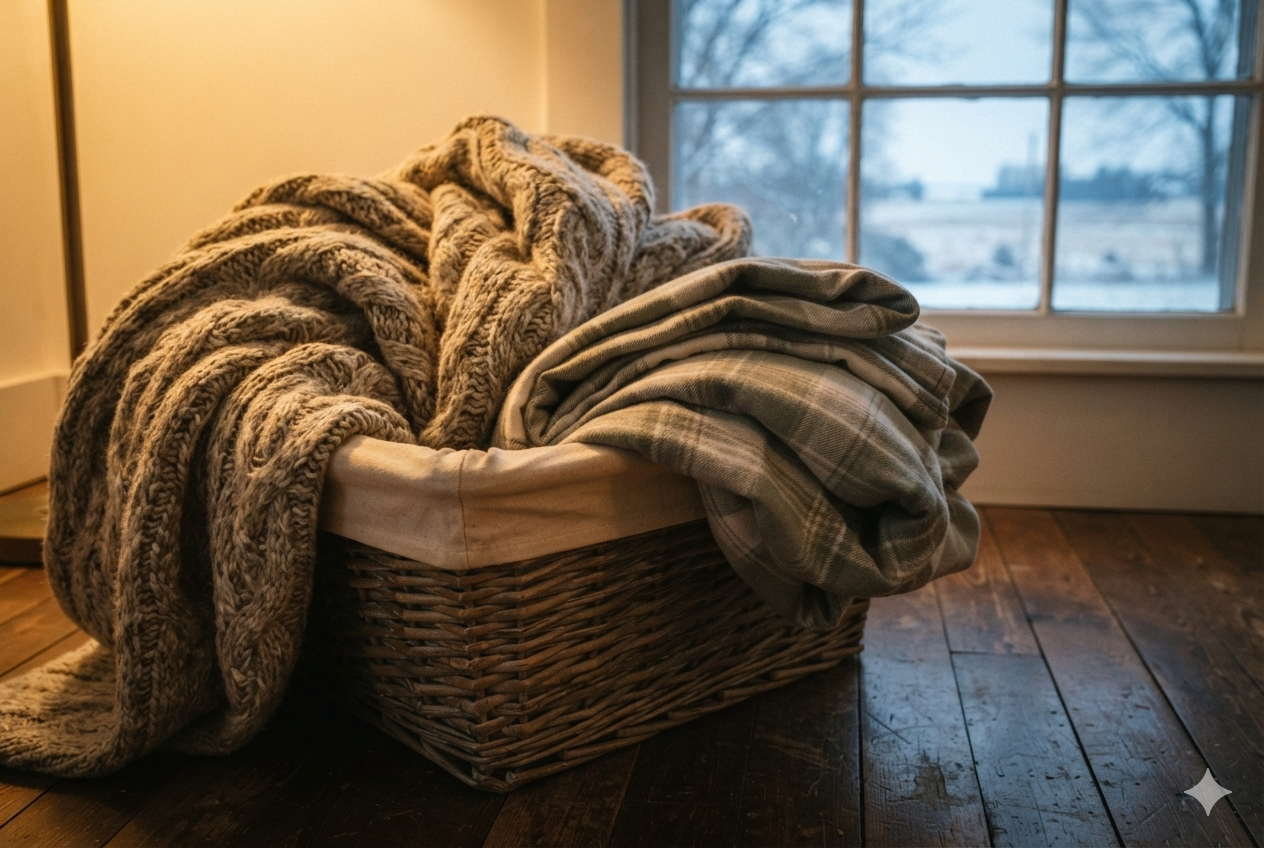
Sunday morning, late January. Ten degrees outside, and the frost is thick on the windowpanes. The laundry basket in the hallway isn’t full of T-shirts and gym socks. It is full of soft furnishings.
The heavy flannel sheets from the girls’ beds, the chunky knit throw from the living room sofa, the thick winter duvet. It takes two hands just to lift the basket off the floor.
Summer laundry is about sweat and frequency. Winter bedding care is about sheer, heavy mass of soft furnishings.
When you wash a heavy wool blanket or a thick down duvet, you aren’t just cleaning a surface. You are handling the physical architecture that stands between your family and the intense cold.
Treat it like a summer T-shirt, and you will crush the very fibers keeping you warm.
The basket weighs a season. Here is the best advice you will ever get on a winter laundry routine for soft furnishings.
This website participates in the Amazon Associates program. As an Amazon Associate, I earn from qualifying purchases. It also participates in the Impact and AWIN affiliate programs. If you buy through links on this site, I may earn a small commission at no extra cost to you. Thank you for supporting The Hugged Home.
The Science Behind the Winter Laundry Routine
Why Winter Textiles Are Different
Summer laundry is largely about stripping oils and removing stains. Winter laundry is about preserving loft.
Loft is the technical term for the trapped air pockets inside a heavy textile. When you pull a thick wool blanket over your shoulders, it isn’t the wool itself that keeps you warm—it is the still air trapped between the fibers.
Hot water, harsh agitation, and high-heat drying crush those air pockets. They cause fiber fatigue, mat the nap, and flatten the weave. Washing heavy blankets incorrectly destroys their insulation.
The goal of a winter laundry routine isn’t to strip the fabric clean; it is to preserve the loft so the textile can continue to keep you warm.
The Odor Myth
We over-wash our winter layers out of habit. We assume that if something has been used for a month, it must be dirty. But natural fibers do not behave like synthetics.
A study conducted by a sensory panel in New Zealand and published by Woolmark found that wool retains 66% less body odor intensity than polyester, and 28% less than cotton. This is what their website says:
The science behind wool’s odour resistance supports a ‘wear more, wash less’ approach, with research proving that the wool fibre naturally stays fresher for longer.
Wool is hygroscopic; it absorbs moisture vapor away from the skin before it can turn into sweat and breed odor-causing bacteria. Polyester, being hydrophobic, traps sweat and the smell.
When you wash a heavy wool throw every two weeks, you aren’t cleaning it. You are just wearing it out. The fiber earns its rest.
The Scent of Hjemlig
Mainstream laundry culture equates “clean” with heavy synthetic perfumes. We are taught that our homes should smell like “Ocean Breeze” or “Spring Meadow.”
But Harvard Health notes that the olfactory system wires straight to memory. The baseline scent of your home is the olfactory memory your children will carry into adulthood.
A home shouldn’t smell like a chemical plug-in. It should smell like hjemlig—the Danish word for the true, unforced homeliness of a lived-in space. It should smell like cedar, lavender, and clean wool.
Astrid once caught me spraying a synthetic linen mist in the hallway. She held the bottle like it was evidence. “You are trying to mask the house,” she said. “A home should smell like itself.”
9 Winter Laundry Routine Rules for Heavy Wool, Flannel, and Linen
1. Wash less, air more
The most important step in winter bedding care happens outside the washing machine.
On a dry, freezing Sunday, take the heavy wool throws and the duvet out to the porch railing. Let them hang in the frost for two hours. The cold air neutralizes odors, and the UV light kills surface bacteria.
When you bring them back inside, they will smell crisp and reset. Wash only when the textile is actually soiled, not just because it is Sunday.
2. Sort by weight, not just color
In the summer, you sort lights and darks. In the winter, you sort by mass. Heavy blankets need room to agitate and move through the water.
If you cram a heavy wool blanket into the drum with three pairs of jeans, the friction will cause pilling, and the machine’s sensor will misread the load, leaving soap residue trapped in the heavy weave.
Give the heavy textiles the drum to themselves.
3. The cold-water rule applies to everything
Heat is the enemy of winter loft. It shrinks cotton flannel and felts wool. The strict cold-water rule we use for washing flannel sheets without pilling applies to every heavy natural fiber in the house.
Modern detergents are engineered to perform perfectly well in cold water. Let the machine do the work; keep the heat out of the drum.
4. Wool gets the no-rinse treatment
Agitation is what ruins wool. The spinning and draining of a standard rinse cycle causes the keratin scales on the wool fiber to catch, lock, and shrink.
The Fix: We use Eucalan Lavender Fine Fabric Wash for all our heavy winter wools and delicate cashmere. It is a no-rinse formula.
You fill a basin with tepid water, add one teaspoon per gallon, gently squeeze the soap through the fibers, and let it soak for 15 minutes.
Then you gently squeeze out the excess water and lay it flat. No rinsing is required. The lanolin stays exactly where it belongs, and the fiber never suffers the violence of a spin cycle.
5. Beat the heavy duvets, don’t bake them
When you must use the dryer for a heavy winter duvet or thick cotton blankets, never use high heat. High heat bakes the fibers, making them brittle and prone to static cling—a massive problem in a house with dry winter furnace air.
The Fix: Tumble on low, and toss in Friendsheep wool dryer balls. The balls physically beat the heavy duvet as it turns, breaking up the wet clumps and restoring the loft.
They cut drying time in half and leave no waxy film on the natural fibers.
6. Embrace the indoor line-dry
Line drying isn’t just for the backyard in July. During the winter months, the furnace runs constantly, dropping indoor humidity to desert levels.
Setting up a heavy-duty folding drying rack in the spare bedroom and draping damp wool blankets and heavy linens over it acts as a massive, natural humidifier.
The evaporating moisture softens the dry air, and the heavy thwack of wet wool hitting the wooden rack is one of the most satisfying sounds of a Sunday reset.
7. Brush before you wash
Heavy textiles collect dust, pet hair, and surface pills. If you throw a dusty wool blanket directly into the water, the dust turns into mud and works its way deep into the weave.
Take a soft-bristled garment brush or a cashmere comb to the heavy throws before they hit the water. Brushing with the grain lifts the nap, removes the surface debris, and means the washing machine only has to clean the fiber, not the dust.
8. The “Dry Clean Only” bluff
Many heavy winter cushion covers, structured linen drapes, and thick wool cardigans carry a “Dry Clean Only” tag.
Unless the item has a structured lining or heavy interfacing, this tag is usually a legal liability shield, not a physical law.
Unstructured wool and heavy linen can almost always be hand-washed in a basin with tepid water and a gentle detergent.
You save hundreds of dollars a year in dry cleaning chemicals, and the textiles last longer because they aren’t being subjected to harsh perc solvents.
9. The Spring Rest
Eventually, the heavy basket empties. When April arrives, and the heavy winter textiles come off the beds and sofas, they need to rest.
Never store natural fibers in sealed plastic bins; trapped moisture will breed mildew, and the fibers will suffocate.
The Fix: We pack the heavy wools and winter flannels into breathable canvas storage bags with cedar blocks.
The canvas allows the fibers to breathe while keeping out dust and moths. The cedar blocks replace toxic mothballs, ensuring that when you open the bags next November, the heavy textiles smell like a quiet forest, not a chemical cabinet.
The Linen Closet in Spring
It is late April. The radiators have finally stopped ticking. The heavy laundry basket sits empty in the hallway corner.
I open the top shelf of the linen closet to put away the last of the winter flannel. As the door swings open, the scent spills out into the hallway—cedar, dried lavender, and the faint, clean smell of washed wool.
The heavy textiles are resting in their canvas bags, stacked neatly in the dark. They have done their job. They held the warmth, they trapped the air, and they kept the frost at bay for five straight months. Now, they sleep.
The house smells like nothing but itself.
If you are rethinking the materials that anchor your home for the long haul, start with the foundational guide to hygge natural materials.
Light a candle. Slow down. Hygge.
— Elise