
How to Wash Flannel Sheets Without Pilling: The Cold-Water Rule
The first cold snap of November arrived on a Tuesday, and the flannel came out of the hall closet the same evening. I ran my palm across the fitted sheet and felt it before I saw it: little hard knots, like breadcrumbs worked into the cotton.
Freya climbed in, wriggled once, and delivered the verdict from the pillow. “It feels scratchy like a sweater.”
She was right. And I knew why. The previous spring, I had washed the set in hot water and added fabric softener, to be nice. The hot water had stressed the nap. The softener had coated it. The pills were the receipt.
Killed with kindness.
Flannel sheet care is not laundry trivia. It is the difference between a bed that welcomes you and a bed that scratches your ankles.
Here is how to wash flannel sheets so the brushed nap stays alive for a decade of first-touch warmth.
This website participates in the Amazon Associates program. As an Amazon Associate, I earn from qualifying purchases. It also participates in the Impact and AWIN affiliate programs. If you buy through links on this site, I may earn a small commission at no extra cost to you. Thank you for supporting The Hugged Home.
Why Flannel Pills: The Science of Fiber Fatigue
The Brushed Nap: What You Bought
Flannel is ordinary cotton that has been brushed until the short staple fibers stand up. That raised nap is the what flannel is all about.
The raised nap traps a layer of still air between your skin and the sheet, which is why flannel feels warm the when you slide in, while linen steals your heat for the first thirty seconds.
The physics of that first touch is covered in the linen vs flannel debate. The point here is that everything soft about flannel lives in those standing fibers. Everything that can go wrong lives there too.
Pilling Is Fiber Fatigue, Not Bad Luck
So do flannel sheets pill because they are cheap? Sometimes. But pilling is mostly fiber fatigue, and it has three engines: abrasion, heat, and alkaline detergent.
- In the wash, the raised fibers get rubbed against zippers, towels, and each other.
- Hot water softens and shrinks the cotton, stressing the weave.
- A heavy dose of harsh detergent makes the fibers brittle.
Snapped short fibers then tangle around the surviving ones, rolling into the little knots Freya complained about.
A pill is not a flaw in the fabric. It is about flannel sheet care and a record of how the fabric was washed.
The Softener Trap
Fabric softener on flannel is the most honest mistake, and the most expensive. Softener works by coating fibers in a thin waxy film.
On flannel, that film glues the nap down, traps detergent residue and odor, and kills the moisture-wicking that keeps a sleeper dry.
Then consider where the fabric lives. Brushed cotton presses against your skin for eight hours each night.
The American Academy of Dermatology recommends washing bedding in fragrance-free, dye-free detergent for exactly this reason — residue on fabric is a known irritant for sensitive skin.
A waxed, perfumed film against a child’s cheek all night is not comfort. It is chemistry.
Astrid sniffed the softener bottle on the dryer once, and set it down like it owed her money. “Fabric softener is a lyseslukker,” she said. “It snuffs out the very thing you bought the flannel for.”
How to Wash Flannel Sheets Without Pilling: The 9-Step Cold-Water Routine
The whole rule in one breath: cold water, inside out, gentle cycle, half the detergent, no softener.
And before the steps, the reasons for cold, because they matter more than the steps. Hot water shrinks cotton and stresses the brushed nap. Heat sets stains and fades dye.
Modern detergent enzymes are engineered to perform in cold water. And the American Cleaning Institute notes that a household switching to cold-water washing saves roughly two hundred dollars a year in energy.
Cold water is kinder to the fiber, the skin, and the utility bill. There is no argument for hot.
1. The first wash: alone, inside out, with vinegar
Washing flannel sheets the first time sets the tone for their whole life. Wash the set alone, turned inside out, in cold water, with half a cup of white vinegar in the rinse.
The vinegar relaxes the fibers, helps set the dye, and rinses out mill residue. It is the softener you are allowed to use.
2. Every wash after: cold, gentle, inside out
Cold water, gentle cycle, inside out, every single time. Inside out means the nap rubs against itself less and sheds its loose fibers into the rinse instead of into knots.
On rhythm: sheets should be washed at least every two weeks, more often if someone sleeps hot or brings a cat into bed. Björn does not count as a clean sleeper.
3. Give it room
Wash flannel separately from the rough citizens of the laundry: jeans, zippers, towels, velcro, the dog’s bed cover.
Load the drum half full so the sheets can move. Abrasion is the engine of pilling, and a crowded drum is just abrasion with a spin cycle.
4. Half the detergent, mild and fragrance-free
Use a mild detergent for flannel, fragrance-free and dye-free, and use half the dose you think you need.
Excess detergent does not rinse out; it stays in the nap as residue, and residue is both a pill magnet and a skin irritant. More suds has never meant more clean.
5. Never softener, never dryer sheets
This is the lyseslukker rule, repeated because it is the one people break. No liquid softener in the washer, no dryer sheets in the dryer.
The wax film is the enemy of the nap, the wick, and the skin. If the sheets feel stiff after washing, the problem is residue, and the fix is vinegar, not perfume.
6. Wool dryer balls instead
Wool dryer balls do the softener’s real job mechanically. They lift the load so warm air moves, they soften the fabric by beating it gently for forty minutes, and they cut drying time.
They leave nothing behind. The flannel comes out soft because it is soft, not because it is coated.
I mostly get Friendsheep Wool Dryer Balls. They are a bit more expensive than others on Amazon, but the girls love them. So, there you go!
7. Low tumble, pull slightly damp
Tumble dry low, and pull the set out still slightly damp. Overdrying is heat damage wearing a different hat; it is what makes flannel brittle by the second winter.
Finish the last of the drying on the line or flat on the bed, then shake the nap back up with your hands.
In our house, the flannel is the base layer under the wool duvet, the same layering answer as the Scandinavian sleep method, so it earns the careful drying.
8. De-pill, don’t discard
A pilled set is not a dead set. Once a season, lay the sheets flat and run a fabric shaver over the worst of it, and the nap comes back smooth.
We use the Electrolux Rechargeable Fabric Shaver because its adjustable height settings let you safely shave the heavy, raised nap of flannel without cutting into the actual weave.
Removing pills from flannel sheets takes ten minutes and keeps a good set out of the landfill for years. Practice over purchase applies to bedding too.
9. Store it breathing
When spring takes the flannel off the bed, store it breathing. Fold it dry, wrap it in a cotton bag or an old pillowcase, and tuck cedar or lavender in the fold.
Never sealed plastic; trapped cotton needs air, and plastic is how a set comes out in November smelling like a storage bin. Stored well, it returns to the bed exactly as soft as it left.
The Warm Fold
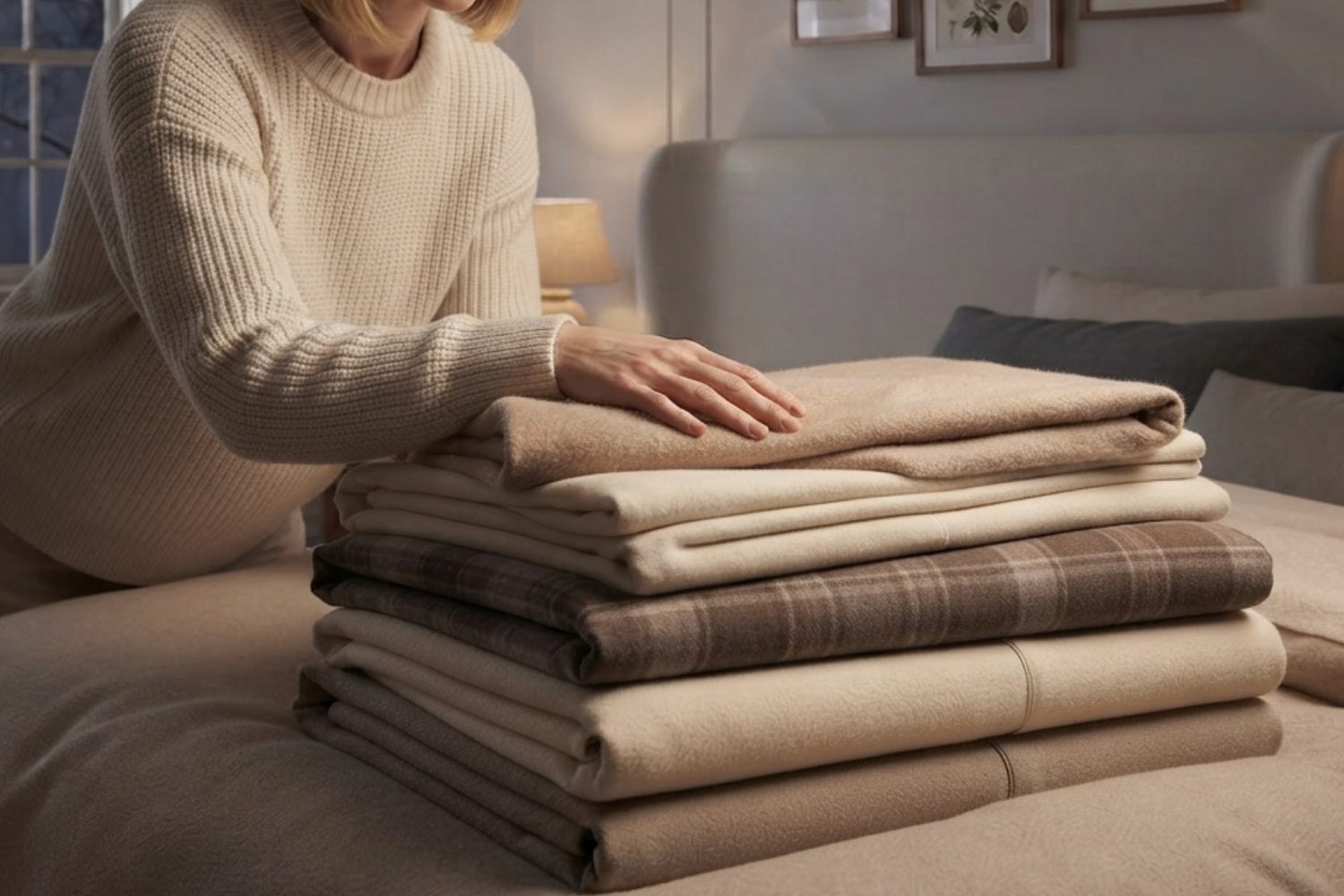
Sunday evening, the dryer buzzed at six. I pulled the set out still warm, the way flannel should come out, and folded it on the bed while a single candle burned on the dresser.
The nap rose under my palm like frost on a window. No knots. No wax. Just cotton, standing up, ready to trap its little layer of air.
Freya’s bed got made first, good side up. She climbed in, sank to the bottom of the wriggle, and her shoulders dropped an inch. She said nothing. That is the review.
When a set finally gives out after a decade of cold-water washes, we replace it with the Tribeca Living Triple-Brushed Cotton Flannel Sheet Set.
It has the heavyweight GSM that actually holds up to this strict routine, and it arrives soft enough to use on the very first night without the scratchy break-in period.
For the rest of the cold-sleeper setup — the layering, the feet, the room itself — start with why your feet are cold in bed, then build the whole retreat in the hygge bedroom guide.
Light a candle. Slow down. Hygge.
— Elise