Sheepskin Rug Care: Why Yours Flattens, Smells, and How to Bring It Back
It was 6:15 a.m. on a Sunday in deep January, and my first two steps told me the whole story. Step one: hardwood, cold as a well. Step two: the bedside sheepskin, still holding a little of last night’s warmth.
Except lately, step two hasn’t felt like much. The wool is matted in two flat ovals — the exact spots my heels land every morning — and brushing it with my hand makes no difference.
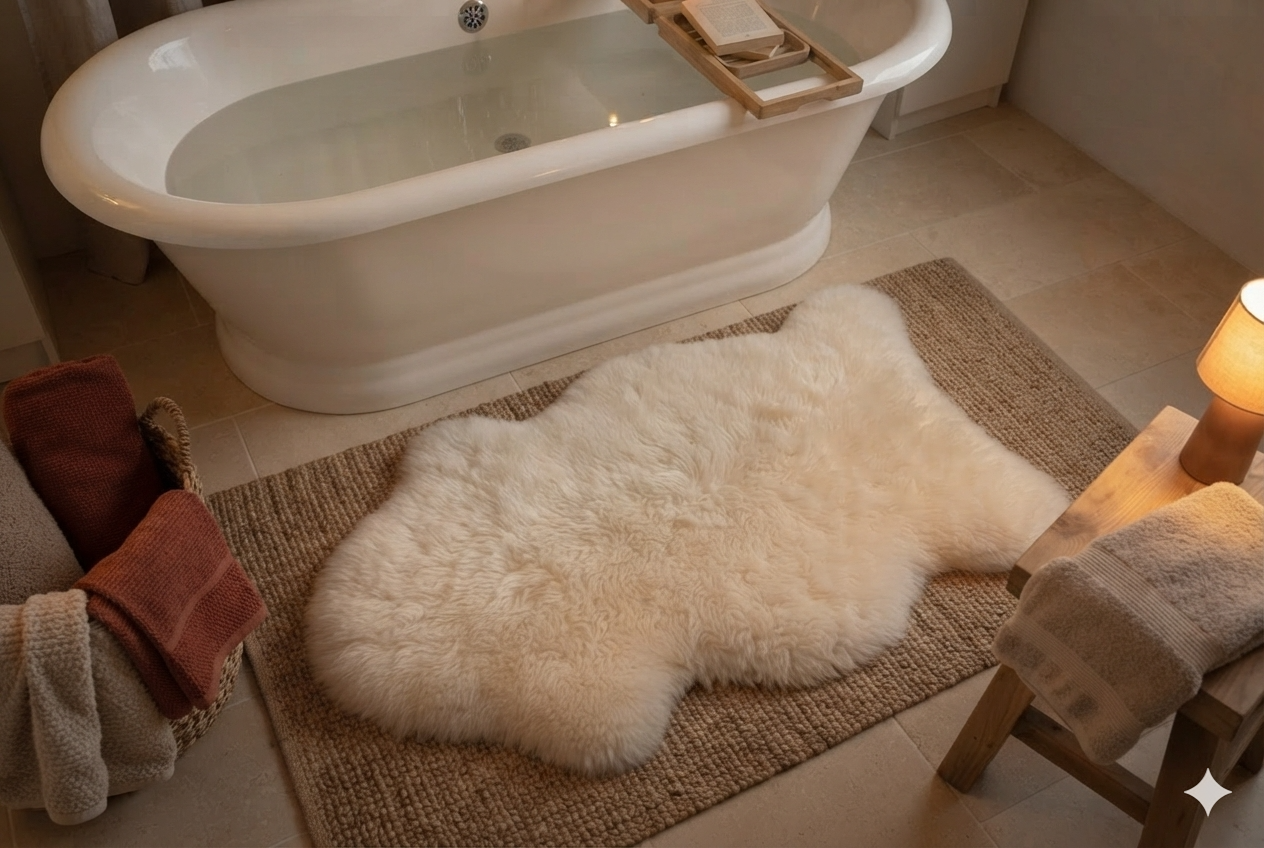
Down the hall, the bathroom sheepskin is also losing its long fight with damp towels. And the sheepskin rug in the home office has been annexed by Björn, who has flattened it into a cat-sized crater.
Three sheepskins, three kinds of damage, one fiber.
This website participates in the Amazon Associates program. As an Amazon Associate, I earn from qualifying purchases. It also participates in the Impact and AWIN affiliate programs. If you buy through links on this site, I may earn a small commission at no extra cost to you. Thank you for supporting The Hugged Home.
If you are interested in buying one, I suggest the Woolous Genuine Sheepskin Rug, 2×3 ft, Natural Lambskin. It’s a single pelt, soft and fluffy underfoot, and is reasonably priced.
A sheepskin is not a rug you walk past. It is a landing zone — the first soft thing your body touches in the morning and the last one before bed.
Flattening isn’t a defect; it’s the receipt. But the fiber has rules, and most of us break them by accident.
Here is how to clean a sheepskin rug, how to bring the bounce back, and keep it for years.
The Science of the Sheepskin Rug
Every sheepskin problem traces back to two materials pretending to be one product: the wool on top and the leather underneath.
The Scales and the Mat
A wool fiber is not a smooth thread. Under a microscope, it looks like a pinecone — overlapping keratin scales from root to tip.
Walk on the fiber, and the scales rub against each other. Add a little moisture and a little heat, and the scales catch, lock, and refuse to let go.
That is sheepskin felting, and it is permanent. This is why a matted sheepskin never brushes back to brand-new, and why the three enemies — friction, moisture, heat — always travel together.
The Lanolin and the Smell
Wool carries lanolin, the natural oil that waterproofs a sheep. When the hide gets damp — a steamy bathroom, snow melting off a boot — the lanolin wakes up, and the rug smells like what it is: a sheep.
Wool is also hygroscopic; it attracts moisture and odors from the air and holds them. If you have ever typed why does my sheepskin smell into a search bar at midnight, that is the answer.
It is not rot. It is not mold. It is the waterproofing doing its job. Air fixes it. Heat bakes it in.
The Leather Backing
The underside is skin, and skin is collagen. Soak it and dry it fast — over a heating vent, against a radiator — and the collagen tightens into cardboard.
The wool on top can be perfect, and the rug is still ruined, because the hide underneath has quit.
Astrid’s rule, delivered over coffee the last time I complained: “A sheepskin will forgive a spill. It will never forgive a radiator.”
The Spec Sheet: Buying So Care Stays Easy
Most sheepskin rug care disasters are decided at the checkout, not the washing machine. Two lines on the label tell you everything.
Tannage Is the Label That Matters
Tannage refers to the process by which raw hide is transformed into durable leather. That ultimately determines the resilience and longevity of your sheepskin rug.
A medical or washable tannage means the raw hide has been treated to survive a gentle cold wash — this is the washable sheepskin rug, the hospital-grade hide that shrugs off water. This is what you need to buy.
A decorative tannage is spot-clean only; put it in the machine and the leather hardens, cracks, and curls. If the label doesn’t say washable, assume it isn’t.
Pile Length vs. Bounce
Long-hair hides — the dramatic Icelandic pelts — mat faster and brush slower. Short, dense pile, the New Zealand and Australian standard, bounces back under foot traffic and forgives a brush.
For a landing zone, pile density beats drama.
One more line worth reading: dyed or natural. Natural ivory shows every shadow of age; a dyed hide wears its years quietly.
My pick, and the why:
A medical-tanned New Zealand sheepskin for the bedside and the bath — because those two hides will get wet.
The decorative long-hair stays on the reading chair, where Björn’s only contribution is napping.
The Sheepskin Rug Care Guide: Weekly, Monthly, and Annually
Weekly: The Brush
Never run a beater bar over a sheepskin — the spinning brush tears the hide and rips wool at the root.
Suction only, or better still, carry it outside and shake it hard, letting the wind do most of the cleaning.
For the matted ovals, use a wire slicker brush. It’s the same tool you’d groom a golden retriever or Björn with. The brush is a Hertzko Self-Cleaning Slicker — the same one I use for grooming Björn.
Do it in short strokes with the grain. The wires reach past the mat and lift the locked scales apart. All it takes is five minutes, once a week, and the bounce returns.
Monthly: The Air
Hang it outside on a dry, overcast day. The moving air pulls the dampness and the lanolin smell out of the fiber better than any product on a shelf.
Skip the direct sun — UV yellows white wool permanently, and the yellow does not brush out.
Seasonally: The Wash
For washable-tannage hides only.
Here is how to wash a sheepskin rug without ruining the hide: cold water, a wool-specific wash like Eucalan, gentle cycle or a slow hand squeeze.
Never agitate — agitation plus water plus wool is the felting recipe from the science section, with the volume turned up. Squeeze the water out; never wring.
Dry flat, away from every heat source in the house. And here is the step everyone skips: brush it with the slicker brush while it is still slightly damp.
Dry-then-brush leaves the mat; damp-then-brush breaks the locks before they set.
When to Call the Cleaners
Some jobs are not yours.
A decorative-tannage hide that takes a real spill — wine, coffee, the dog’s muddy paw. A washable hide that comes out fully saturated when you aren’t confident hand-squeezing it. An heirloom pelt with a story attached.
The reason is the same in all three: the leather underneath is the fragile half, and once it hardens or cracks, no brushing brings it back. DIY on a soaked decorative hide is how a $150 rug becomes a $150 lesson.
Knowing the threshold is the stewardship move.
The Sheepskin at the End of the Winter
It is April now. The snow is gone, the boots are in the garage, and the bedside sheepskin is brushed out and bouncing again.
It isn’t pristine. The edges have gone a shade of tea from the morning sun, and the two heel ovals sit a little thinner than the rest.
A flat patch on a sheepskin is a footprint. Footprints are the whole point.
P.S. If your feet are still the coldest part of the morning, read the cold feet guide next — the sheepskin is step one of the landing. And for where the pelt sits in the bigger stack, the How to Layer Rugs guide shows the jute-and-wool base under it.
Light a candle. Slow down. Hygge.
— Elise