Wool Rug Care: Why Yours Sheds, Stains, and Smells (And the Fixes That Cost Nothing)
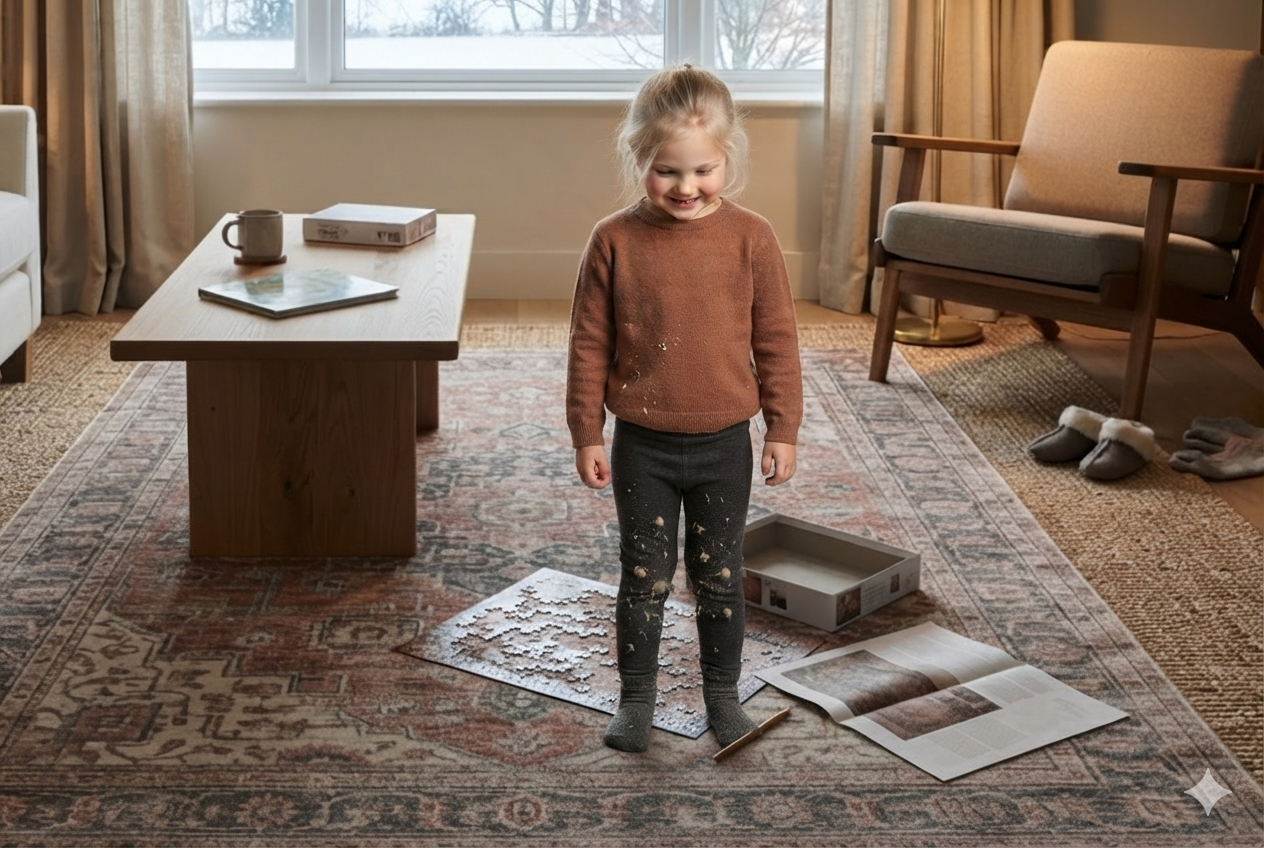
It was a Sunday afternoon in late January. Freya had been rolling across the living room rug in her socks for an hour — her after-lunch puzzle sat half-finished. But when she stood up, her leggings came up dusted in little wool fuzzballs.
Then Henrik came in from the garage and, for once, forgot the boot tray. One pale ring of road salt bloomed at the rug’s edge. The boot print he never sees. The one I always do.
And when the humidifier kicked on, the room took on that faint smell. Not bad, but strange. Like a wet dog we don’t own.
Fuzz, salt, and smell are not necessarily signs of a bad rug. They are signs of wool, a natural fiber doing its job of keeping our home cozy and warm.
Here is how to clean a wool rug, stop the shedding, and rinse the winter out — every fix costs about a dollar.
This website participates in the Amazon Associates program. As an Amazon Associate, I earn from qualifying purchases. It also participates in the Impact and AWIN affiliate programs. If you buy through links on this site, I may earn a small commission at no extra cost to you. Thank you for supporting The Hugged Home.
The Science: Shed, Salt, and the Wet-Dog Smell.
Why a Wool Rug Sheds: The Staple Fiber
Wool yarn is spun from staples — individual fibers of a certain length. Long staples lock together and stay put. Short staples can work themselves loose underfoot, and every footstep hands you a little fuzz.
That is the entire mystery of wool rug shedding: the short fiber leaving. The construction method decides how much.
A hand-tufted rug is punched into a canvas backing and glued; the pile is cut, so every tuft is a bundle of loose ends, and it sheds like a dog in June.
A hand-knotted rug ties each strand around the warp; the fiber is continuous, so it sheds a lot less.
Flatweaves shed the least of all, because the wool is woven and is not standing up.
The Timeline: Is It Normal?
- Months one to three: the break-in. The rug is handing you every loose end it came with. Vacuum twice a week and don’t panic.
- Months three to six: the taper. The fuzz thins to a whisper.
- Month six and beyond: if it is still shedding in handfuls, the rug was spun from short staples. It will always shed. That is not a care problem. That is a label problem. Essentially a bad purchase. Write it off.
The Wet-Dog Smell
The wool side of the smell is lanolin waking up damp — the same science as the sheepskin by the bed.
But the louder half is usually the backing: jute and cotton are plant fiber, cellulose, and cellulose smells like wet hay when the humidifier runs.
The rug isn’t dirty. It’s breathing your house’s moisture. Airflow fixes what spray cannot.
The Salt Ring
Road salt is alkaline; wool is mildly acidic, and the two do not get along. Salt is also hygroscopic — it pulls moisture out of the air, so a ring left alone keeps itself damp and slowly brittles the fiber around it.
The white ring is not a stain. It is mineral residue, and it rinses.
The Spec Sheet: Buying So Care Stays Easy
The Pad Is Non-Negotiable
A felt-and-rubber pad under a wool rug does two jobs simultaneously. It absorbs the friction of footsteps — friction is the engine of shedding — and it lifts the backing off the floor so air moves under the jute.
The jute is where the wet-hay smell starts. The pad costs less than one professional cleaning and prevents most of them.
The Two-Zone Strategy
This is the same truce the throws made: put the washable fiber where the water is. A cotton or indoor-outdoor runner takes the entryway and the mudroom — the salt, the slush, the boot traffic.
The wool rug stays in the dry zone: the living room, the bedroom, under the coffee table. Ask a wool rug to do a runner’s job, and you have signed up for every symptom in this article.
The Construction Check
If fuzz drives you mad, buy the weave, not the pile: hand-knotted or flatweave.
If you want the plush sink-in feel and can live with a three-month break-in, hand-tufted is a good trade-off.
Just know what you’re buying before you start complaining about your new wool rug shedding.
My picks, and the why:
Under the living room rug, a felt-and-natural-rubber pad — because the felt stops the creep and the rubber stops the friction, and neither off-gasses onto wool.
At the front door, a washable cotton runner in a forgiving stripe — because a stripe hides snow and rain-drenched boot prints. Finally, the runner goes in the washing machine in April.
The Wool Rug Care Guide
Weekly: The Vacuum
With the pile, never against it — run your palm over the nap first; the rug tells you which way it likes to be brushed.
Suction only. The beater bar is the shedding engine you paid extra for: it hammers the staples loose and hands them back to you as fuzz.
The Salt Fix
One part white vinegar to three parts cool water.
Blot the ring — never rub; rubbing grinds the crystal into the nap. The mild acid neutralizes the alkaline salt, and the residue lifts with a clean damp cloth.
Blot dry. Salt left alone keeps itself damp; salt rinsed in February is gone for good.
The Smell Fix
Baking soda, sprinkled like you mean it, left overnight, vacuumed slowly in the morning. It pulls the moisture and the odor with it.
For a backing that smells, flip the corner up and let the underside breathe for an hour. It just needs air, not perfume.
And never soak a wool rug to chase a smell: water plus agitation plus wool is felting — the keratin scales catch and lock, the rug shrinks, and the shrink is forever.
The sheepskin guide explains the scale mechanics; the rule here is never put it in a washing machine or under water.
The Rotation
Every six months, spin the rug 180 degrees. The walking path wears where it walks; the sun fades where it lands.
Rotation makes both even, so the rug ages like a face in good light, not a face always at a window.
When to Call the Cleaners
An heirloom hand-knot, a silk blend, a flooded basement: hand those over to trusted rug cleaners. A professional wash is cheaper than a felted heirloom, and knowing when to hand it over is real care.
The Rug at the End of the Season
It is April. The salt bucket is empty by the door, the humidifier is off, and the rug has gone quiet — the shedding tapered to nothing sometime in March, the way the timeline promised.
It is softer underfoot than it was in October. Broken in, the way wool does. At the front door, the cotton runner is in the washing machine, spinning out a winter of boot prints, and it will come out fine. It was built for that.
Two zones, two fibers, one quiet living room.
P.S. The wool rug is the anchor, but the anchor sits in a stack — read the How to Layer Rugs guide next to see the jute base and the sheepskin landing on top.
And if the entryway is still tracking winter indoors, the winter porch guide handles the boots before they reach the door.
Light a candle. Slow down. Hygge.
— Elise