Scandinavian Christmas Decor: A Hygge Guide to a Quiet, Candlelit Holiday
It was 4:30 on the Tuesday after Thanksgiving, and the Minneapolis sky was already the color of a bruised plum. I was driving home from the grocery store, gripping the cold steering wheel, squinting against the glare of the neighborhood.
The holiday season had officially ambushed us.
Every lawn on my street was staked with neon-blue LED snowmen. Cool-white strobe lights flashed in erratic, dizzying rhythms against vinyl siding. Inflatable Santas, tethered by thick black cords, sagged wearily onto frost-bitten grass.
I felt the familiar, low-grade tightening in my chest. The holiday shoulds were already piling up. I should buy more outdoor lights. I should hang the wreath with the battery-operated blinking bow. I should perform Christmas for the street.
When I finally pulled into the driveway, only the porch light was on. I dropped the groceries on the kitchen island, poured a glass of water, and called my Danish friend Astrid, now in Copenhagen for the Christmas holidays.
I complained about the visual noise. I complained about the pressure. I complained about the inflatable Santa next door.
Astrid laughed. It was a warm, crackling sound over the phone line.
“Don’t decorate for the street, Elise,” she said gently. “In Denmark, we do not decorate to be seen from space. We decorate to survive the dark. We decorate for the soul.”
This website participates in the Amazon Associates program. As an Amazon Associate, I earn from qualifying purchases. It also participates in the Impact and AWIN affiliate programs. If you buy through links on this site, I may earn a small commission at no extra cost to you. Thank you for supporting The Hugged Home.
The Biology of a Quiet Christmas
We think of Christmas decor as an aesthetic choice. It isn’t. It is a biological intervention.
When your retinas are bombarded with 5000K cool-white strobe lights and flashing LEDs, your brain registers a threat signal.
Cool, blue-toned light suppresses melatonin production and triggers a spike in cortisol. It tells your nervous system to stay alert, to hunt, to move.
But it is December. The solstice is approaching. Your biology is screaming for rest, for conservation, for the parasympathetic nervous system to take over and let you hibernate.
American holiday decor fights our circadian rhythms. Scandinavian Christmas decor—known as Jul (pronounced yool)—honors them.
The Nordic approach to the holidays is rooted in biophilia and low-lumen survival. It is an evolutionary cue that tells the nervous system it is safe to slow down.
Bringing raw, asymmetrical nature indoors and bathing it in the amber glow of firelight isn’t just “minimalism.” It is an ancient, tactile remedy for the dark season.
You do not need to buy a new house or import furniture from Copenhagen to steal this quiet. You just need to change the light, change the textures, and close the door to the street.
8 Small Ways to Bring Jul Into Your Home
1. Ditch the Cool-White LEDs (The 2700K Tree Rule)
If you take only one piece of advice this year, let it be this one. The overhead light stays off. Always. And the lights on your tree must match the light in your lamps.
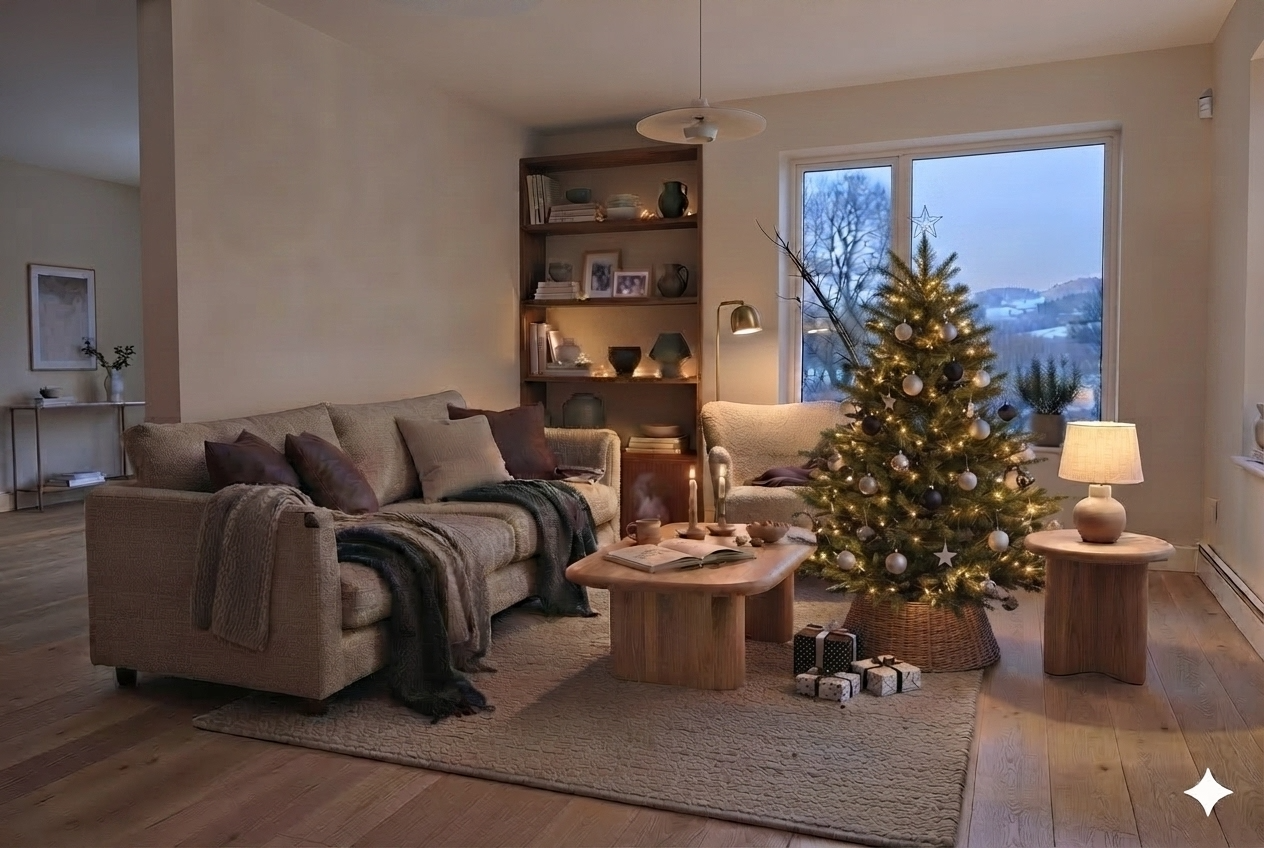
Cool-white LEDs cast a clinical, blue-gray pallor that instantly kills intimacy. Swap them for warm-white bulbs rated at 2700K or lower. The tree should look like it is glowing from the inside out, not one lit in a movie scene.
2. Weave Paper Hearts (Julehjerter)
In Denmark, you do not buy perfectly symmetrical, mass-produced ornaments. You make them. Julehjerter are woven paper hearts, traditionally crafted from red and white cardstock.
Maja and Freya make them at the kitchen island every December. The scissors are blunt. The lines are crooked. The glue sticks dry out.
To me, they are perfect. I hang them on the lower branches where the kids can touch them. Hygge is a practice, not a purchase.
3. Light the Windows, Not Just the Tree
Astrid’s grandmother placed a real candle in every windowsill at dusk. It was a signal to the neighbors: Someone is home. The street is held.
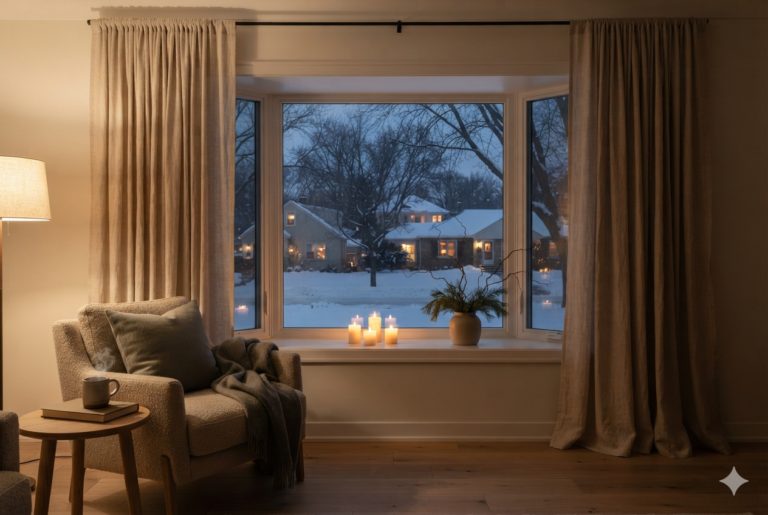
You don’t need to risk the curtains with open flames. Place a cluster of thick pillar hygge candles on a heat-safe tray in the window, or use a high-quality, warm-toned LED taper. We use Flickering Flameless Pillar Candles.
When you look out from the inside, the glass stops feeling like a black mirror and becomes a warm frame for the dark.
4. Invite the Nisser
Forget the plastic “Elf on the Shelf” that demands you move it every night and perform for the camera. Meet the Nisse (or Tomte).
In Scandinavian folklore, these little, bearded farm spirits live in the attic or the barn. They protect the home, but they are mischievous. If you don’t leave them a bowl of rice porridge with a pat of butter on Christmas Eve, they will tangle your yarn or sour the milk.
Buy one small, felted wool Nisse. Tuck him on a bookshelf. Let the kids leave him a cracker. It adds whimsy without the performative exhaustion.
5. Ditch the Foil Tree Skirt
Plastic, sequined tree skirts reflect light in harsh, unnatural ways. They feel temporary and cheap. Drape a chunky, imperfect wool blanket or a heavy raw-linen throw around the base of the tree instead.
It grounds the room in natural materials and provides a soft, tactile landing pad for bare feet on Christmas morning. It aligns perfectly with a warm winter color palette, anchoring the bright green of the pine in earthy, muted tones.
6. Simmer the Scent of Jul
Olfactory hygge is the fastest way to uplift a room’s mood, but skip the synthetic aerosol sprays.
Fill a small saucepan with water, add a handful of foraged pine needles, three cinnamon sticks, a teaspoon of whole cloves, and the peels of two oranges. Let it simmer on the lowest burner.
The house will smell like a damp, cold forest and a warm kitchen at the same time. Add water as it evaporates.
7. Mark the Sundays (Adventskrans)
The weeks before Christmas blur into a frantic rush. An Adventskrans (Advent wreath) forces a pause.
It is a simple wreath of evergreen branches holding four long candles. You light one candle on the first Sunday of Advent. Two on the second. Three on the third. All four on the fourth.
It is a visual, burning countdown that demands you sit in the living room for twenty minutes once a week and watch the wax melt.
8. Forage, Don’t Shop
Scandinavian styling relies heavily on the asymmetry of the natural world. Take a walk in your yard or a local park. Cut a few bare, twisting winter branches.
Bring them inside and place them in a heavy stoneware pitcher on your dining table or in your hyggekrog. Do not add flowers. Do not add glitter. The stark, beautiful architecture of the bare wood against the warm room is enough.
The Deep Breath
It is mid-December now. The inflatable Santas outside are flashing their cool-white strobes against the snow. But inside, the heavy front door is closed, and the deadbolt is thrown.
The big light is off. The only illumination in the living room comes from the 2700K fairy lights wrapped loosely around the pine branches, the thick pillar candles burning down in the windowsills, and the small lamp beside the sofa.
The house smells faintly of clove and orange peel.
Henrik is in the kitchen. The kettle clicks off. He walks in, carrying two heavy ceramic mugs, his glasses slipping slightly down the bridge of his nose.
He sets mine on the coaster and sinks into his armchair. Beneath the lowest branch of the tree, Björn is curled into a tight, gray croissant, his tail giving one slow, rhythmic thump against the wool blanket before he falls back asleep.
The house does not look like a magazine. It looks like us. It feels like a deep breath.
Light a candle. Slow down. Hygge.
— Elise