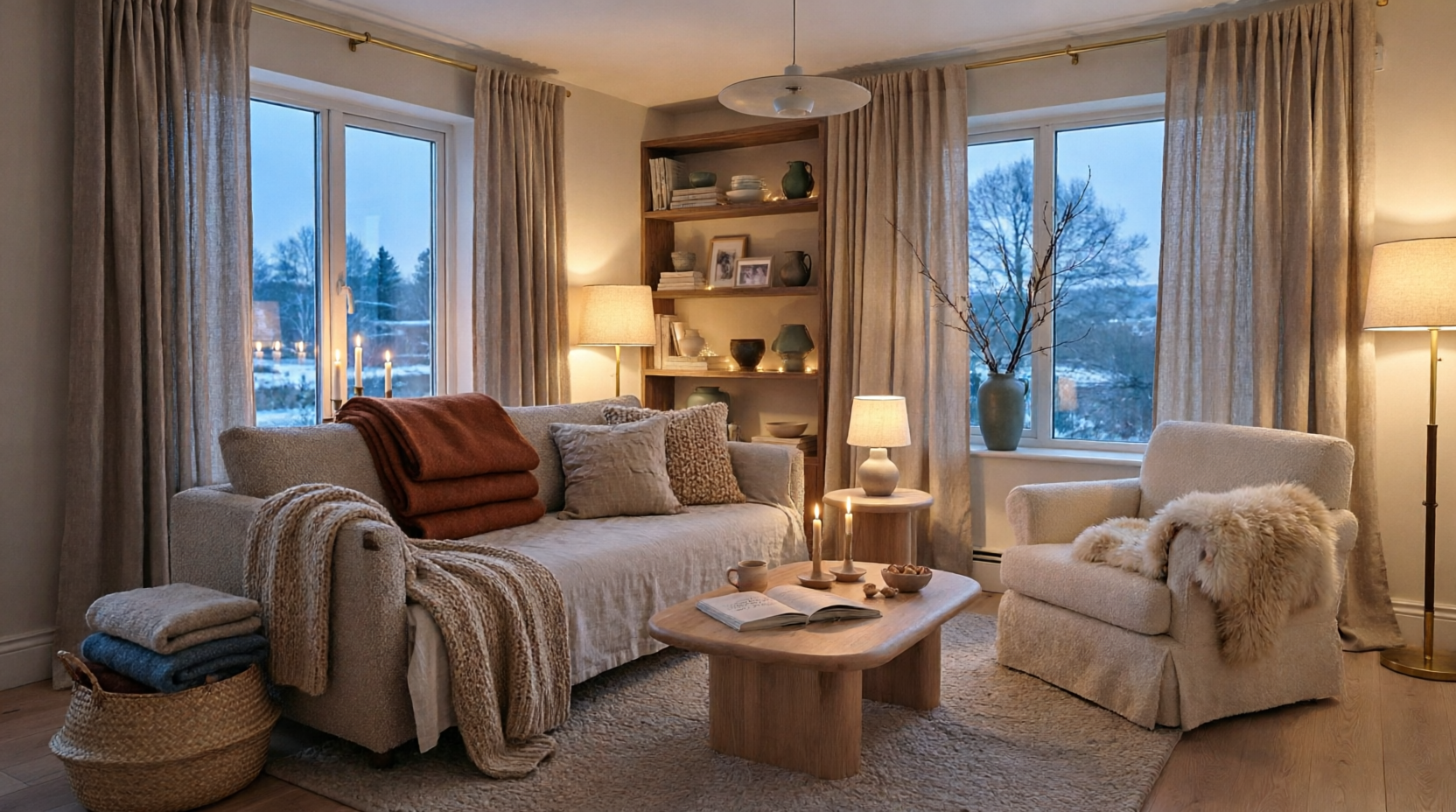
Layering Home Textiles: The Art of Creating a Cozy Winter Home
Early November, 3:45 p.m. The living room is tidy. The sofa is bare, save for two stiff, matching throw pillows and a single decorative blanket folded into a perfect, unused square at the foot. It looks like a furniture showroom.
Freya walks in, drops her backpack, and immediately slides off the sofa to sit on the rug. “It’s cold in here,” she says, pulling her knees to her chest.
The room isn’t cold. The thermostat reads 68 degrees. But the room feels cold because it has no thermal mass. All it has is one decorative throw.
One blanket reads a waiting room, not a living room.
Creating a cozy living room during winter is the art of layering home textiles. It is usually not about buying more, but about stacking what you own so the room holds warmth the way a lap holds a child.
This website participates in the Amazon Associates program. As an Amazon Associate, I earn from qualifying purchases. It also participates in the Impact and AWIN affiliate programs. If you buy through links on this site, I may earn a small commission at no extra cost to you. Thank you for supporting The Hugged Home.
The Physics of a Warm Room
When you ask designers how to layer textures in a room, they talk about visual contrast—matte against gloss, rough against smooth. But visual contrast only changes how a room looks. It doesn’t change how a room feels.
To make a room feel cozier, you have to look at the physics of insulation. The U.S. Department of Energy notes that insulation works by creating small pockets of trapped, still air.
The same principle applies to your sofa. A flat, tight-weave slipcover sheds air. A stacked, uneven pile of wool, linen, and cotton traps a microclimate.
The air between the layers warms to your body heat and stays there, creating a buffer against the drafty window.
Then there is the weight. Harvard Health research on weighted blankets shows that distributed, deep pressure signals the parasympathetic nervous system to slow the heart rate and lower cortisol.
The effect of a deep pressure calming blanket translates perfectly to the living room. A middle layer of heavy wool provides that same distributed weight across the shoulders when you sink into the corner of the couch.
Finally, there is the texture. The Danish word hjemlig translates roughly to homeliness, but it means more than just “cozy.”
Hjemlig means a space that shows evidence of being lived in. Irregular, natural fibers—pilled wool, slubby linen, nubby cotton—tell the eye that it is safe to relax.
Smooth, synthetic fabrics signal “do not touch.” They reflect light harshly and feel cold to the skin.
When you surround yourself with winter home textiles that have irregular weaves, your nervous system registers the room as a shelter, not a showroom.
10 Home Textile Layering Tips to Increase Warmth
You can actually make the rooms in your home feel warmer, simply by the correct layering of winter home textiles. Here are 10 tips that are easy to implement and guaranteed to work.
1. Lay the base layer flat and honest
Start with the foundation. If you have a slipcovered sofa, use a heavy, natural fiber like washed linen or dense cotton. This is your canvas.
It should feel cool and smooth to the touch, providing a clean contrast to the heavier layers you will add on top.
When layering throws and blankets on a sofa, the base layer is the one that touches the upholstery, protecting it while offering a crisp, clean backdrop for the softer textures to come.
2. Add the middle layer for weight
The middle layer is the engine of the stack. This is where you bring in natural fiber throw blankets that carry actual weight.
Look for a wool throw blanket weight around 450 to 600 GSM (grams per square meter). It needs to be heavy enough to stay put when someone pulls it, but soft enough to drape over a shoulder.
If you are debating between natural and synthetic for this middle layer, remember that wool beats fleece where it counts when it comes to trapping warmth without trapping sweat.
My Faribault Mill wool throw keeps me cozy and warm, as I sip hot coffee and read in my hyggekrog. Faribault Mill — a Minnesota mill has been weaving since 1865. Henrik has one on his armchair in the living room as well.
The twill weight stays anchored on a chair or sofa arm and softens a little more every winter, earning its place as a true heirloom piece.
If the sofa takes a beating from kids and pets, the middle layer needs to be washable. That is where our collection of Pendleton Eco-Wise Washable Throw with Fringe come in handy. They are 100% wool, but washable.
3. Finish with the accent layer for contrast
The top layer is the exclamation point. This is where a chunky knit throw or a plush sheepskin on the reading chair comes in. It should be the softest, most tactile piece in the stack—the one you reach for blindly in the dark.
I use Woolous Genuine Sheepskin Rug in my bedroom where my feet land in the morning, as well as in my bathroom, to step ont from the bath tub.
Draped over the arm of a leather or linen chair, the single-pelt plush provides a third texture entirely. No wonder, I have one in my home office as well, sometimes on the chair, sometimes on the carpet just under my feet.
4. Keep three textures per seat, no more
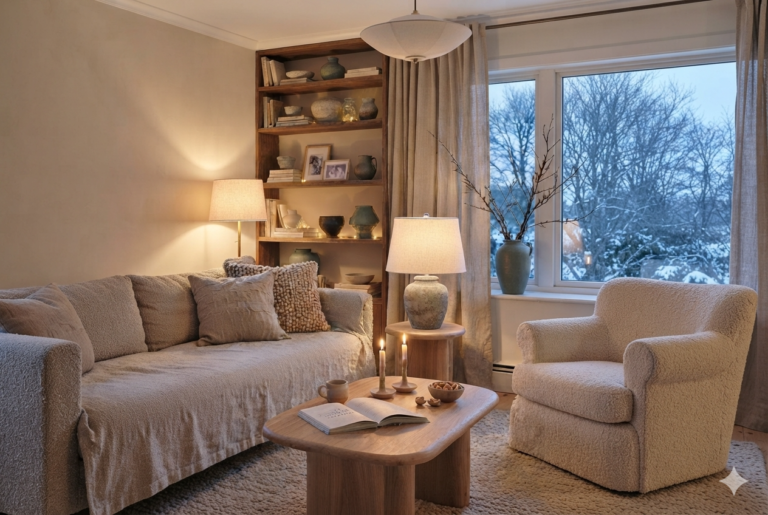
The rule of three textures is the golden ratio of seating. One flat base (linen or cotton), one heavy middle (wool), one plush accent (sheepskin or knit).
Anything more than three starts to look cluttered and chaotic. Anything less looks unfinished, like you forgot to bring the rest of the room inside from the cold.
5. Mix fibers, not patterns
When mixing textures in home decor, let the fibers do the talking. Pair linen and wool together. The cool, smooth slub of the linen highlights the warm, fuzzy halo of the wool.
The contrast in how they absorb light is what makes the stack look rich and intentional.
If you mix too many patterns, the eye gets confused and the room feels chaotic. Stick to solid, natural tones—oatmeal, charcoal, rust—and let the weave provide the visual interest.
6. Layer by the hour
Hygge is a practice, not a static display. Layer by the hour. At noon, the heavy wool is folded in a basket to let the winter sun warm the wood floors.
At 4 p.m., the throws are draped over the arms, and the linen curtains are drawn halfway to diffuse the harsh glare.
At 8 p.m., they are pulled across the lap. Move the stack where the evening lands.
7. Let one layer stay imperfect
A pristine stack is a stressful stack. Let one layer stay imperfect. A slightly pilled wool throw on the back of the sofa is a visual invitation to sit down. Pilled means used. Used means loved.
8. Anchor every stack to a person’s habit
Don’t just scatter textured throw pillows randomly. Anchor every stack to a person’s habit.
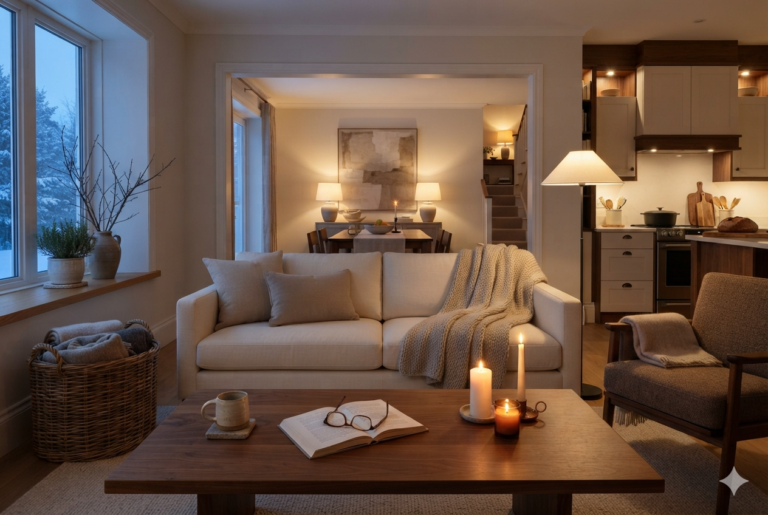
Henrik’s reading chair gets the heavy wool and the reading glasses tray. The main sofa gets feather down cushion inserts that slouch into the corner like they live there, instead of springing back like a gym ball.
9. Don’t forget the floor
Textile layering doesn’t stop at the sofa cushion. It extends to the floor.
If you are layering rugs and throws, remember that a flatweave wool rug base layer grounds the room, while a softer, thicker rug on top defines the seating area.
The transition from hard floor to soft rug is the first tactile experience of entering the room. For the exact mechanics of the floor stack, read our guide on how to layer rugs.
And remember why wood feels warm underfoot when the rugs are pulled back in the summer.
10. Air the stack weekly
Wool and natural fibers need to breathe. Once a week, take the heavy throws out to the porch or hang them over the balcony railing for an hour.
Air out wool blankets to let the fibers release trapped moisture and odors. It is a small ritual that keeps the stack smelling like a home, not a closet.
The Fort at the End of the Day
It is 7:30 p.m. The overhead light is off. The 2700K floor lamp is casting a warm pool of light over the coffee table.
In the center of the living room rug, Maja and Freya have constructed a fortress. It is built entirely from the sofa’s middle and accent layers.
The heavy wool throws form the load-bearing walls. The sheepskin is the roof. The linen cushion covers are the drawbridge.
They are inside, illuminated by a single flashlight, completely absorbed in a game of their own invention.
Björn is stationed outside the walls, tail thumping a slow, rhythmic beat against the floorboards, guarding the entrance.
Henrik walks in from the kitchen with two mugs of tea. He doesn’t sit on the bare, stiff sofa. He sits on the floor, leaning his back against the woolen rampart, and slides a mug under the drawbridge.
The room isn’t just tidy anymore. It is holding them.
For more on how these layers anchor the entire hygge living room, explore the full room guide. As I wrote in the guide to hygge textiles, a room is built in layers, not single statement pieces.
Light a candle. Slow down. Hygge.
— Elise