

How to Fix Candle Tunneling (and Prevent It for Good)
How to Fix Candle Tunneling: 3 Proven Methods
Don’t toss a tunneled candle. Reset its wax memory with
- aluminum foil for moderate tunnels,
- a hair dryer for shallow ones,
- or a candle warmer for deep tunnels.
My Danish friend, Astrid, once watched me blow out a newly lit candle within fifteen minutes because I said to myself, “the room smells nice now.”
She gently shook her head. “Don’t be a a lyseslukker, Elise, a candle is not just for the scent, it is for the light,” she said. “If you do not let it burn long enough the first time, it will remember and stay within the boundary you have set for it.”
She was right. In Denmark, candles are deeply tied to the concept of levende lys, or “living light.” A candle is not a disposable air freshener; it is a living element of the room that requires attention and time.
When we rush the burn, we break the ritual. We get the scent, but we lose the light, the warmth, and the longevity of the candle itself.
Dark Season Candle Scent Calendar

If you want to skip the guesswork, I’ve mapped out a Free Dark Season Candle Scent Calendar It breaks down exactly which scent profiles work best for each room and each month, right from October to March.
Click the button above · Enter your email · Check your inbox and confirm the verification email · Your calendar unlocks instantly · NOTE: Check your spam folder too!
This website participates in the Amazon Associates program. As an Amazon Associate, I earn from qualifying purchases. It also participates in the Impact and AWIN affiliate programs. If you buy through links on this site, I may earn a small commission at no extra cost to you. Thank you for supporting The Hugged Home.
Is Candle Memory Ring for Real?
Yes it is. Wax has a memory. The first time you light a new pillar or jar candle, the melt pool—the liquid wax that forms around the wick— gradually expands outward.
The point to which that pool reaches on the very first burn sets the maximum diameter for every subsequent burn.
If you blow out the candle before the melted wax reaches the edges of the vessel, the wax “remembers” that smaller diameter.
The next time you light it, the flame will only melt the wax within that original, narrower boundary. The outer ring remains solid, creating a deep, wasteful tunnel down the center.
Candle Memory Explained: Why Tunneling Happens
When you light a candle for the first time, the flame creates a melt pool. If you blow it out before that melt pool reaches the outer edges of the jar, the wax hardens with a “ring” or trench.
On subsequent burns, the flame will naturally follow that established path of least resistance, digging deeper and deeper into the center while leaving the outer wax untouched. This is candle tunneling.
How to Fix Candle Tunneling
You do not need to throw away a tunneled candle. With a little patience and a few simple tools, you can reset the memory ring and save the wax.
Here is how to fix the damage and prevent it from happening again.
NOTE: I have used the term vessel. Replace it with jar or pillar as the case may be.
1. The Aluminum Foil Method (The Fix)
This is the most reliable way to fix a candle that has already tunneled. Tear off a sheet of standard kitchen aluminum foil and wrap it loosely around the top of the candle vessel.
Pinch the foil at the top to create a small opening, about an inch wide, directly above the wick. Light the candle and let it burn for two to three hours.
The foil traps the heat, forcing the ambient temperature inside the vessel to rise. This melts the hard, untouched ridge of wax on the edges, allowing it to pool evenly with the center.
Once the surface is completely liquid and level, remove the foil and let the candle burn normally.
2. The Hair Dryer Method (For Minor Tunnels)
If the tunnel is shallow and you don’t want to wait hours for the foil method, you can use a hair dryer.
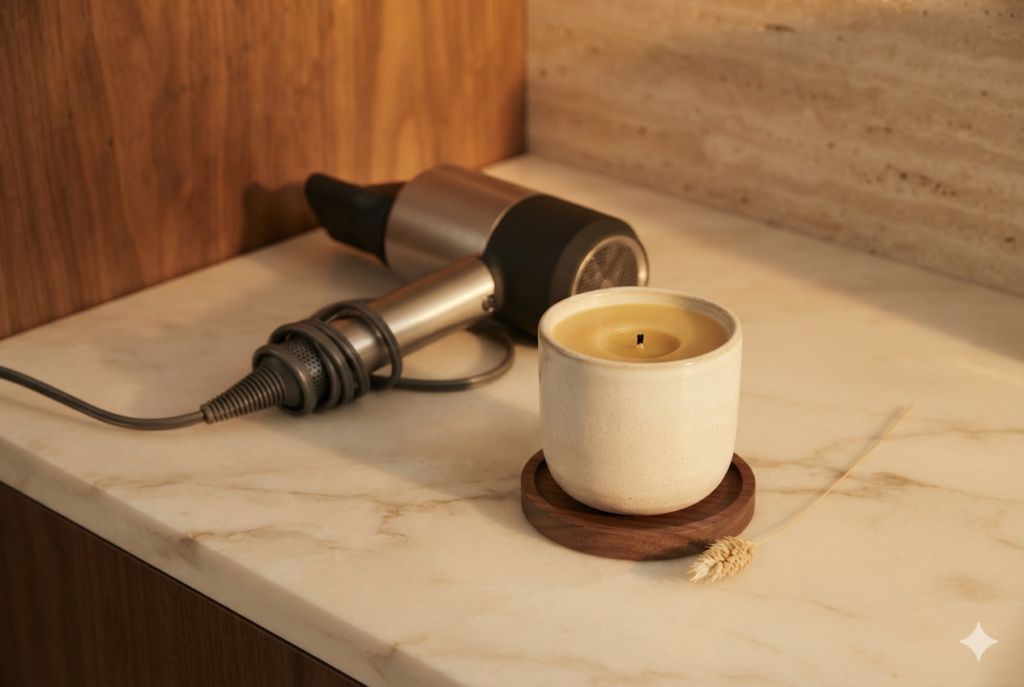
Set the dryer to its highest heat setting and lowest fan speed. Hold it a few inches away from the top of the candle, moving it in slow circles.
Melt the surface manually until the hard ridge is gone and the top is completely even. Let the wax cool and harden before you light the wick again.
This resets the memory ring without the wait time, though it requires a bit more manual attention.
3. The Candle Warmer (The Reset)
For the impatient among us, a candle warmer lamp is a highly effective tool. These lamps use a low-wattage bulb to heat the top of the candle from above, melting the entire surface without an open flame.
If you have a tunneled candle, placing it under a warmer for a few hours. That will melt the entire top layer evenly. It is a foolproof way to reset the memory ring, and it eliminates the risk of soot or an unattended open flame.
How to Prevent Candle Tunneling
Prevention is better than cure, they say, and a little patience can pretty much ensure that your candle never tunnels. Here is what you must do.
- The One-Hour-Per-Inch Rule: Allow the candle to burn long enough on the first light.
- Trim the Wick Religiously: Before every single burn, trim the wick to 1/4 inch.
- Avoid Drafts: Keep your candle away from open windows, fans, or HVAC vents.
4. The First Burn Rule (The Prevention)
The only true way to prevent tunneling is to respect the first burn.
A good rule of thumb is to let the candle burn for one hour for every inch of its diameter. If your candle is three inches wide, it needs to burn for at least three hours on its first light.
Watch the wax, not the clock. Do not blow it out until the melt pool reaches the very edges of the vessel. This initial, full melt establishes the correct memory for the rest of the candle’s life.

5. Maintain a Quarter-Inch Wick
A wick that is too long will create a tall, aggressive flame that burns the wax too quickly and produces black soot.
A wick that is too short will create a weak flame that cannot generate enough heat to melt the wax to the edges.
Always trim your wick to a quarter-inch before lighting.
Elise would pick
Foton Candle Care Kit
The listing describes a candle kit with a USB-rechargeable lighter, wick trimmer, snuffer and wick dipper. I’d choose it for anyone who burns candles often, since tending them is part of the ritual.
See itAffiliate link. As an Amazon Associate I earn from qualifying purchases.
6. Protect the Flame from Drafts
Even a perfectly trimmed wick will tunnel if the flame is constantly flickering in a draft. Air currents from HVAC vents, open windows, or ceiling fans cause the flame to lean to one side.
This creates uneven heating, melting the wax on one side of the vessel while leaving the other side solid.
Place your candles in sheltered spots. If you are styling your winter mantel, ensure the candles are not sitting directly in the path of a drafty window or a heating vent.
7. Prioritize Patience Over Scent
This is the hardest step for me. When a candle smells good, the instinct is to blow it out and save the rest for later. Resist the urge. If the wax has not reached the edges, the candle is not done.
Let it burn. Let it provide the foundation of levende lys that the room needs. The scent will remain, and the wax will be preserved for the next evening.
8. Understand Your Wax
Different waxes have different melting points, which affects how they tunnel.
Soy wax has a lower melting point and is generally more forgiving, but it still requires a full first burn. Beeswax has a much higher melting point and requires a hotter, longer burn to reach the edges.
If you are choosing the right wax for your ritual, understand that a thick beeswax pillar will take significantly longer to achieve a full melt pool than a wide soy vessel. Adjust your burn time accordingly.
FAQ — Candle Burning: Safety and Best Practices
Why only burn candles for 4 hours?
Burning longer raises wick overheating, soot, and container heat; 4 hours limits fire risk and wick mushrooming.
Should you burn a candle all the way down?
No. Stop when 1/2–1/4 inch of wax remains to avoid overheating containers and glass breakage
Do I have to let my candle burn to the edges every time?
No. First burn should reach edges to set the wax memory; later burns can be shorter to avoid tunneling.
What I Have Learned About Candle Tunneling
Astrid was right: a candle is not something to rush. Give it enough time to create its full pool of living light, and it will reward you with warmth, beauty, and many more evenings of hygge.
Now, I rarely face the problem of candle tunneling. But, even if I do, I know that a tunneled candle is not necessarily a ruined one. With a little patience, I can usually fix the problem.
Light a candle. Slow down. Hygge.
— Elise