The Hygge Dining Room: The Danish Art of the Unhurried Meal
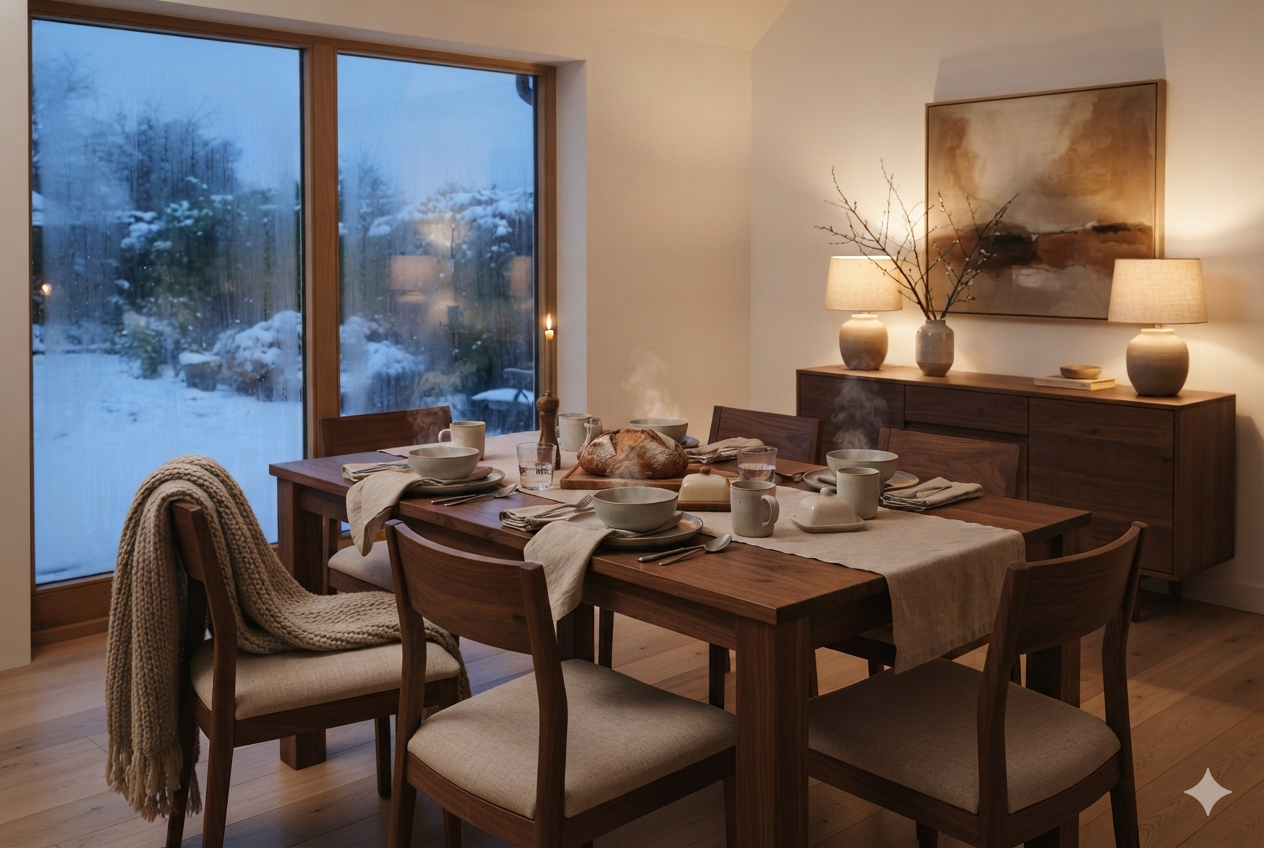
It’s a Sunday in January, six-fifteen, and I’ve just lit the candle in the middle of the table — before anyone has sat down, before the pot has even come off the stove.
Henrik sets the table. Maja helps him by folding napkins; they don’t look like perfect squares, but Henrik indulges her with a smile of approval. Freya claims the seat nearest the candle.
Björn has snuck under the table into the warmest spot and promptly fallen asleep. He’s confident he’ll get something when the time is right. Patient as ever.
It’s just the four of us. Our phones are being charged in the living room; far enough so that we won’t be tempted to reach for them during dinner. Nobody made that rule. (Maybe Astrid recommended it). It’s just how we eat now.
We’re not fueling up before the next thing. There isn’t a next thing tonight. This is the thing.
This website participates in the Amazon Associates program. As an Amazon Associate, I earn from qualifying purchases. It also participates in the Impact and AWIN affiliate programs. If you buy through links on this site, I may earn a small commission at no extra cost to you. Thank you for supporting The Hugged Home.
What the Danes Call a Candle (And Why It Changes the Table)
Astrid was the one who told me the Danish word for a candle is levende lys — literally, “living light.”
Not mood lighting. Not ambiance. Not decor. Light that behaves like a living thing: it flickers, it leans, it needs tending.
There’s another word Astrid taught me, half as a joke: lyseslukker — literally “the one who puts out the candles.” It’s what Danes call a spoilsport; the person who kills the mood.
In a way, I think the two words capture the spirit of hygge more than any other. Always light a candle before you do anything and don’t be a lyseslukker.
That distinction — fueling versus gathering — is the whole hygge dining room in a few words. The hygge dining room is where the evenings stretch longer.
Fueling happens standing at the counter, plate in one hand, phone in the other, because there’s somewhere else to be in eleven minutes. Gathering is when the candle is lit before anyone sits down, and nobody’s in a hurry to blow it out.
Why People Relax at a Shared Table
Like everyone, I used to think “eating together is nice” is, well, just a nice sentiment. But the curious me wanted to know if there was a reason behind this “nice feeling”. Turns out there is.
Researchers have a word for it: commensality — the practice of eating together, as opposed to eating in the same room while doing separate things.
Sharing food triggers a release of oxytocin, the same neurochemical involved in trust and bonding.
Watching someone across the table taste something and react to it activates what researchers call “self-other merging” — a small, involuntary sense of shared experience, wired in from a time when eating together meant you’d both survived the day.
There’s a practical version of this, too. Studies on adolescents have found that the more regularly a household shares meals, the lower the reported rates of stress, anxiety, and low mood among the kids at that table.
Meik Wiking, who has spent more time studying hygge than almost anyone, points to another piece of this: equality at the table.
Nobody hosts alone. Nobody is served like a guest in their own home. Everyone helps cook, everyone helps clear, and no single chair is the important one. It sounds small. It changes the entire feeling of a meal.
I call this the communal anchor — the grounding force that settles you into a room with others. The hygge dining room’s purpose is to make dropping that anchor effortless.
The Habit That Changed Our Dining Experience
For years, I lit the candle after everyone sat down — a little flourish once we were all in our seats, like a toast. It took Astrid pointing it out for me to notice I had the order backwards.
“You light it after you’ve all arrived,” she said, “so it’s decoration. Light it before, and it’s the reason you came.”
Now the candle goes on before the pot comes off the stove. By the time anyone sits down, the table’s already been waiting for them — not the other way around.
Same principle we use everywhere else in this house: light it before the task starts, not after. [→ Full guide to Hygge Kitchen]
Habits like this don’t announce themselves. They just get repeated until they’re load-bearing.
10 Hygge Dining Room Decor Ideas
A hygge dining room does not need much. In fact, the more you try to decorate it, the more likely you will lose what you were trying to create in the first place.
Hygge is not a table scape you arrange for a photograph. It is the feeling of sitting down at the end of the day and realizing nobody is in a hurry to leave.
The light is warm. The table feels inviting. There is fresh bread and soup that has been simmering the entire afternoon. Conversation stretches a little longer than expected.
These ten ideas are less about dining room decor and more about creating the conditions for that kind of evening.
1. Warm Lighting
If there is one change I would make first, it is the lighting. A dining room washed in bright overhead light can never feel intimate, cozy, and warm.
Instead, layer the room with a couple of table lamps and maybe a floor lamp placed where they can cast soft pools of light without shining directly into anyone’s eyes. Find out more about how to choose the right table lamp here.
Choose warm 2700K bulbs, which give the room a gentle golden quality, especially after dark. The goal is not to illuminate everything. It is to give the evening a tapestry of light and shadow to settle.
2. Candles as Living Light
Three unscented beeswax taper candles are enough to change the entire mood of a dining table.
I like to style taper candles by placing them clustered together rather than spaced mechanically across the length of the table. Their small flames create movement, shadows, and that particular kind of living light that makes people instinctively slow down.
Unscented beeswax is especially lovely at dinner because it adds warmth without competing with the food. As Astrid would remind me, the candle is not decoration. It has a job to do: make the table feel alive.
The Bluecorn Beeswax 12-Inch Ivory Taper Candles are my go-to when I want the holder and the room to remain visually important during the day and the flame to become the focus at night.
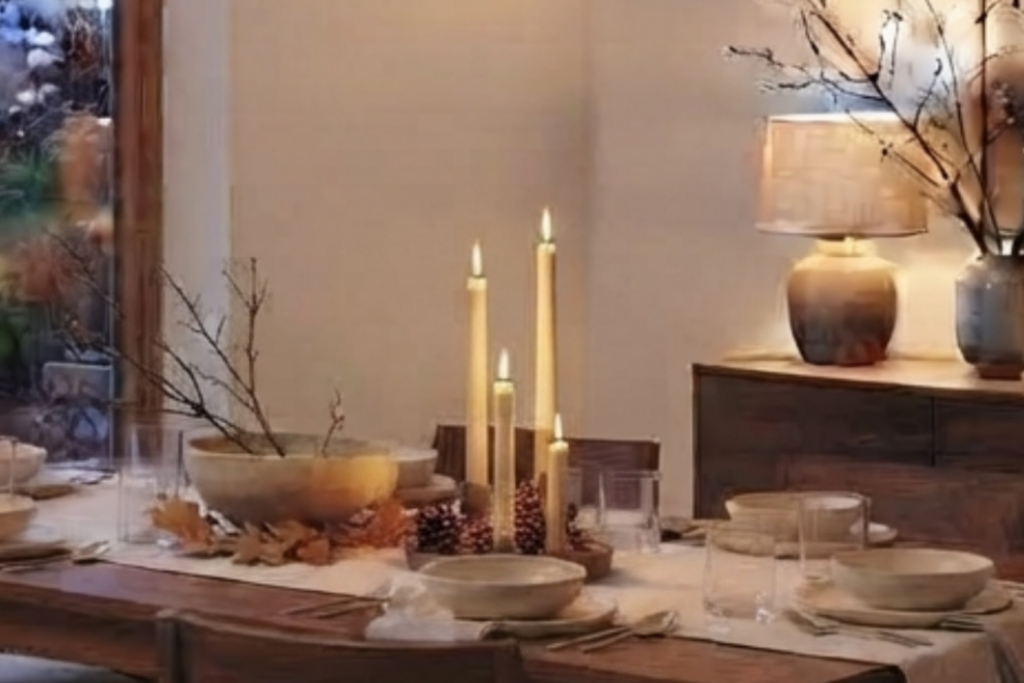
And Light the candle before anyone sits down.
Not as the meal begins — before it’s placed on the dining table. The candle should already be burning when the first person walks in, so the table appears to be waiting for them.
It’s just a change in the order of doing things, but it has a completely different effect on the room.
Moreover, Let one candle run down naturally.
A candle blown out the moment dinner is served or gets over was never really lit for the meal — it was lit, maybe for a photo. Let the candle run down naturally. Don’t be a lyseslukker.
On birthdays or when Astrid’s over, we go to three or four. Most nights, one is exactly right.
3. Natural Centerpieces
A centerpiece should give the eye something beautiful to rest on without becoming an obstacle to conversation.
Dry branches in a simple stoneware or ceramic vase, a few sprigs of herbs, natural stones, or a piece of driftwood can bring the quiet textures of the outdoors inside.
Minimalism is the key. Ask any reputed designer, and they will tell you that empty space around a decor piece is what makes it stand out.
I especially like arrangements that look as though they were gathered rather than purchased. Keep them low enough that everyone can see across the table. A dining table should connect people, not create a botanical wall between them.
4. Layer Textiles
The quickest way to make a dining room feel softer is often to put something textured under, beside, or beneath what is already there. It is the art of layering textiles in a home.
A linen runner can break up a bare wooden table without covering its character. Cloth napkins make an ordinary Tuesday dinner feel slightly more considered, while wool cushions add warmth to hard dining chairs.
None of these pieces needs to match perfectly. Hygge has room for wrinkles, natural texture, and the evidence that something has actually been used.
5. Wood Accents
Real solid wood furniture brings a dining room back to something wonderfully uncomplicated: food, gathering, and the dining table itself. Make them shine.
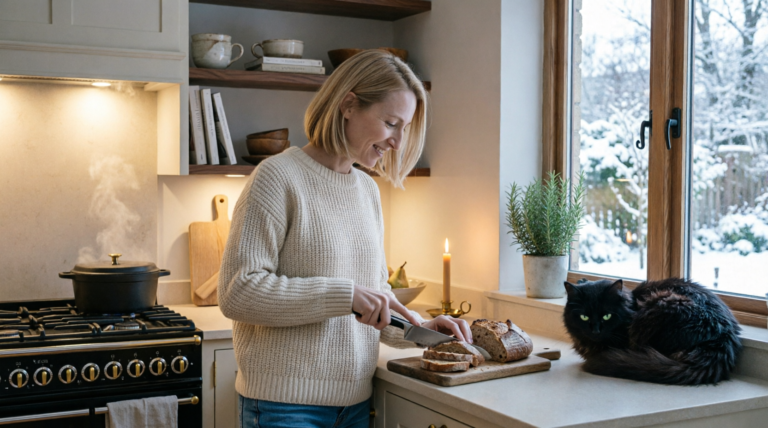
Add wood accessories where it works. A well-used breadboard, a carved wooden bowl, or a rustic serving tray adds texture without making the room feel decorated for decoration’s sake.
Look for pieces with visible grain, even small imperfections, and a finish that feels comfortable and warm to the touch. Buy once, spend your money wisely, create an arv, if you can.
I would rather have one beautiful wooden breadboard that gets used every week than a shelf full of objects nobody is allowed to touch.
6. Minimalist Tableware
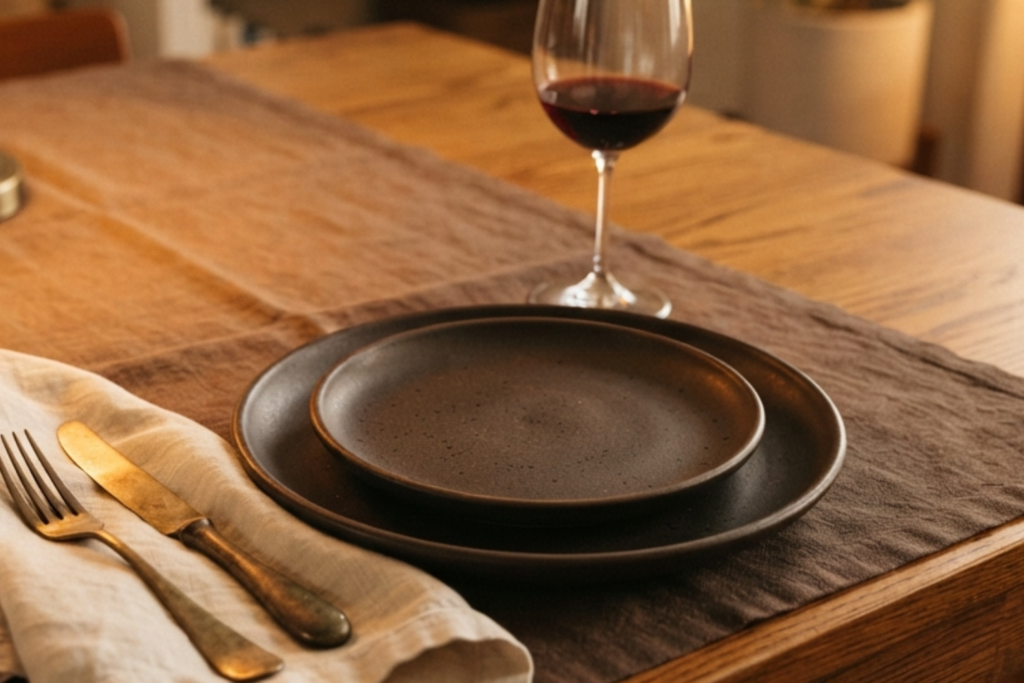
Hygge tableware does not need to be precious. Handmade ceramics and simple stoneware have a warmth that perfectly manufactured pieces usually lack.
A slightly uneven rim or variation in glaze makes each plate feel individual, particularly when everything is gathered together on the table. Choose pieces in quiet, natural shades that work with what you already own.
The point is not to create a perfectly coordinated collection. It is to make setting the table feel easy enough that you actually want to do it.
7. Choose Cozy Dining Room Colors
The walls and large furnishings set the stage for your meals. Cozy dining room colors should promote relaxation and appetite, avoiding stark, clinical whites or overly stimulating brights.
Lean into a hygge color palette of warm neutrals: think creamy off-whites, soft greiges, and muted taupes.
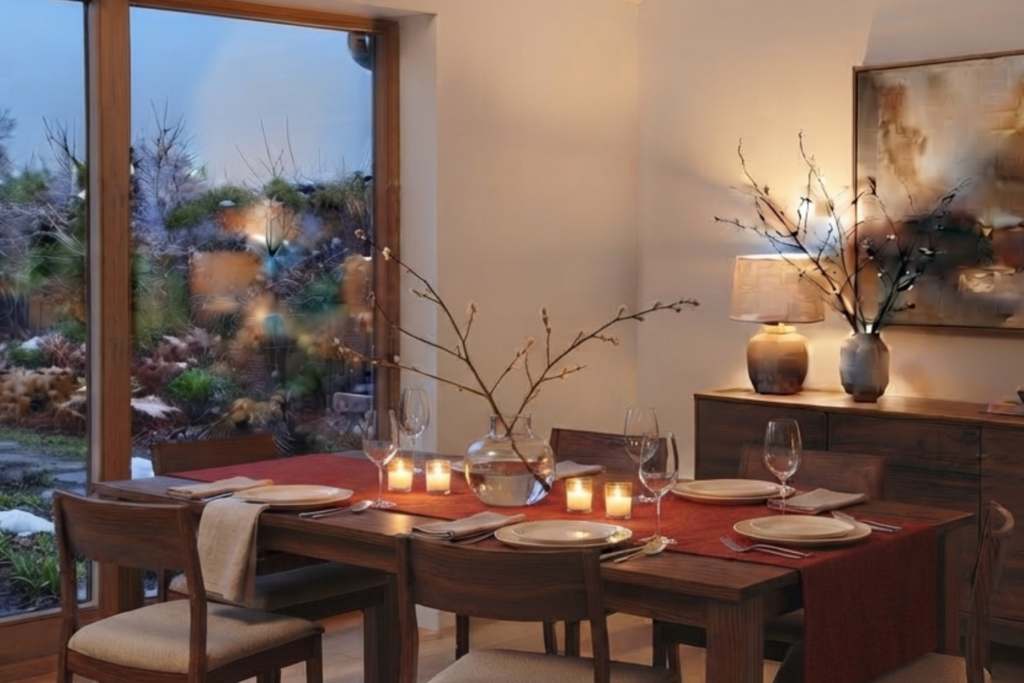
These tones reflect candlelight beautifully and make the room feel like a warm embrace. If you want to add depth, consider an accent wall in a grounding earthy tone, like those found in my guide to warm neutral paint colors.
Of course. it does not mean that everything needs to be beige. Wood, aged brass, stone, linen, and muted greens can all sit comfortably within a warm neutral palette.
Think of the room as a backdrop for evening light rather than a collection of colors competing for attention.
8. Seasonal Touches
A hygge dining room should change quietly with the seasons.
In spring, that might mean fresh greenery in a simple vessel. Summer can bring lighter linens and herbs from the garden, while fall invites branches, deeper natural textures, and warmer textiles.
In winter, I love bringing the room back to evergreen, wool, beeswax, and candlelight.
You do not need to redecorate the dining room every few months. Changing one or two small things is enough to remind you that the year is moving outside the window.
9. Mixed Seating
A hygge dining table should feel as though people are welcome to pull up another chair.
Formal matching dining sets can be beautiful, but mixing a bench, wooden chairs, upholstered seats, or even a well-loved chair from another room can make the table feel more relaxed and communal.
The important thing is comfort. Nobody should be sitting stiffly because the dining room looks too important to disturb. A little informality gives the room permission to become part of everyday family life.
10. Digital-Free Dining
Perhaps the most important thing you can remove from a hygge dining room is not an object you decorate with, but the phone in your pocket.
Put the devices somewhere else and let the table become the place where everyone is actually present and talking to each other.
A bowl by the door, a drawer in the next room — anywhere that isn’t the dining table. The habit works because then reaching for a phone requires getting up. Phones out of arm’s reach ensure everyone is eating and conversing.
Dinner does not have to be elaborate, and conversation does not have to be profound. It can be Henrik telling the girls something ridiculous, someone asking for more potatoes, or everyone talking at once.
That is precisely the point. The table is for people.
Hygge Dinner Party Rituals for Cozy Entertaining
A hygge dining room is just a room until you fill it with life. The true magic happens in the habits you build around the table.
It is so important, that I feel I must devote a section to it, even though it has already been covered earlier, in bits and pieces.
Here are three hygge dinner party rituals we practice to ensure every meal feels special:
- The Digital Detox Rule: Phones and tablets stay in another room. The dining table is a sacred space for connection, eye contact, and being fully present with the people in front of you.
- Light the Candles First: Before the food even goes on the table, the candles are lit. This simple, 10-second act signals a psychological shift from the busy day to a slow, intentional evening.
- Serve Family-Style Comfort Food: Instead of plating food in the kitchen, place warm, comforting dishes (like a slow-roasted root vegetable bake or a hearty stew) in the center of the table. Passing plates encourages interaction and makes everyone feel cared for.
FAQ for Hygge Dining Room
What’s the simplest hygge dining table decor idea?
Keep centerpieces low and natural—one candle, a sprig of greenery, or a wooden breadboard.
How to create a hygge dining room on a budget?
Focus on atmosphere. Swap bulbs for warm 2700K light, add a linen runner, and light a candle before meals.
How to make dinner feel more hygge with little effort?
Establish small rituals: phones away, candles lit first, and serve food family‑style to encourage connection.
The Hygge Dining Room Table’s Only Purpose
By seven‑forty, dinner is nearly done, but no one rushes to clear the table. Henrik leans back, one arm draped over his chair. Freya bargains for five more minutes before bath. Maja laughs as she folds her failed napkin into an even worse one.
Nobody will blow out the candle. It’ll burn another twenty minutes on its own. We will sit and chat some more. That’s not wasteful. That’s a custom. That’s just how we do dinner now.
A hygge dining room doesn’t need a china cabinet or a table twice the size of the one you already have. It has just one purpose: to gather everyone in one room, face to face—not just to eat, but to share, both food and stories.
Everything here—the candle lit early, the phones kept away—exists for one reason: to let the hygge dining room fulfill its single purpose.
Looking for the rest of the house? Start with the hyggekrog [→ What Is a Hyggekrog?], move through the living room [→ The Hygge Living Room], or go back to the full room-by-room walkthrough in The Complete Guide to Hygge Home Decor [→ Hygge Home Decor].
Light a candle. Slow down. Hygge.
— Elise