How to Layer Rugs the Hygge Way: Getting the Formula Right
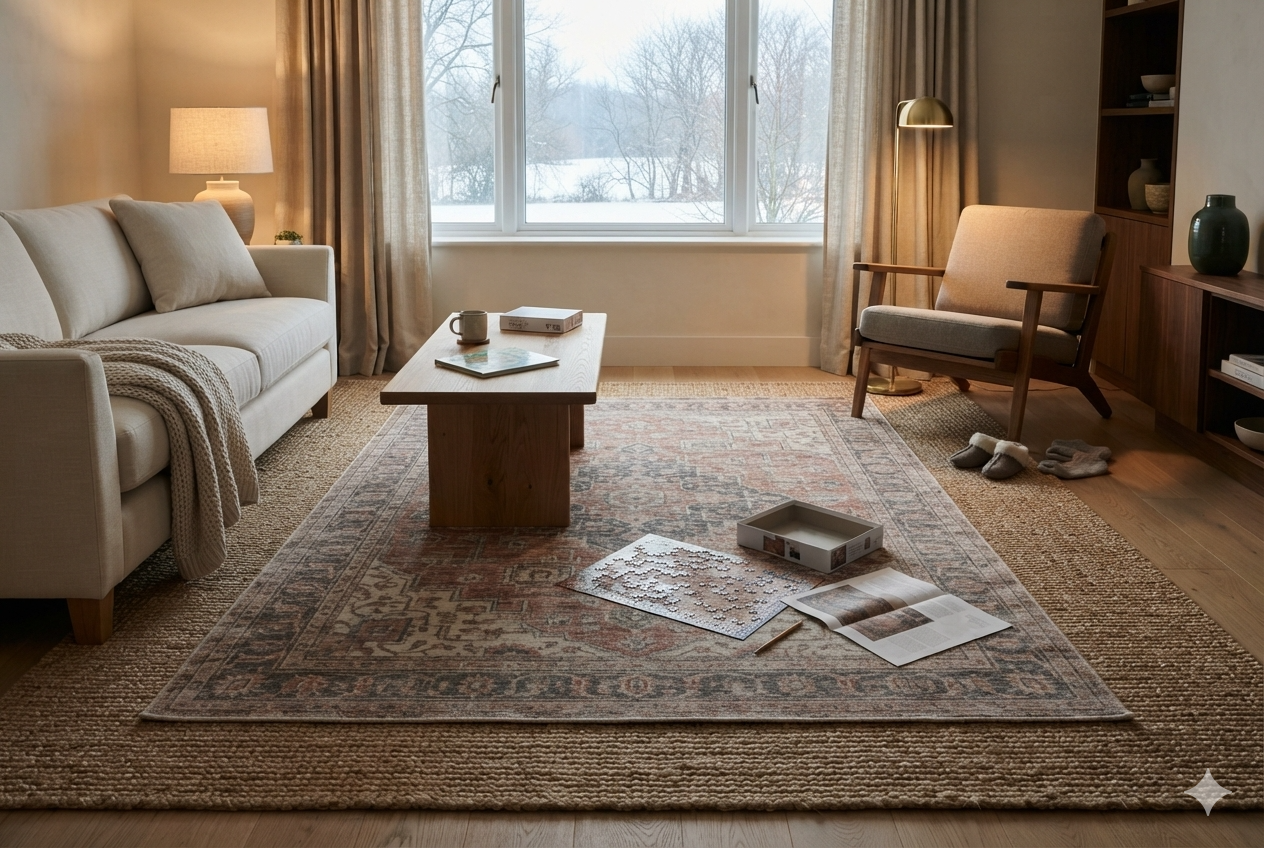
Maja was three‑quarters of the way through a thousand‑piece puzzle on the living room floor. The vintage rug under her kept sliding a few inches every time she leaned forward.
One corner bunched up, another drifted off the big jute rug beneath it. Soon half her puzzle pieces were on the wood floor instead of the rug.
“Mom. The rug keeps moving.” Her voice carried the frustration of someone who just wanted her puzzle to stay put.
The truth is, it had been moving for weeks. I’d been nudging it back into place with my foot, pretending it wasn’t a problem. A quick fix here, a shuffle there, and I never stopped to ask why it wouldn’t stay.
That Saturday, though, I couldn’t ignore it. A ten‑year‑old glaring at a sliding rug mid‑puzzle has a way of forcing you to sit down and face the issue.
I realized there was something fundamentally wrong — I did not know how to layer rugs. So I started paying attention. Why did the rugs bunch? Why did the layers look awkward instead of collected? What was missing from the setup?
That’s when it clicked. There’s a real formula behind what looks like a casual pile of rugs. It isn’t random. It’s structure disguised as ease.
And once I worked it out, the puzzle pieces stayed on the rug, the layers stopped sliding, and the room finally looked the way I had imagined and Maja wanted.
Here’s what I discovered.
This website participates in the Amazon Associates program. As an Amazon Associate, I earn from qualifying purchases. It also participates in the Impact and AWIN affiliate programs. If you buy through links on this site, I may earn a small commission at no extra cost to you. Thank you for supporting The Hugged Home.
Why One Rug Never Feels Finished
A single rug, however beautiful, is a purchase in isolation — one item, sitting on top of the floor, doing its one job. However, buying two or more rugs and layering them correctly is a well-thought-out purchase decision.
This is the same instinct behind the textiles rule I’ve written about before: hygge is built by layering comfort, not swapping one item for a better one. [→ Hygge Textiles & Layering]
A rug is no different from a throw blanket in that sense — it’s rarely the single best rug that makes a room feel warm. It’s all about how many layers of texture are stacked underfoot.
Astrid, predictably, had a rule for this long before I did.
“One rug is a floor covering,” she told me. “Two or more rugs is a cozy room.”
The Two-Thirds Rule for Layering Rugs
Here’s the two-thirds rule that solves most layered-rug mistakes.
The area of the top rug should be roughly two-thirds that of the bottom rug. Place it centered or slightly off-center rather than dead-center.
If the top rug is larger than two-thirds of the bottom rug, it stops looking like a layer as the bottom rug is barely visible.
If the top rug is less than half of the bottom rug, you will have issues of sliding, curling, and it may even become a tripping hazard.
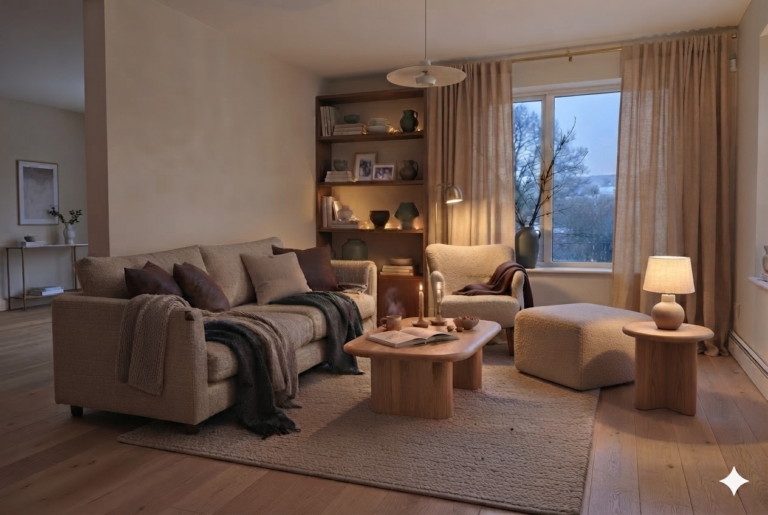
In our living room, the bottom layer is a 9×12 jute rug that runs nearly wall-to-wall. Earlier we had a 5×7 Persian rug on top of it. Very pretty but too small — just one-third of the bottom jute rug.
No wonder the top rug slid around, curled at the edges, and became a tripping hazard. I moved it into one of the bedrooms and got a new 8×9 soft wool rug for the living room.
Here’s the maths. The total area of the jute rug is 108 sqft. The total area of the original Persian rug was 35 sqft. The total area of the new soft wool rug is 72 sqft. This means the two-thirds-to-one-third ratio is now being upheld.
Pick Contrast, Not Matching
The first instinct when layering rugs is to choose two that look alike—same color family, similar style. Resist it. Layering works best when the rugs contrast. Each rug should serve a distinct purpose, not compete for the same one.
Start with a natural‑fiber base. Jute, sisal, or a flatweave wool adds texture and warmth without overwhelming the room with pattern. It grounds the space and creates a neutral foundation.
Then add a rug with personality on top. A vintage‑style Persian, a Berber‑inspired weave, or even a solid wool in a bold tone gives the eye something to rest on. This second layer should feel deliberate, not accidental.
When both rugs are busy with pattern, they clash. The eye doesn’t know where to land, and the layering feels chaotic.
When both rugs are plain, there’s no layering at all. It reads as two beige rectangles stacked on top of each other, more by mistake than by design.
Contrast is what makes the combination work. One rug anchors, the other elevates. Together, they create balance and depth instead of duplication.
Texture Does More Work Than Pattern
Pattern gets most of the attention in rug-shopping advice, but texture is what your feet actually notice. Texture makes a layered rug arrangement feel intentional rather than just decorative.
Jute and sisal are coarse and grounding underfoot — good as a base layer. Your feet rarely touch it, as two-thirds of it is anyway covered by the top rug,
A wool rug on top is denser and softer, the layer your feet are in touch with most of the time.
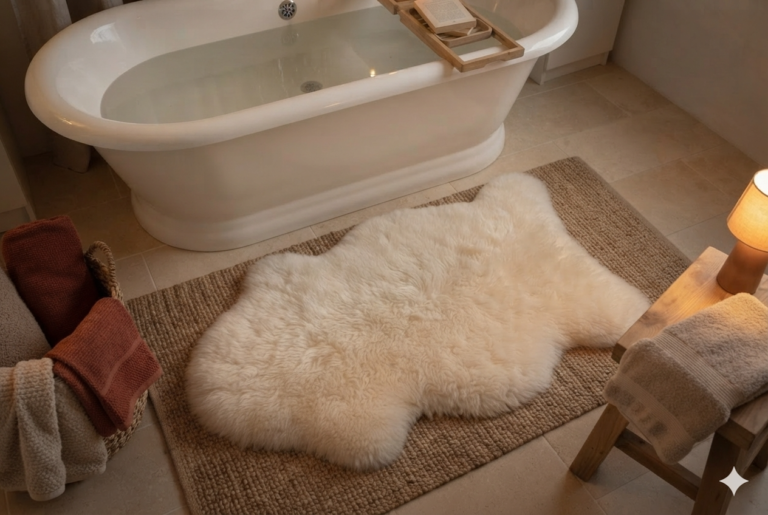
If you add a third, smaller layer — a sheepskin by an armchair, say — you get a third texture entirely: plush and warm, reserved for the one spot where someone sits still the longest.
If you are interested in buying one, I suggest the Woolous Genuine Sheepskin Rug, 2×3 ft, Natural Lambskin. It’s a single pelt, soft and fluffy underfoot, and is reasonably priced.
Three textures, three jobs. Each layer makes a different contribution, and together they create balance.
That’s the whole trick, and it’s the same layering logic behind every textile choice in this house, from throws to cushions. [→ Hygge Textiles & Layering]
The Rug Pad Nobody Talks About
This part isn’t glamorous, but rug pads make a huge difference when layering rugs. Both rugs need their own rug pad — not one pad under the whole stack, but one under the bottom rug, and a thinner one between the two rugs themselves.
Without a pad between layers, the top rug may creep and bunch every time someone walks on it, especially with kids or a cat treating it as a racetrack.
You need to pick the right rug pad. Matching the correct rug pad material to your flooring type protects surfaces from damage and slippage.
The best pairings use natural rubber for hardwood, felt-and-rubber combinations for tile or stone, and dense felt for carpet.
| Flooring Material | Recommended Rug Pad Material | Key Benefit & Safety Reason |
|---|---|---|
| Hardwood | Natural Rubber | Prevents sliding without sticking; avoids plasticizer chemicals that ruin wood finishes. |
| Tile / Stone | Felt & Rubber Combo | Provides strong non-slip grip on smooth surfaces while adding cushion. |
| Luxury Vinyl / Laminate | Pure Felt or Woven/Synthetic (Non-Rubber) | Prevents chemical reactions and permanent discoloration caused by cheap rubber/PVC. |
| Carpet | Dense Felt | Stops rug bunching through surface friction without needing a sticky rubber grip |
RUGPADUSA is my go-to brand for rug pads. It is the perfect rug pad for keeping rugs secure on all types of floors! Check them out. They are on Amazon.
How to Layer Rugs the Hygge Way: What to Skip
Skip layering two rugs of nearly the same size. When the top rug only covers half—or less—of the bottom one, it slips, curls, and quickly becomes a tripping hazard. If it covers more than two‑thirds, the layering effect will hardly be noticed.
Avoid layering directly over a rug with a busy border. Ornate woven edges are meant to be seen in full, not half‑hidden beneath another rug. To layer rugs, always start with a simpler base rug that won’t fight for attention.
And don’t force layering in a small room just because it looks stylish in photos. A layered-rug arrangement needs enough floor space to read as two distinct rugs.
In a tight space, the layering feels crowded and cluttered rather than cozy and intentional.
Layering is about balance, not excess. Knowing what to skip is just as important as knowing what to add.
The Living Room Now
After I’d worked out the issue of how to layer rugs, the living room (and the other rooms) not only looked prettier, but Maja could finish her puzzle without the rug sliding once. Even Björn seemed to approve the change.
For more on why hygge homes build warmth in layers rather than single statement pieces — throws, cushions, and the fibers worth investing in — see the full guide: Hygge Textiles & Layering.
Light a candle. Slow down. Hygge.
— Elise