Why Does Wood Feel Warm to the Touch (and Why Your Tile Never Will)
Six in the morning, bare feet, and the bathroom floor is ice cold. But the bedroom and the hallway oak floors are comfortably warm — the same bare feet, the same thermostat setting.
Same temperature in the bedroom, hallway, and bathroom, but why does wood feel warm to the touch while ceramic or stone tile feels cold? The answer is not in the thermometer; it is in your skin — and the science of heat transfer.
This website participates in the Amazon Associates program. As an Amazon Associate, I earn from qualifying purchases. It also participates in the Impact and AWIN affiliate programs. If you buy through links on this site, I may earn a small commission at no extra cost to you. Thank you for supporting The Hugged Home.
The Science Behind the Warmth of Wood
Your Hand Is the Thermometer
Skin has no thermometer for degrees. It has one for flow — how fast heat is leaving you.
Stand a wood chopping block and a cast-iron Dutch oven on the kitchen counter for a week, and they are both, to any instrument, the same 68°F. Put your palm on each; the chopping block feels warmer than the pot.
Why? Simple. The metal pot is drawing heat from your hand roughly 300 times faster than the wooden block. The cold you feel is actually your own heat leaving.
That is the whole answer to why metal feels colder than wood: it isn’t colder. It’s greedier.
The Ladder
Every material in your house sits on a conductivity ladder, and the rungs are not close together.
Air: 0.024. Wool: 0.04. Pine: 0.12. Oak: 0.17. Glass: 1.0. Granite: 2.5. Steel: 50. Aluminum: 200.
The bottom of the ladder holds its heat; the top of the ladder steals it. Wood sits so low that it barely trades with your skin at all.
The thermal conductivity of wood vs metal isn’t a close comparison — they are in two different leagues.
The Skin Threshold
Touch has its own number: thermal effusivity, the rate a material sucks heat at first contact.
Your skin sits around 1,000 to 1,400. Anything below skin reads warm — wool at about 100, wood at 400 to 700.
Anything above reads cold — stone at 2,000 and up, steel near 14,000.
One threshold explains the warmth or coldness of every surface in the house: the counter, the rail, the bench, the bath mat.
This is for touch what 2700K is for lighting.
The Slow Release
Low conductivity cuts both ways. The window seat that catches the two o’clock sun is still warm at four, because wood releases its borrowed heat as slowly as it steals yours. Stone dumps its warmth in minutes. Wood banks it.
The ladder at a glance — five rungs, from the hug to the cold shock. The numbers are approximate; the feel is not.
| Material | Conductivity (W/m·K) | Effusivity | Feels at 68°F |
|---|---|---|---|
| Wool | 0.04 | ~100 | A hug |
| Oak | 0.17 | ~500 | Warm |
| Glass | 1.0 | ~1,500 | Neutral-cool |
| Granite | 2.5 | ~2,300 | Cool |
| Steel | 50 | ~14,000 | Cold shock |
The Touch Map: One Saturday, One House
One January Saturday, coffee in hand, I walked the house and asked every room three questions. What steals? What can be replaced without a renovation? And what can only be layered?
The rule that came out of it: fix only what bare skin touches often. The brass stem of the floor lamp gets a hand once a day — it stays. The bed rail gets a shin at 2 a.m. — it goes. Touch frequency is the budget.
Keep, replace, layer.
Most of the house landed in the third column, which is the affordable, easily doable column.
The water rooms first, because water always wins — then the rooms I rebuilt over the years and you can too.
The Rooms Where I Added Wood Objects or Warm Layers
The Bathroom
The coldest room in the house, and the least fixable — tile and stone stay, because water demands them.
So the warmth goes on top: the sheepskin bath mat at the tub, a wood stool by the sink, linen towels instead of the shiny synthetic ones, the wood bath tray across the tub for the evenings that count.
The stone counter keeps its stone coasters — stone for protection, wood for touch, the pillar’s old truce. The room keeps its bones; the skin changes.
The Kitchen Counter
The granite stays — knives and hot pans decide that.
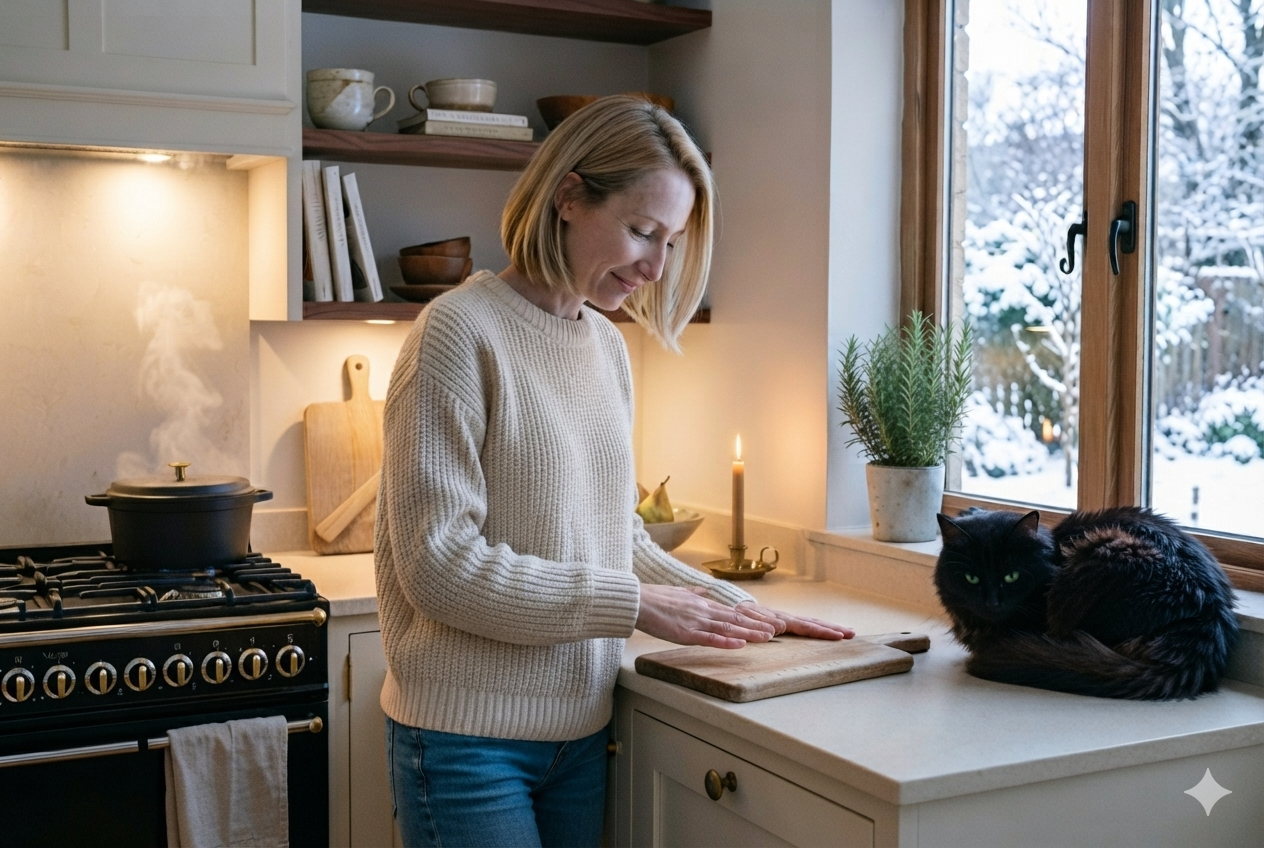
The warmth lives in the small additions: the John Boos Maple Cutting Board that never goes back in the cupboard, parked next to the cooking range; wood stools replacing the metal ones; a PÜSKÜL Natural Cotton Waffle Kitchen Towel over the oven handle, the most-touched rail in the house.
And the stainless refrigerator, the coldest touch in the kitchen? It stays. Of course, and anyway nobody hugs a fridge.
The Rooms I Rebuilt (Piece by Piece)
Some rooms passed the audit years ago, one Astrid visit at a time — the living room and the bedroom went wood gradually, and stayed. What follows is for the rooms that are still losing.
The Entryway
The entryway now has wood underfoot despite the boots, because the layers protect it from water and snow.
A pebble tray takes the melt, a coir mat takes the threshold, a wool runner takes the path — the runner is the bottom of the conductivity ladder, air and fiber, moved under the footstep.
And the hooks went from plastic to wood, because a coat hook is a touch you make twice a day with a bare hand in winter.
The Living Room
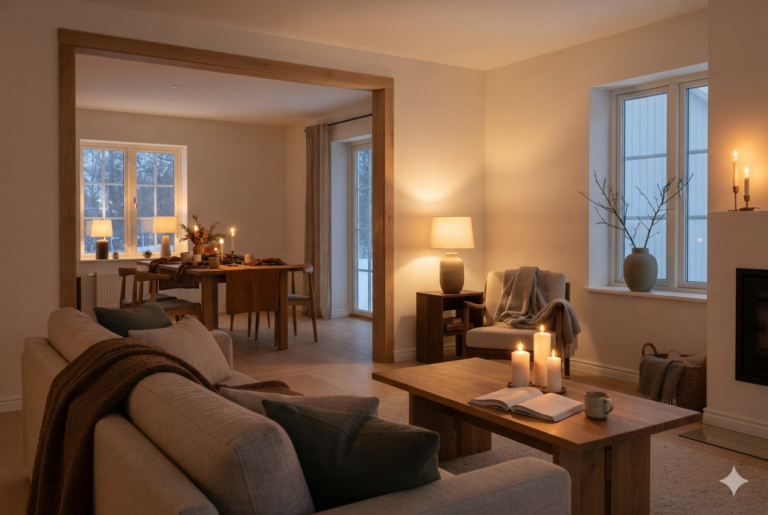
The glass coffee table went first — glass sits above skin on the effusivity ladder, so it steals, and it flattened the light besides. Wood took the center of the room and never gave it back.
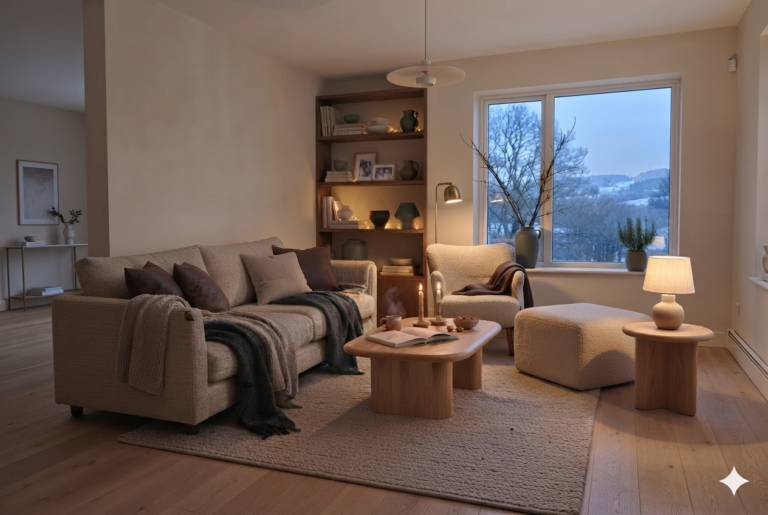
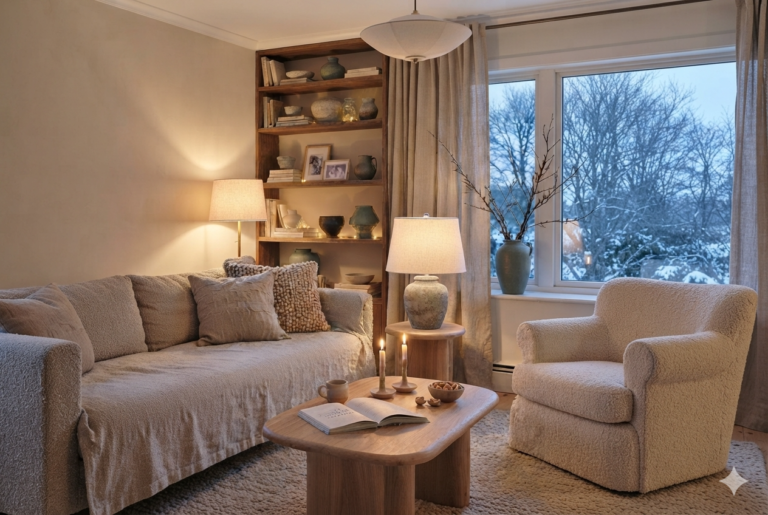
The metal-frame chair gave way to the cream armchair by the window, Henrik’s hyggekrog — the one spot where he can be truly at peace with himself. It is all wood, wool and linen. Real cozy and warm to the touch!
There are a couple of chunky-knit throws that live on the sofa — folded but loosely, because they are used most evenings.
A small side table beside each chair keeps tea, a glass of wine, books, and puzzles close at hand. Always wood, always warm to the touch.
Small changes that make even winter evenings longer and conversations easier.
The Bedroom
The metal bed rail was the original complaint, so the frame went to wood. I stopped complaining the very first winter after the change.
Even insulated glass never stops stealing heat from the bedroom. So, the cold window glass got a curtain layer, heavy and pooled.
And the bedside landing got the sheepskin — the first soft touch of the morning and the last of the night.
Why Does Wood Feel Warm: The Touch Test
In the store, hold the sample for ten seconds. The wood, the stone, the metal — palm flat, eyes closed, ten seconds each.
The first two seconds are marketing; the next eight are science. No spec sheet required — the threshold in your skin is older than the ladder. Your palm votes before your budget does.
The Sauna Inversion
Here’s proof the Scandinavians are not just being sentimental. A sauna runs at almost 200°F (90°C), but everything you touch inside is wood — because at that heat, wood is still safe.
Steel at that temperature will blister your skin instantly. The same property that makes oak feel warm at 68°F (20°C) keeps it survivable at almost 200°F (90°C).
Forget sentiment. Forget feelings. Saunas prove it’s science. Astrid puts it best: “We don’t touch the stove. We sit on the bench.”
Touch Tells the Truth
Touch is a report card. A well‑oiled tabletop feels like wood — warm, alive, grain‑deep. A dried‑out surface, or one sealed under lacquer, feels like plastic.
Lacquer sits above skin on the thermal ladder, and you can feel the sleeve between you and the tree. Oiled vs. lacquered wood is the difference between a handshake and a handshake through a glove.
That’s why the once‑a‑season oiling isn’t a chore — it’s how the ladder stays honest. My go‑to is Tried & True Original Wood Finish: no VOCs, no film, just oil and beeswax. Fifteen minutes, a soft cloth, and the table goes back to speaking wood.
The Seat at Four O’Clock
The afternoon sun leaves Maja’s reading nook by the window at three. At four, when the lamps come on, the seat is still warm — wood banking its afternoon the way it banks everything, slowly.
Maja reads there with Björn, who arrived first and claims precedence. I put my palm flat on the oak beside her, the way you check a forehead. Warm. The house banks its own heat.
P.S. The ladder starts with the material — read the Solid Wood Furniture guide for the pieces worth keeping forever, and the linen vs flannel guide for the same physics, one layer closer to your skin.
Light a candle. Slow down. Hygge.
— Elise