2700K Light Bulbs: Why Yours Are Ruining Your Evening
It is four-thirty on a Tuesday in early November. The layered lighting routine I mapped out in the complete winter guide is almost working.
The entry lamp is glowing on its timer. The kitchen under-cabinets are on. The living room floor lamp is casting a low pool of light as required.
But the hallway lamp—the one between the bedrooms—is throwing a flat, white sheet over the wool runner on the console.
It is a 4000K “daylight” bulb I bought in a hurry at the hardware store last spring, back before I understood the physics of the evening.
Freya stops mid-sentence on the stairs and squints. “It feels like morning in here,” she says. “But it should be evening.”
The box had said daylight. That was the problem. The rest of the house was doing evening, and this one bulb was shouting noon.
One bulb. A clinic.
Before I could build the three-layer system that runs this house by December, I had to fix the bulb itself. Here is the 2700K rule that made the rest of the layers possible.
This website participates in the Amazon Associates program. As an Amazon Associate, I earn from qualifying purchases. It also participates in the Impact and AWIN affiliate programs. If you buy through links on this site, I may earn a small commission at no extra cost to you. Thank you for supporting The Hugged Home.
3 Reasons a Bulb Can Ruin Your Evening
You need to know the Kelvin scale, melatonin, and flicker to understand how the wrong choice of a light bulb can actually ruin your evening and your sleep.
Kelvin Is a Temperature, Not a Brightness
The Lumens vs. Kelvin mix-up is where most of the confusion in the aisle starts.
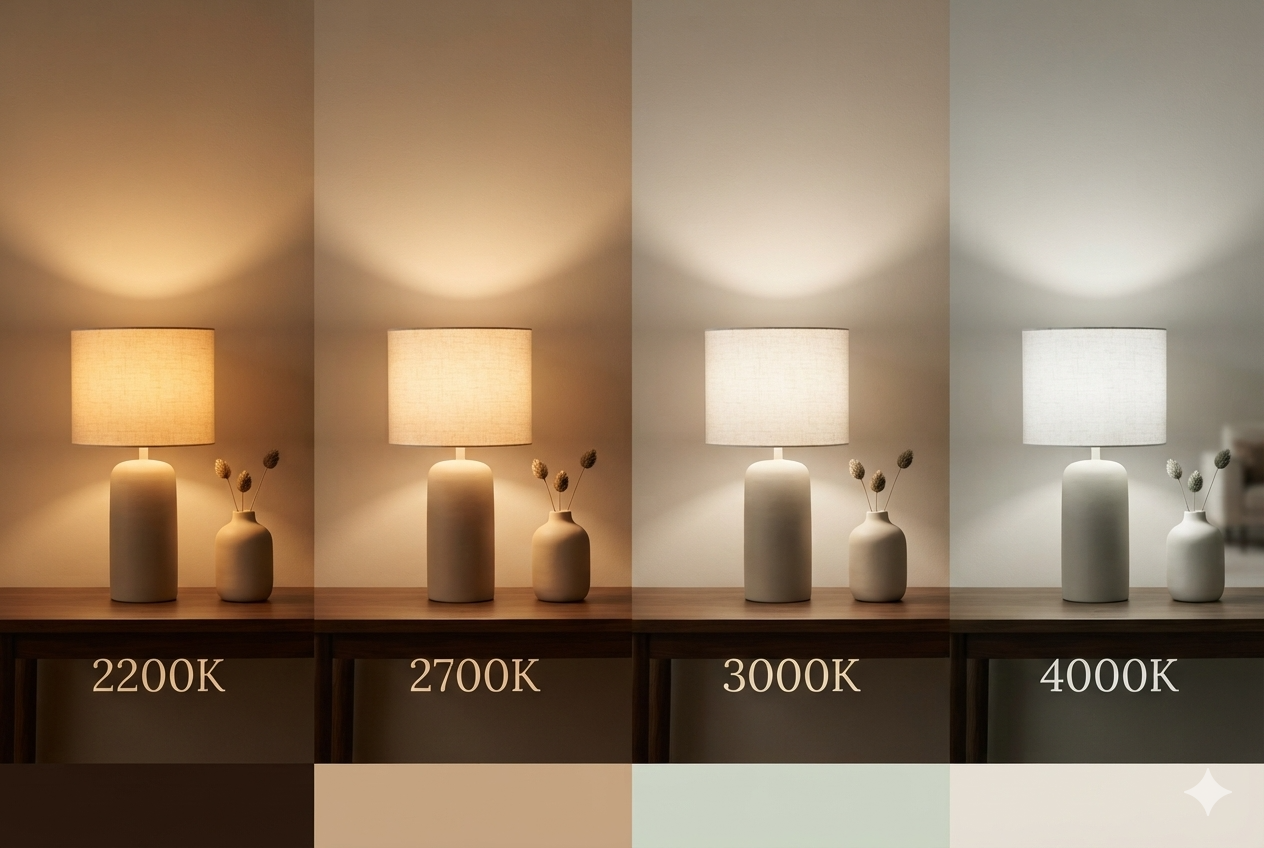
Lumens measure brightness. Kelvin measures color temperature. The Kelvin scale runs backwards from what your instincts expect: the lower the Kelvin, the warmer the light. Picture it as:
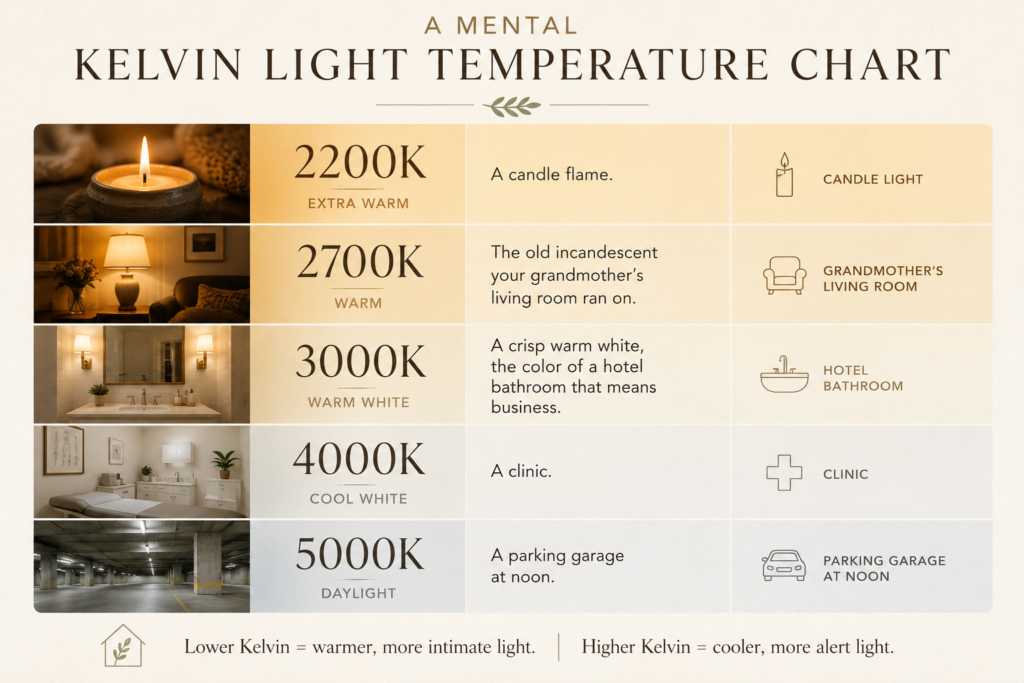
Some, including light bulb manufacturers, may describe 3000K as the “cozy” choice, but I am of the firm opinion that to hygge you need to be in the 2200K to 2700K range. Numbers do not lie; so decide what works for you.
The Melatonin Tax
After sunset, blue light tells the brain the sun is still up, and the brain responds by holding back melatonin, the hormone that lowers the drawbridge to sleep.
Harvard Health has even documented how strongly blue-rich evening light suppresses melatonin and shifts the circadian clock.
The full story of our bedroom bulb swap — the night Astrid ordered every bulb under 2700K — lives in the hygge bedroom guide.
The short version: the bulb over your nightstand is a sleep decision, not a decor decision. If you are shopping for light bulbs for better sleep, the prescription is boring and beautiful: warm, dim, low.
Flicker and the Eye That Never Rests
Cheap LEDs carry two quiet defects you may not notice.
The first is flicker: many budget bulbs strobe at 100 to 120 times a second, below conscious sight but not below the nervous system.
The second is low CRI: a low color rendering index (CRI) is why your walnut shelves and your own hands look gray and flat under a bargain bulb.
Flicker-free LED bulbs with a high CRI cost a few dollars more but pay it back every evening.
9 “Must Do’s” for Every Lamp in the House
There is no single best light bulb for the entire living room, leave aside the entire house. There is a right bulb for each lamp, and these nine decisions are how we make the call, room by room.
1. Read the label like a food label
The Lighting Facts label on the box is the ingredient list. Kelvin first, Lumens second, Watts last, because Watts only tell you the energy consumption.
Even the U.S. Department of Energy’s buyer guide files 2700K under “friendly, personal — homes,” while 4100K is best for offices and showrooms. The aisle was never neutral.
And learn the soft white vs warm white trap: “soft white” is an adjective, not a number, and it can hide anything from 2700 to 3000K. If the Kelvin isn’t printed, the bulb doesn’t belong in the evening half of your house.
2. Run the whole house on 2700K (with one exception)
The biggest myth in the lighting aisle is that you need “cool white” (3000K or 4000K) to see well enough to work. You don’t.
As I learned when wiring the kitchen task lighting, Kelvin and Lumens are separate dials. Kelvin is the color; lumens are the actual brightness.
You do not need a harsh, blue-white 4000K bulb to chop an onion safely—you just need a 2700K bulb with more lumens and a high CRI.
Keep the 2700K rule unbroken across your task zones and living layers.
The only exception is 2200K, which is strictly reserved for decorative, exposed bulbs in ambient zones—like a clear-glass dining room chandelier or an entryway sconce where the glowing filament is the decor.
Relegate 3000K and 4000K bulbs to the garage workbench, where the evening never goes.
3. Dimmable by default; warm-dim where the evening lands
A non-dimmable 2700K LED bulb can cater to just one mood. So, dimmable 2700 K LED bulbs are the baseline now. But all dimmable bulbs behave in the same way.
Most dimmable LED bulbs get less bright, without getting warmer. Philips LED bulbs with a warm-glow dimming effect dim just like traditional incandescent bulbs. They get warmer in tone as the light gets dim.
Philips explains the warm-glow effect on its own pages, and it is the closest an LED gets to remembering fire.
My Pick: Philips Warm Glow dimmable 2700K A19. It dims the way an incandescent did — warmer in tone as it falls — so the room at ten percent looks like candlelight, not a refrigerator with the door ajar.
4. Light Bulb Specs and Uses
Codes like A19, B11, and G25 on light bulb specs describe the shape and physical size of a light bulb.
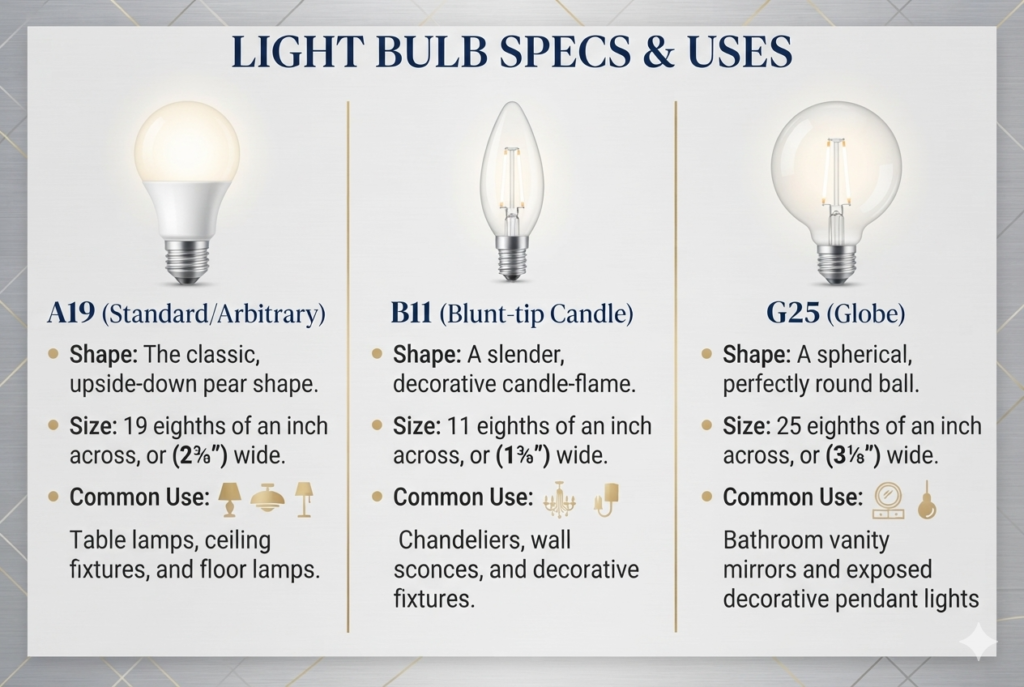
And where the fixture is open, and the bulb is the show — the krog pendant, the entryway sconce — hang an Edison bulb warm-glow filament and let it be the levende lys understudy it was born to be.
My Pick: 2200K LED Edison filament bulb. A 2200k candlelight bulb with a visible filament for every open fixture; the glow is the point, and it throws no blue at all.
5. CRI 90+ when applying make-up or dressing up
CRI is the number that decides whether your walnut credenza looks like walnut or like cardboard. Above 90, colors render the way they do under candlelight and daylight.
Philips’ own quality-of-light pages make the case for high CRI — a rare advertisement worth agreeing with.
My Pick: 90+ CRI 2700K G25 globe. For the vanity and any lamp that lights a face; CRI 90 or higher light bulbs render skin and wood much closer to reality.
6. Do the phone-camera flicker test
Point your phone camera at the lit bulb and watch the screen. If you see a strobe or rolling bands, the bulb is flickering.
You do not want it in your home; it belongs in the garage. Ten seconds, no equipment, and it explains half the “headache by nine o’clock” houses I have ever stood in.
7. One warm pool per seat
Cozy lighting for the living room is not a fixture count; it is a coverage rule. Every seat where a person is likely to sit gets its own warm pool of light at elbow height — layered lighting carries the three-layer doctrine.
The bulb inside each pool is 2700K, and the pools are allowed to overlap. The ceiling between them stays dark.
8. No cool-white ambush at 2 a.m.
The hallway, the bathroom, the nursery: these are the rooms that catch you half-asleep, and a 4000K blast at two in the morning is an assault on your biology.
Warm light for bedroom at night means 2700K at the mirror — yes, 2700K bathroom vanity lighting included — and an amber night light bulb, 1800 to 2000K, in the hallway plug-in.
Amber is the color the brain forgives when you are half-asleep.
9. Retire the cool whites to the garage
Practice over purchase applies to bulbs too. Don’t trash the daylight bulbs; the garage, the workshop, and the basement storage all need bright, cool light for finding screws.
So, retire them with honors. Let every room where a person rests run on the warm end of the scale, and let the workbench keep the noon.
The 2700K Light Bulbs Rule Restored
Henrik is on the step stool in the hallway, glasses fogged, the old 4000K bulb still warm in his palm like a just-extinguished match. The new 2700K bulb clicks home.
The hallway exhales from clinic to honey. The wool runner gets its color back.
By five-thirty, when I start my walk through the house turning on the evening layers—the entry lamp, the kitchen strips, the living room floor lamp—the hallway is finally speaking the same language as the rest of the rooms.
The rule of 2700K light bulbs has been restored. Layered light only works when every single bulb agrees on the temperature and when that temperature is always 2700K.
For the three-layer doctrine that tells each of these bulbs where to sit, start with layered lighting — or go straight to the full hygge lighting philosophy and rewire the whole house one click at a time.
Light a candle. Slow down. Hygge.
— Elise