The Complete Guide to Layered Lighting: How to Light a Home, Room by Room
It’s five-thirty on a Tuesday in December, dark enough outside that it might as well be midnight, and I’m walking through the house turning on lights the way I do every evening this time of year — not all at once, and never the overhead switch.
The entry lamp is already lit; it’s on a timer now, so it’s glowing before I even open the door. In the kitchen, the under-cabinet lights come on first, then one lamp on the counter. Nothing overhead.
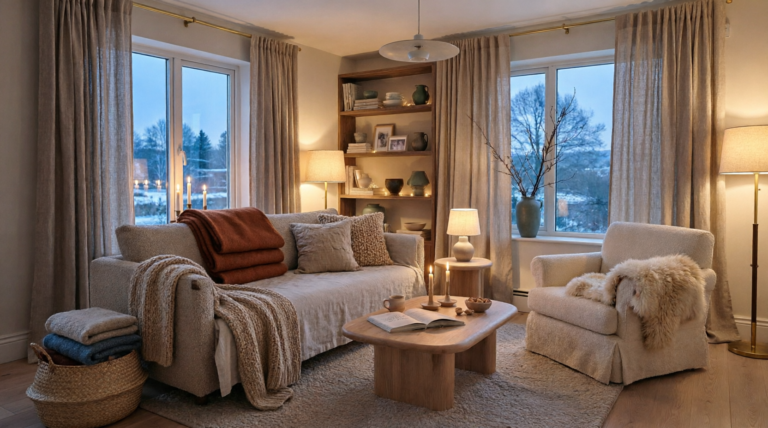
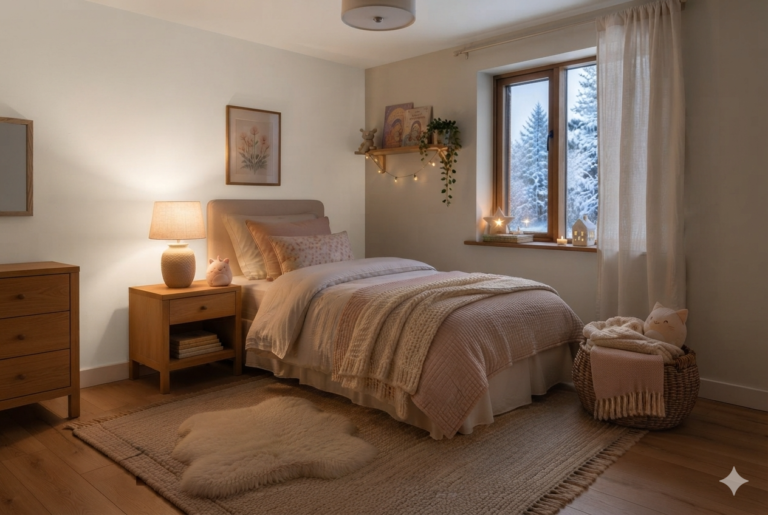
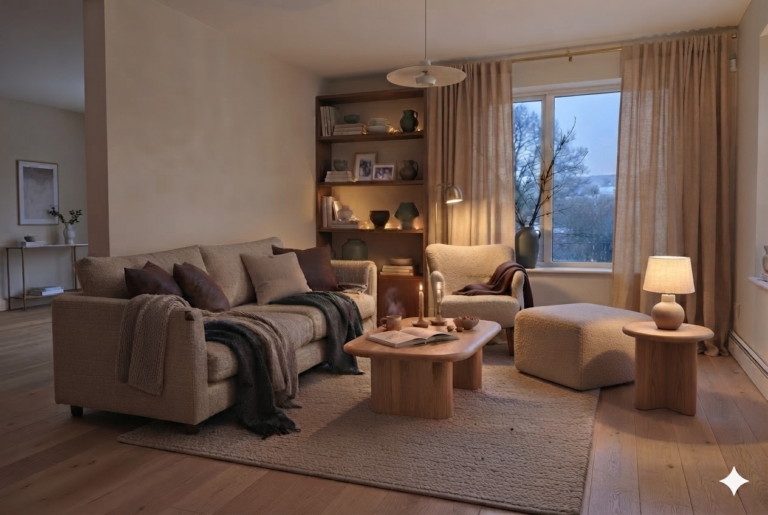
In the living room, it’s the floor lamp and a candle, not the ceiling fixture. In the bedroom, it’s just the two lamps on either side of the bed.
Not one of these rooms uses only a single light source. That’s not an accident, and it’s not really about any lighting technique, either, though it happens to be an excellent lighting technique.
Winter here is long — five months of dark by five o’clock, some years closer to six. Layered light is how this house makes that stretch feel chosen instead of endured.
One bulb was never going to do that job. It was never built to.
This website participates in the Amazon Associates program. As an Amazon Associate, I earn from qualifying purchases. It also participates in the Impact and AWIN affiliate programs. If you buy through links on this site, I may earn a small commission at no extra cost to you. Thank you for supporting The Hugged Home.
Why One Light Source Is Never Enough
There was a time when I used to think good lighting meant a single standout fixture—an elaborate chandelier or an elegant pendant over the dining table, or perhaps an industrial floor lamp in the study.
It took an embarrassing conversation with my Danish friend Astrid to realize that a room doesn’t just need light; it needs layered lighting.
“You are thinking like an electrician,” Astrid told me. “Your instinct is to solve a room all at once. Hygge never works by solving a space, it builds it, one small pool of light at a time.”
An overhead fixture makes a room feel like a dentist’s waiting room, evenly, completely, and with no soul. Your brain reads that flat, shadowless light as daytime, no matter what the clock says.
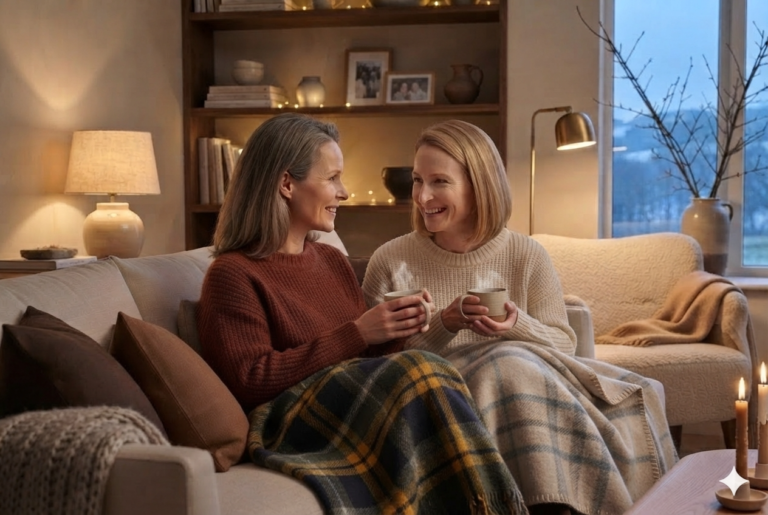
On the other hand, multiple lower, warmer light sources create pools of light and pools of shadow, and that contrast is what your nervous system reads as evening, the cue to slow down.
The 2700K Rule
The one lighting rule that Astrid lives by is: no bulbs with a temperature over 2700K should be turned on after dusk, especially in winter. This has now become my rule too.
Guess what? We are not alone!
“2700K is our go-to for most rooms. It provides a soft, warm glow that feels natural without being overly yellow.” – Sophie Paterson Academy
That’s the color temperature you want on every bulb in every room, unless it is in overhead fixtures and turned on for detailed work like chopping vegetables or sewing.
Look at the packaging; it’ll say 2700K, or “soft white,” or occasionally “warm white.” Anything at 3000K or more creeps toward a colder, whiter cast.
Philips Hue Essential Smart LED A19 Bulbs work for us. These smart bulbs are perfect, as you can vary the temperature from 2200K to 6500K. I love these bulbs! They are easy to install and give the desired lighting for any room.
The Three Kinds of Light You’re Actually Working With
To create hygge lighting in every room of your home, you need to understand the three different kinds of lighting. You need each, but they play a different role.
Ambient light
Ambient light is the base layer — the general glow that lets you walk through a room without stubbing your toe. It’s not meant to be noticed. It’s meant to be enough.
In most homes, this defaults to the overhead fixture, which is exactly the problem: ambient light doesn’t have to come from the ceiling.
A few lamps, spread around a room at different heights, can do the job of “general light” far more gently than one bright source straight overhead.
Task light
Task light is the light you actually need to do something by — read a paperback, chop an onion, find the right pair of scissors in a drawer. It’s brighter and more focused than ambient light, and it’s meant to be temporary. On, then off.
A reading lamp beside the armchair. Under-cabinet strips in the kitchen. A small lamp on a desk. Task light comes on to perform, and goes off once the job ends.
Accent light
Accent light is the one people often skip, but it’s the one that actually makes a room feel considered.
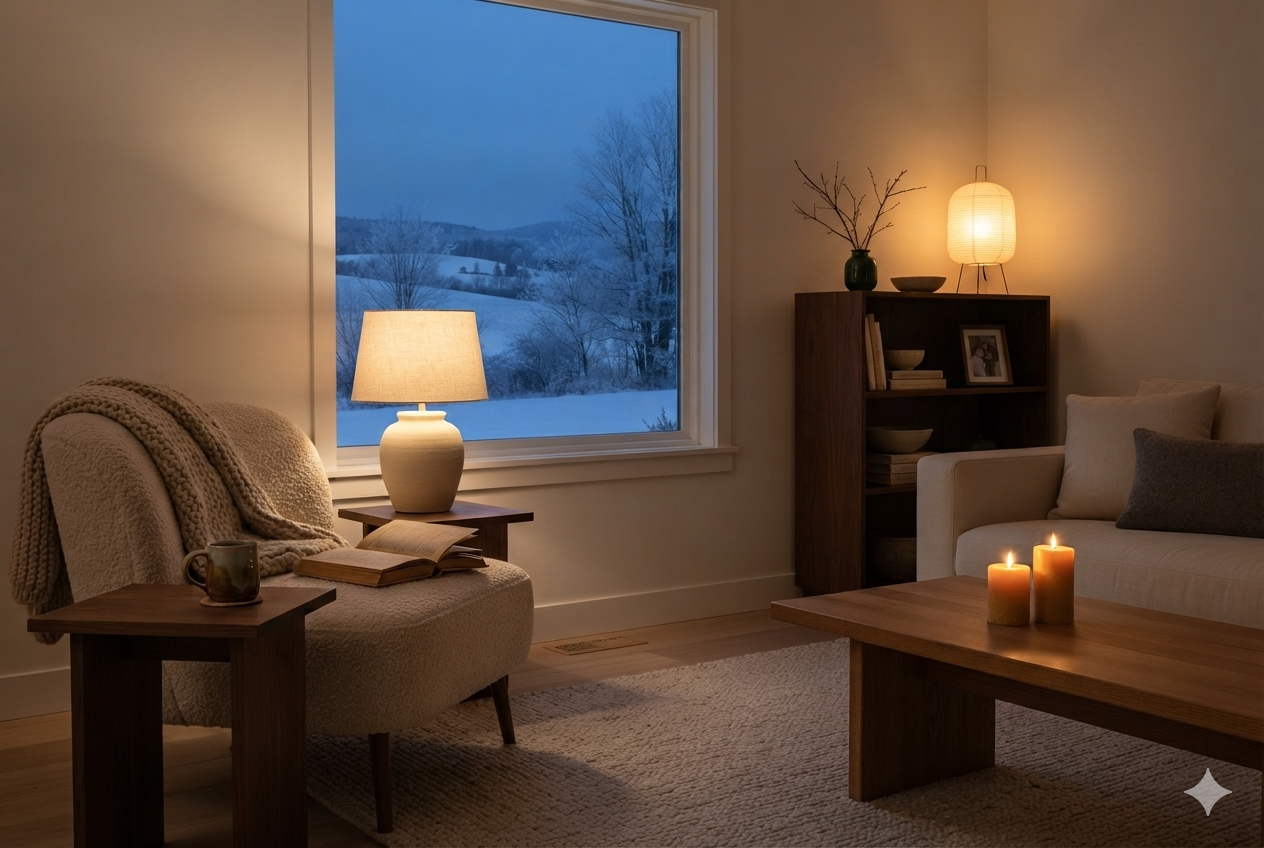
It’s light with no practical purpose at all — a small lamp lighting up a bookshelf, a candle glowing on a windowsill, a picture light over a piece of art. Accent light doesn’t help you see. It helps the room feel cozy, a delight to be in.
Here’s the part that trips most people up: a room usually has only ambient and task light, and nothing else. That’s what makes it feel functional instead of warm — every light in it is working, and nothing’s just there to glow.
The rooms that feel effortlessly cozy almost always have all three types running at once, at different heights, doing different jobs.
That’s the essence of layered lighting. That’s what my house embodies. That’s what this guide is all about.
The Larsen House, Layered Lighting Room by Room
Every room in this house gets some version of the layered lighting rules, but never the same combination twice, because every room is different.
Living Room
One floor lamp in the corner near Henrik’s hyggekrog — [→ see the hygge living room] — positioned to cast light downward and inward.
A table lamp on the bookshelf at the opposite end of the room. Two or three candles on the coffee table and side table.
For the overhead lights, we went for a Philips Hue Wireless Dimmer Switch; it’s easy to install and control! We rarely use it, though, from October through March.
Kitchen
The under-cabinet ambient lighting handles the actual cooking; a single warm bulb over the counter serves as task lighting (I switch it on only when I am chopping vegetables).
Always a candle on the kitchen counter, lit before the pot goes on the stove rather than after. [→ The Hygge Kitchen]
Bedroom
Two matching lamps, one on each nightstand, and nothing overhead at all after dark. This is the one room in the house where the ambient layer is deliberately left out most evenings.
Restraint is the correct call for a room where you sleep. The light’s only real job is to let you read before you drift into sleep. [→ The Hygge Bedroom]
Dining Room
Once again, always a single candle, lit before anyone sits down. More candles on birthdays, Christmas, or when we have visitors over, for dinner.
Two table lamps on the console along one wall provide all the ambient light we need. Task lighting is not required here. [→ The Hygge Dining Room]
Entryway
A small lamp on the entrance table. Another porch lamp outside. Both on the same timer, set at 4 pm during winter. None of us arrive at a dark, cold home that is not ready to welcome us.
Henrik or I light the candle on the table, depending on who is back earlier. [→ The Hygge Entryway]
The Complete Guide to Layering Light, One Layer at a Time
Most lighting advice online treats this as a shopping list. Here’s the fuller picture — what each layer is actually for, and how to build one inspired by hygge and with the sole objective of making your home cozier and more welcoming, even in winter.
Ambient Layer
1. Start with bulb temperature, not fixtures.
Before buying anything new, check the Kelvin rating on every bulb already in the room. Anything above 3000K is working against the mood you’re trying to build, no matter how nice the lamp itself is.
2. Aim for soft and diffused, not bright and direct.
A bare bulb is always harsh on the eyes even at the right temperature. A fabric shade, frosted glass, or an uplight bouncing off the ceiling softens the same light source considerably.
3. Keep ambient light off a single switch if you can.
A dimmer on the main ambient circuit means the difference between “cleaning day” brightness and “winding down” brightness is one turn of a dial, not a different bulb.
Task Layer
4. Light the surface, not the room.
A task light aimed at a countertop, a desk, or a reading chair does its job even in an otherwise dim room. Task lighting doesn’t need to compete with the ambient light; it just needs to reach the surface where the work is being done.
5. Check the CRI, not just the brightness.
Color Rendering Index measures how accurately a light source shows true color — useful shorthand when you’re chopping vegetables or checking a stain. Aim for 90 or above anywhere color accuracy actually matters.
6. One task light per activity, not per room.
A kitchen might need under-cabinet lighting for chopping and a separate pendant over the sink for dishes — two task zones in one room is normal, not excessive.
Accent Layer
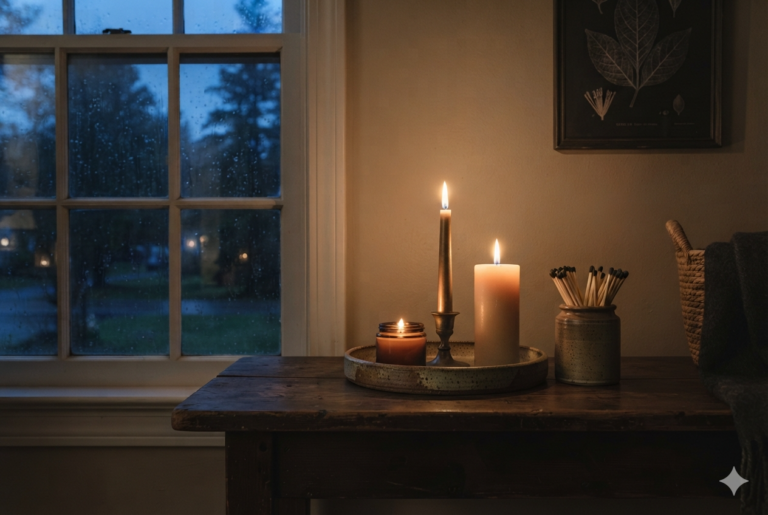
7. Let candles do accent work no bulb can.
There is a reason the Danish word for candles is levende lys, literally “living light.” Not a mood. Not a setting on a dimmer. Light that behaves like it’s alive — it flickers, it leans, it asks, in its own small way, to be tended, not turned on. [→ Full guide to Hygge Candles]
8. Use accent light to highlight one thing, not the whole wall.
A single picture light or a lamp positioned to catch a piece of art does more than the same wattage spread evenly across a room.
9. Accent light is the layer most rooms are missing entirely.
If a room has ambient and task covered but still feels flat, accent is almost always the gap — it’s the smallest layer and the easiest one to forget.
Control and Flexibility
10. Put ambient and accent on separate circuits or switches where you can.
Being able to kill the overhead light while keeping a lamp on is the single most useful piece of lighting infrastructure in this whole guide, and it’s often just a matter of which switch controls which outlet.
11. Consider a smart system if you want scenes, not just on and off.
Philips Hue Starter Kit is really smart and very easy to set up. The color and dimmer options are impressive – there are so many choices to create the perfect mood for any room.
Perfect for creating the perfect ambiance, it lets you save one-tap scene settings — “cooking,” “winding down,” “company’s coming” — instead of adjusting three lamps individually every evening. [→ Nest List: Philips Hue starter kit]
12. Rechargeable, wireless lamps solve the outlet problem.
For dark corners with no nearby socket — a common problem in older houses like this one — a rechargeable lamp lets you create a pool of warm light in a spot that would otherwise have just stayed dark all winter.
What the Light Is Actually For
By six, every room downstairs has its evening layers on. None of them match each other, but then, none of them are supposed to. The kitchen is doing dinner. The living room is doing nothing in particular, which is the whole point. The entry lamp is still glowing for whoever gets home last.
None of this is really about lighting technique, even though a professional uses the same rules. It’s about what five months of early dark are going to feel like in this house — endured, or chosen.
Layered light is the cheapest, least dramatic way I know to make this home hug back, one bulb and one lamp at a time.
For the two rooms that get their own full lighting breakdown, see The Hygge Living Room [→ Layered Lighting for the Living Room] and The Hygge Bedroom [→ Layered Lighting for the Bedroom].
For everything else, start with The Complete Guide to Hygge Home Decor [→ Hygge Home Decor].
Light a candle. Slow down. Hygge.
— Elise