The Hygge Kitchen: Why Danes Cook Differently in Winter
The Hygge Kitchen TL;DR
- The hygge kitchen is not just a room for cooking, but a place for slowing down and savoring the process.
- Hygge in the kitchen is about presence and the deliberate choice to be in the moment, not just about aesthetics.
- Danes cook to enjoy the process of chopping, stirring, waiting, and tasting, which is considered hygge itself.
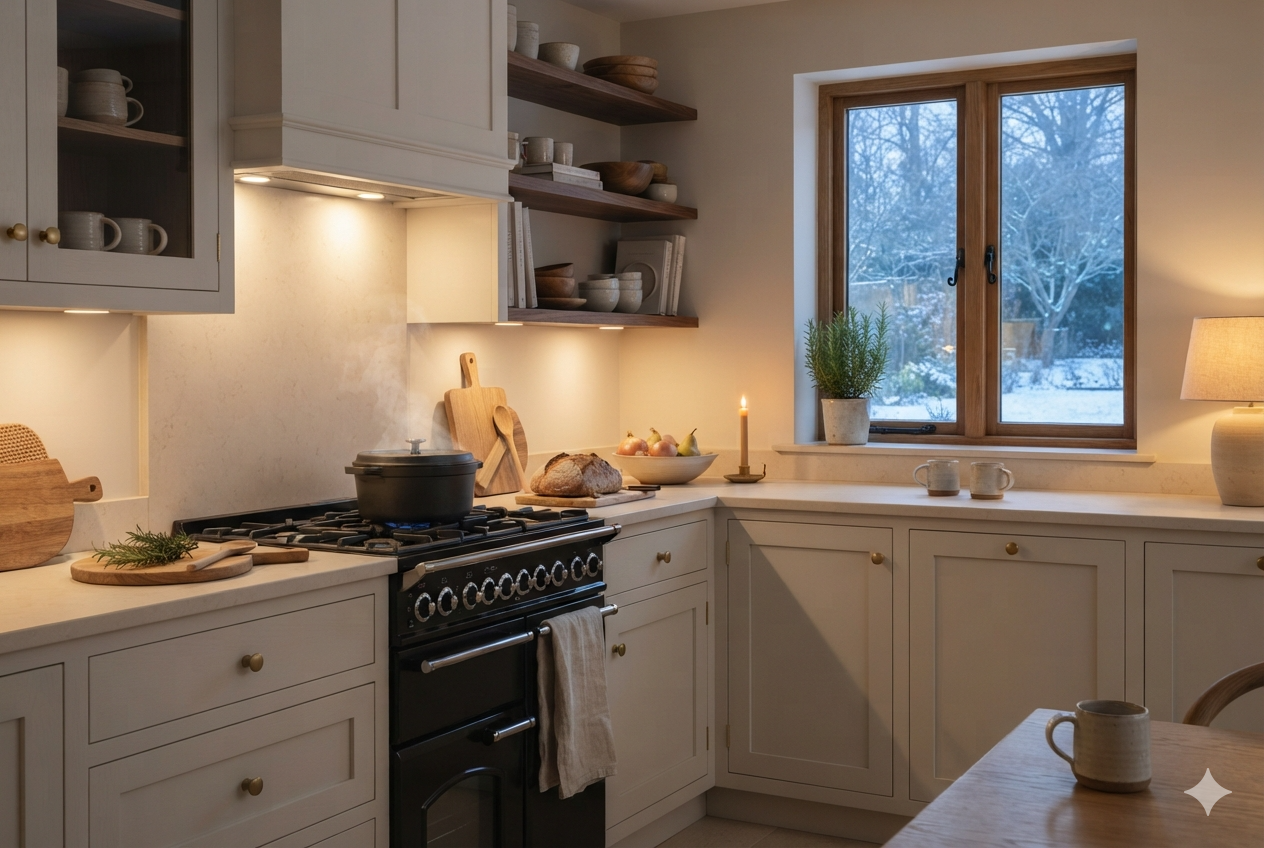
- Essential hygge kitchen decor includes open shelving to display everyday items and natural wood elements like cutting boards.
- Cozy kitchen lighting should be layered and warm, avoiding harsh overhead lights.
This website participates in the Amazon Associates program. As an Amazon Associate, I earn from qualifying purchases. It also participates in the Impact and AWIN affiliate programs. If you buy through links on this site, I may earn a small commission at no extra cost to you. Thank you for supporting The Hugged Home.
It was a typical Sunday afternoon in January. My cast-iron pot was already on the stove. I lit a candle and placed it on the counter.
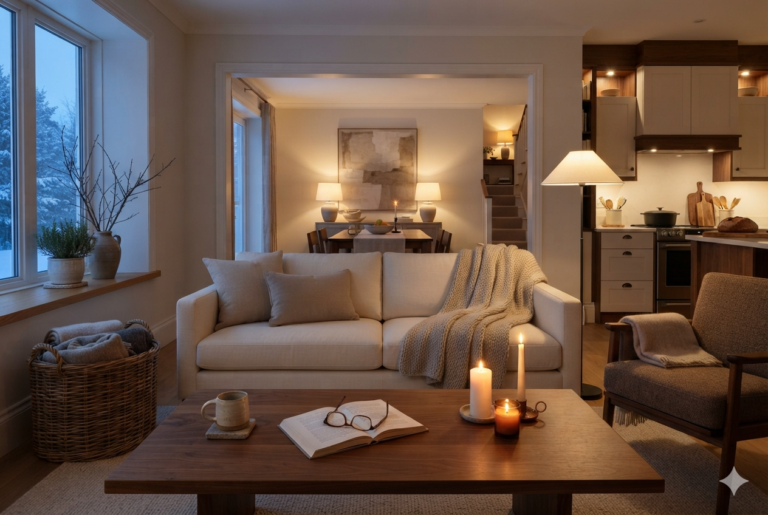
It is cold outside. I can see it through the kitchen window. But in here, it is cozy, warm, and comforting. This is it, me in my hygge kitchen, the soup simmering slowly, the smell of onions and thyme wafting through the house.
Henrik is in his own hyggekrog in the living room, reading. The girls are playing on the rug, and Björn has settled under the coffee table.
I remember thinking: This is the best time in my week. Not because anything remarkable is happening. But because nothing is.
This is what Astrid means when she talks about the Danish kitchen. Not the cabinets. Not the open shelving.
The afternoon. The deliberate, unhurried, slightly steamy afternoon on a Sunday in January when the pot is on, and nobody is going anywhere.
The Danish kitchen isn’t a room for cooking. It’s a room for slowing down.
What Actually Makes a Kitchen Hygge?
It’s not just about design. Warm lighting. Natural wood. Neutral colors. Open shelves displaying ceramic bowls.
And those things are lovely — I have some of them.
But that is not the point. A kitchen can have all of those things and still feel like a workspace. The difference between a hygge kitchen and a beautiful kitchen isn’t aesthetic. It’s the ritual.
Hygge, at its core, is about presence. It’s the deliberate choice to be in a moment rather than rushing through it. And the hygge kitchen is where that choice is made most consciously, most mindfully, and most deliciously.
The Danes don’t cook to get dinner done. They cook to savor the process itself. The chopping and stirring and waiting and tasting — that’s not the means to the meal. That is the hygge.
My friend Astrid explains it this way: “In Denmark, the kitchen isn’t a room you pass through. It’s a room you stay in.”
Essential Hygge Kitchen Decor
True hygge kitchen decor isn’t about trendy, mass-produced gadgets. It’s about curating a space that feels grounded, welcoming, and ready for everyday use.
Start by embracing open shelving to display your favorite everyday items. There is a quiet beauty in seeing your collection of stoneware vs ceramic mugs and bowls ready for use.
Incorporate natural wood styling wherever possible, from a well-worn cutting board to a simple wooden spoon rest. (If you have wooden countertops or butcher blocks, my guide on how to care for wood furniture applies perfectly here, too).
To make sure you have the foundations covered, use this quick checklist for your space:
- Tactile Tableware: Mix and match substantial, warm-to-the-touch ceramics.
- Natural Textiles: Keep soft linen tea towels and cotton dishcloths within easy reach.
- Visible Storage: Use clear glass jars for spices and coffee beans to add visual texture.
Cozy Kitchen Lighting Hygge
Cozy kitchen lighting hygge style relies entirely on layers.
Ensure your prep areas have focused, warm kitchen task lighting so chopping vegetables feels effortless, not like a surgical procedure.
For ambient warmth, rely on under-cabinet glow or a small pendant light over the kitchen island. And never underestimate the power of a few well-placed candles on the counter while dinner simmers.
Mastering Scandinavian Kitchen Lighting
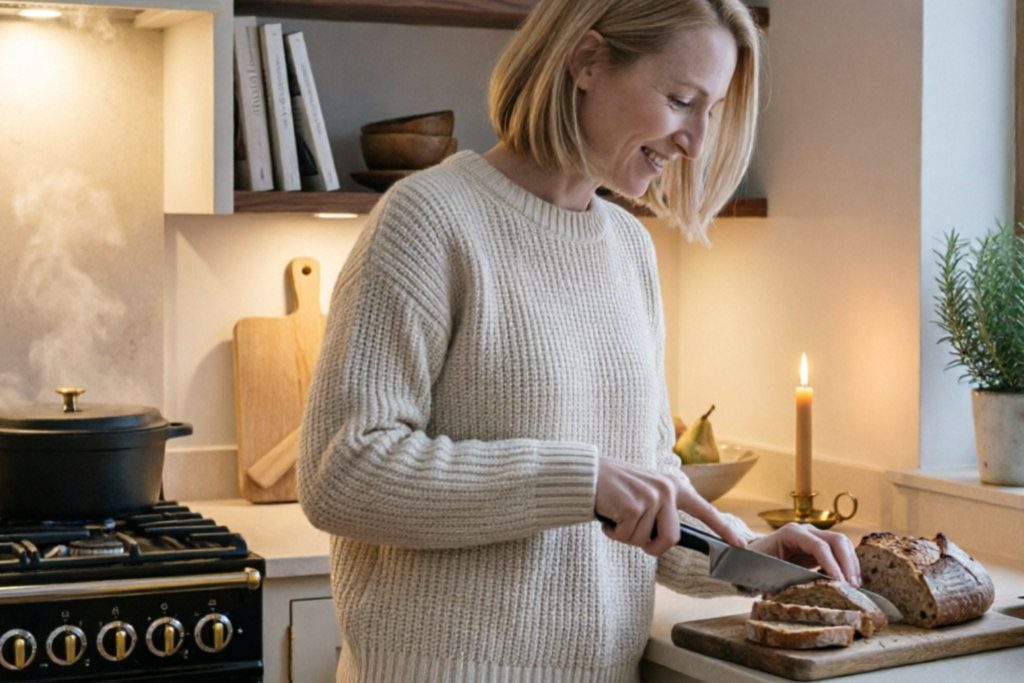
The harsh glare of a single, bright overhead LED is the quickest way to kill a cozy atmosphere. Scandinavian kitchen lighting relies on warmth and layers.
- Ditch the Cool Whites: Swap out any bulbs above 3000K. Stick strictly to 2700K light bulbs for your pendants and under-cabinet strips to mimic a warm, golden glow.
- Safe Candle Placement: Candles belong in the kitchen, too. Light a candle on the windowsill or the far end of the kitchen counter or island, well away from the stove, to add a flickering, ambient layer while you slice bread.
Explore my favorite hygge candles to find clean-burning options that won’t compete with the aroma of your cooking.
Cozy Kitchen Organization Ideas
Organization in a hygge kitchen isn’t about hiding everything away in sterile, uniform plastic bins. It’s about functional, beautiful storage.
- Visible Storage: Use clear glass jars for dried goods, spices, and coffee beans. It’s practical, and the visual texture adds to the room’s charm.
- Wooden Accents: Display your cutting boards on a wall-mounted rack. Not only does this free up counter space, but it also brings natural warmth to the room.
Don’t forget to regularly oil the boards using my tips on how to care for wood furniture to keep them beautiful.
Three Danish Kitchen Habits That Changed How My Home Feels
I’ve been working on my hygge kitchen for four winters. Not renovating — I haven’t changed a cabinet or a countertop. Just changing how I use the room. These are the three things that made the most difference.
The Sunday Soup Ritual
Almost every Sunday, from October through March, I make a soup or a stew. Usually, it is not a complicated recipe. It does not need much skill. But it takes time.
Usually, it takes most of the afternoon. It sits there simmering away on medium or low heat. And it makes the whole house smell of warmth for three hours. All the way up to dinner.
The point isn’t the food, though the food is good. The point is the hours. When soup or stew is slow-cooking on a Sunday afternoon, the day organizes itself quite differently.
There’s an anchor. Everyone drifts toward the kitchen. Freya asks what’s cooking before she’s even downstairs. Henrik appears in the doorway around the time it starts smelling really good.
The Sunday soup has become one of the most consistent hygge rituals in my house. And it costs almost nothing except time, which is, in a way, the whole point.
The Candle While Cooking
Before Astrid, I thought candles belonged on dining tables and mantlepieces. For special occasions. For dinner parties.
Astrid lights a candle when she starts cooking. Not when dinner is ready. Before. Before the onions get chopped, before the broth comes to a simmer, before the bread is in the oven. The candle is part of the cooking process.
I’ve been doing this for three winters now. It sounds almost silly. It isn’t. The mood in the kitchen seems to change when there’s a candle already lit while you’re standing at the stove.
You move more slowly. You taste more. You stop checking your phone. The kitchen becomes, without your deciding to make it so, a place you want to be rather than a place to whip up a quick dinner.
I light a candle every time I cook now. Even on Tuesdays. Especially on Tuesdays. [→ On hygge candles]
The Unhurried Meal
This is the hardest one, and I still get it wrong more often than I’d like.
In Denmark, the meal isn’t fuel. It isn’t something that happens between activities. It’s the activity. Dinner is the event itself — not a pause before the real evening begins.
What this looks like in practice: phones are put away before we sit down. Not turned over — away. A candle glows on the table. No discussion of schedules, school logistics, or anything that requires a phone to resolve.
Just the four of us, the food, and whatever Freya needs to tell us about what happened at school last week. She always has something.
The Hygge Kitchen Isn’t a Renovation
I want to be clear about this because most of what you’ll find online about hygge kitchens is written by kitchen companies selling cabinets.
My Minneapolis kitchen is not particularly beautiful. The cabinets are original to the house. The countertop has a chip on the right corner where a hot cast-iron pan was placed three winters ago. I cover it with a lamp now.
The window faces the garden. I wish it were larger, but it is what it is. I wish I had more storage. Someday I will. But that is a project for the future, and I am quietly stashing savings to fund that major renovation.
My kitchen may not photograph like one in a high-end home decor magazine. But it sure smells of delicious soup on winter Sundays.
That, I have decided, is enough. More than enough, for now. That’s the whole point.
The hygge kitchen isn’t built. It’s practiced. You don’t necessarily need new cabinets. You need a cast-iron pot, a candle, and a Sunday afternoon with nowhere else to be.
Seven Must-Haves for a Hygge Kitchen (IMHO)
If you do want to make big physical changes — small ones, nothing requiring a contractor — here’s where I’d start. Each of these costs less than a family dinner outside.
1. A Cast Iron Pot — The Visible Anchor
A Cast Iron Dutch Oven Pot on the stove, even when it’s not in use, changes the feeling of a kitchen. It’s heavy, permanent, real. It says: slow cooking happens here.
Elise would pick
Lodge Cast Iron Dutch Oven with Loop Handle
A hygge kitchen runs on slow cooking. This Lodge is listed as a cast iron Dutch oven that doubles as a dual-handle skillet, and I would pick it for winter stews and bakes.
See itAffiliate link. As an Amazon Associate I earn from qualifying purchases.
A great choice for slow cooking. This Dutch oven has dual handles and is pre-seasoned for durability.
2. A Candle Before You Start Cooking — Not After
The timing matters. Light it before you start. Let it be part of the cooking, not the decoration at the end. One candle on the counter near where you work. That’s all.
3. Cotton Dish Towels — You Touch Every Day
The objects you handle daily should feel good. Cotton dish towels feel different in your hands than synthetic ones. Not precious — just good. Worth it.
Elise would pick
PÜSKÜL Natural Turkish Cotton Waffle Towels
Listed as three 100% Turkish cotton towels in a honeycomb waffle weave, for bath and kitchen. I’d choose these for a kitchen or bath that leans on natural texture.
See itAffiliate link. As an Amazon Associate I earn from qualifying purchases.
These dish towels are a must-have for any kitchen. Great for drying dishes!
4. Fresh Herbs on the Windowsill — Scent as Hygge
Scent is very underrated as a hygge tool. A small pot of rosemary or thyme on the windowsill — even a north-facing one — changes the air quality of a kitchen in a way that’s hard to quantify and immediately felt.
Mine keeps dying. I keep replacing it. Still worth it.
5. Warm Bulbs Under the Cabinets
One small lighting change, significant mood shift. Under-cabinet lighting with a warm bulb (2700K or lower) transforms a kitchen in the evening from a workspace to a cozy place you want to linger. Takes thirty minutes to install.
Elise would pick
Philips Warm Glow Dimmable 2700K A19 Bulb
Dimmable A19 LED bulbs that, per the listing, warm from 2700K to 2200K as you dim. I would go for these in the lamps of a hygge home, where a warm, dimmable glow matters most.
See itAffiliate link. As an Amazon Associate I earn from qualifying purchases.
Click here for [→ Full hygge lighting guide]
6. A Kitchen Rug
Underfoot warmth signals that a room is for lingering, not just working. A rug in front of the stove or the sink changes your relationship to the time you spend standing there. Get one that washes easily. You will need to wash it.
One more thing: if your kitchen has a corner with a stool or a chair — even a wooden one pulled up to a counter — that’s your kitchen hyggekrog. It deserves the same attention as any other cozy nook in your home. [→ What is a Hyggekrog?]
7. Ceramic Mugs — and Display Them
The mug you reach for every morning should make you happy. Keep the ones you love on a hook or an open shelf where you can see them.
Put the ones you don’t love somewhere else or give them away. The mug matters more than you think.
Danish Winter Cooking Rituals and Hygge Kitchen Recipes
A hygge kitchen is defined less by what is on the shelves and more by what is happening on the stove. Danish winter cooking rituals are all about slowing down and letting the warmth of the kitchen fill the home.
Sunday afternoons are reserved for low-and-slow methods that make the whole house smell incredible.
Here are a few iconic Danish winter comfort food recipes and rituals we return to all winter long:
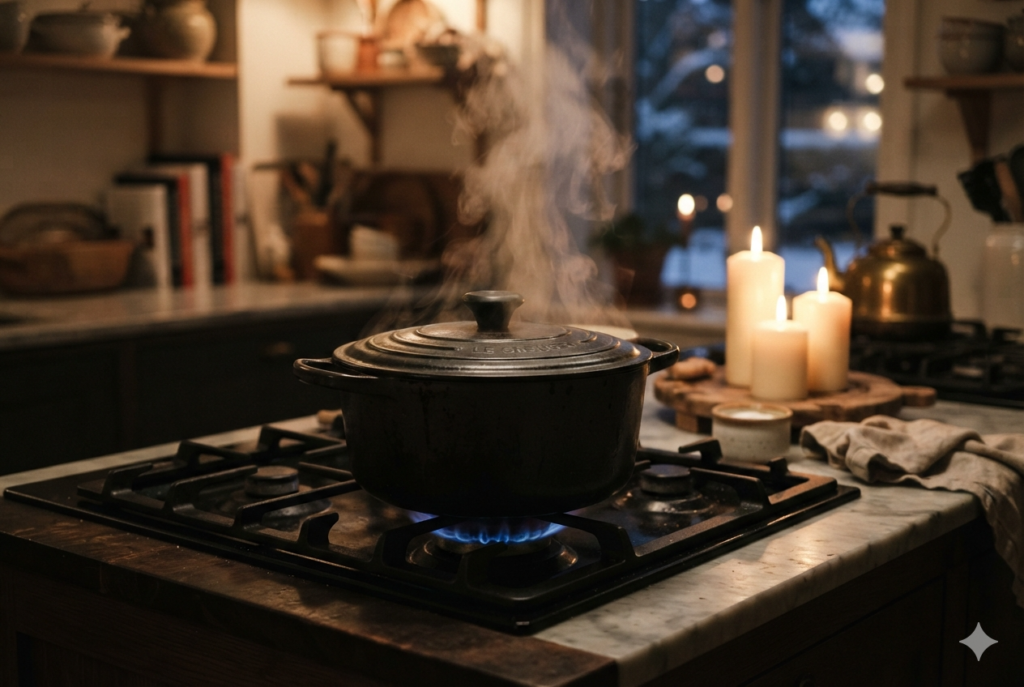
- The Sunday Slow-Roast (or Skipperlabskovs): Whether it’s a traditional, hearty Danish sailor’s stew made with beef and root vegetables, or a simple pork roast left to tenderize for hours, there is nothing quite like the smell of rosemary and garlic filling the house on a cold afternoon.
- The One-Pot Wonder: Utilizing a heavy cast iron Dutch oven for hearty stews or rustic bread baking. The cast iron retains heat beautifully, keeping the food warm long after it’s pulled from the oven. (I detail my exact 5 winter cooking traditions in my dedicated Dutch oven guide).
- Warm Gløgg & Afternoon Baking: Simmering red wine with cardamom, cloves, and cinnamon on the back burner makes the whole kitchen smell like a winter holiday. Paired with a simple batch of cinnamon or cardamom buns, the act of kneading dough and waiting for it to rise is inherently grounding.
Translating Rituals to a Hygge Dining Table Setting
The cozy atmosphere doesn’t end at the stove; it extends to where you eat. A hygge dining table setting should feel inviting, not formal.
Ditch the paper napkins for soft, washed linen. Use your favorite stoneware bowls, and always light a candle in the center of the table.
For more inspiration on bringing this warmth to your meals, explore my guide to a winter table setting or our broader ideas for a hygge dining room.
Creating a Hygge Kitchen Nook
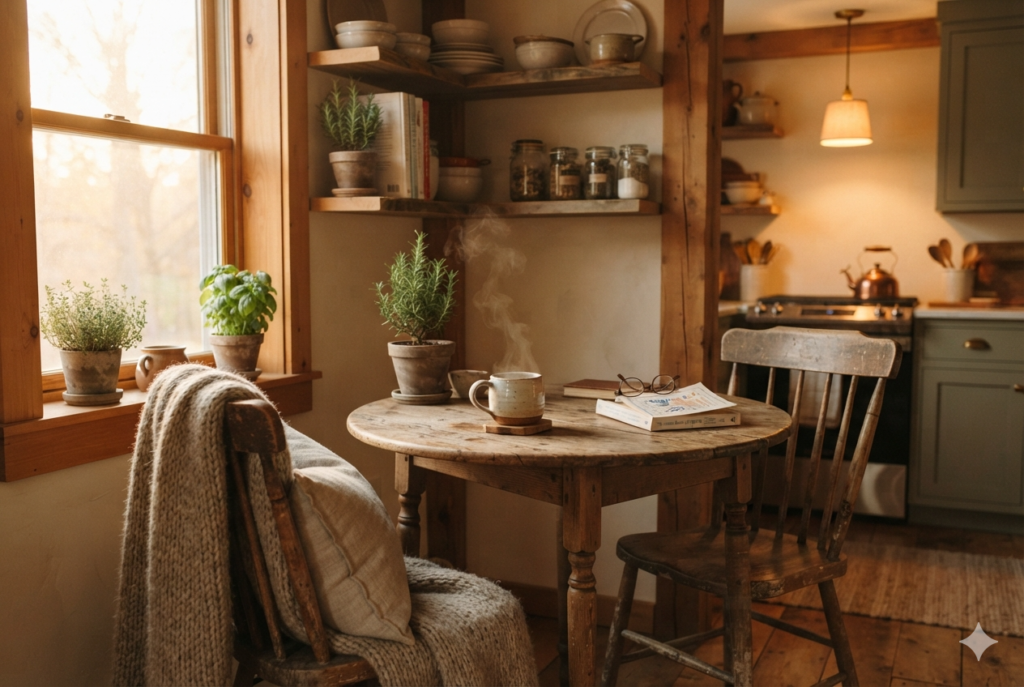
Even if your kitchen is small, you can carve out a dedicated space for lingering. A hygge kitchen nook doesn’t require a sprawling farmhouse dining table.
A small, round bistro table tucked into a sunny corner, or a built-in bench with a thick cushion and a few wool throw blankets draped over the back, is all you need. This becomes your morning coffee station or your evening tea spot.
Browse Throws, Blankets, & Rugs →
It’s essentially a hyggekrog tailored for the heart of the home, inviting you to sit, sip, and stay awhile.
Frequently Asked Questions (FAQs) About Hygge Kitchens
What makes a kitchen feel truly hygge?
A hygge kitchen is about atmosphere: warm 2700K light, natural wood and stoneware, and the slow, comforting aroma of food simmering on the stove.
Do I need to renovate my kitchen to make it hygge?
Big changes aren’t required: swap cool bulbs for warm, plastic containers for glass, display spices and cutlery, light a candle before cooking begins.
What is the best cookware for a hygge kitchen?
A cast iron Dutch oven is a hygge staple—perfect for slow winter cooking that fills the home with comforting aromas and moves seamlessly from stove to table.
The pot came off the stove around five that Sunday. Maja and Freya have been popping in and out. Henrik found excuses to visit the kitchen a couple of times. I smiled, content.
I poured four bowls — one for each of us. We sat at the dining table and ate and chatted. No agenda. No phones. Just hot soup and warm, fresh bread. It’s cold outside, but we are cozy, warm, and nourished.
That same habit — slowing down enough to notice you’re already in it — is really the thread running through every room in this house. See how it plays out room by room here. [→ The Complete Guide to Hygge Home Decor]
Light a candle. Slow down. Hygge.
— Elise